Every year, millions of prospective pet parents consult online encyclopedias to choose the perfect companion. They select a Golden Retriever expecting an immediate, baseline docility, or they completely avoid a herding dog out of fear of destructive hyperactivity. We treat ancestral breed standards as immutable behavioral contracts. It is one of the most pervasive miscalculations in modern Dog Breeds selection, and it regularly leads to structural placement failures.
The truth is, behavioral genetics are not copy-and-paste algorithms. When you choose a puppy based entirely on generalized labels, you are buying a historical baseline—not a guaranteed, pre-programmed individual personality.
A truly sophisticated understanding of canine behavioral science requires a hard look at actual dog breed temperament reliability. By examining the friction between ancestral breed selection and individual epigenetics, we can move past damaging stereotypes and set up our dogs for real behavioral success.
At STYPETS, we reject superficial breed stereotyping in favor of rigorous, individualized behavioral tracking. This masterclass will provide you with a comprehensive framework to understand how behavioral traits develop, allowing you to accurately assess the unique animal standing right in front of you.
1. The Science of Dog Breed Temperament Reliability: What Genomics Actually Tells Us
The belief that a dog’s breed dictates their exact behavioral profile has been thoroughly challenged by modern canine genomics. Recent large-scale DNA sequencing studies have revealed that while physical traits are strictly tied to specific lineages, behavior is vastly more fluid.
The Behavioral Variance Breakdown
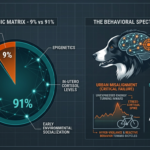
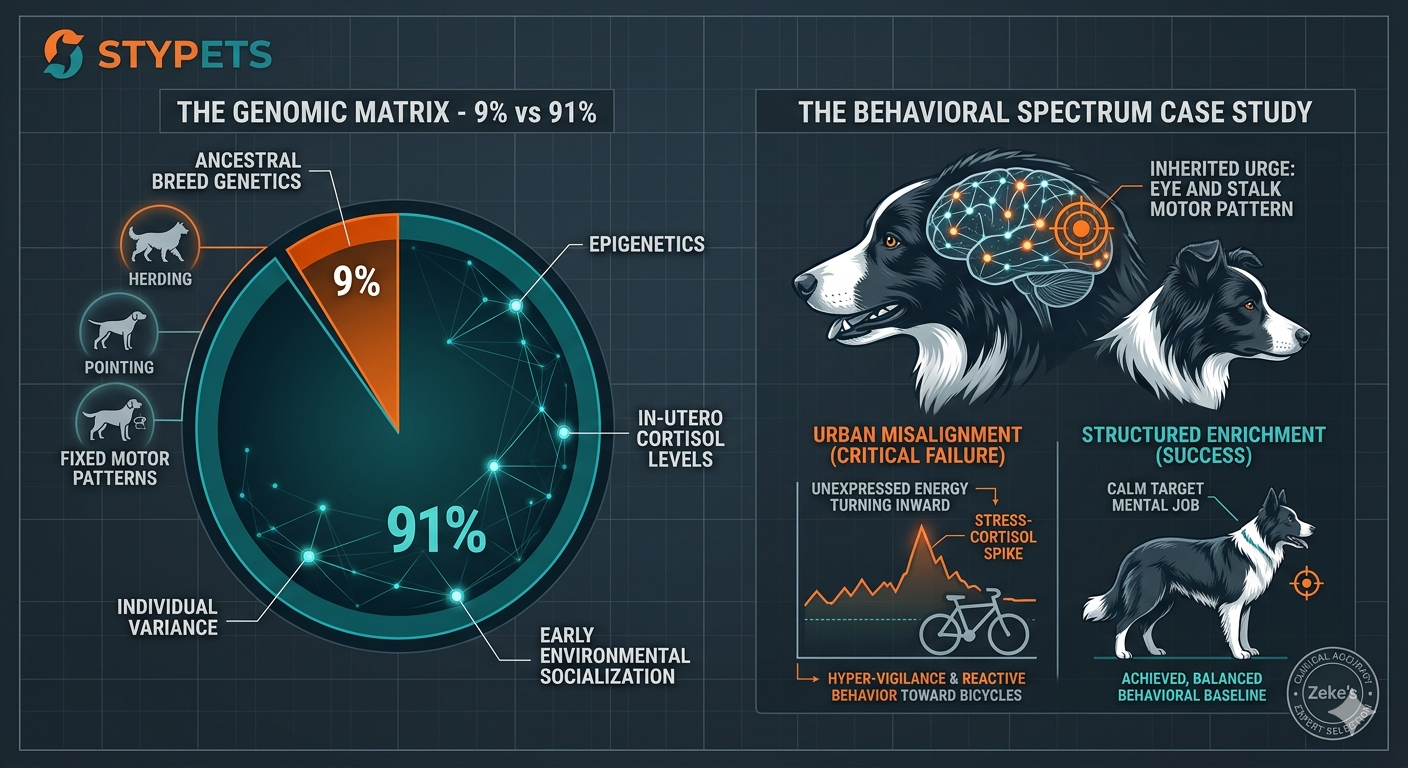
When scientists map the canine genome, they find that breed identity accounts for only about 9% of the behavioral variance in individual dogs. This means that assuming a specific dog breed temperament reliability metric is absolute ignores the massive 91% of behavioral variance driven by environmental factors, maternal stress, and individual genetic mutations.
[Canine Behavioral Variance]
├── Breed Heritage: 9% (Baseline motor patterns like pointing or herding)
└── Individual Variance: 91% (Epigenetics, early socialization, and environment)
What is actually passed down through breed lines are not complex personality traits like “affection” or “laziness,” but rather fundamental motor patterns. A Border Collie inherits a structural urge to eye and stalk objects; a Pointer inherits a specific predatory pause. How those raw urges manifest as an adult canine personality depends entirely on developmental environment and deliberate training.
2. The Behavioral Spectrum: Auditing Common Stereotypes vs. Reality
To help you look past surface-level assumptions about various Dog Breeds, let’s audit the real behavioral consistency across major structural archetypes.
| Breed Group Archetype | Expected Historical Stereotype | Genomic Reality & Variance |
| Gundogs (e.g., Labs, Goldens) | Universal friendliness and built-in obedience | High individual variation; can display significant resource guarding or arousal regulation issues if unsocialized. |
| Herding Breeds (e.g., Aussies, GSDs) | High-intelligence protectors or frantic workaholics | Highly prone to sound sensitivities, reactivity, and obsessive-compulsive loops without targeted mental jobs. |
| Terriers (e.g., Jack Russells, Yorkies) | Untrainable, stubborn, and highly aggressive | Possess high predatory drive and tenacity; highly responsive to clear training frameworks that respect their prey-drive mechanics. |
| Guardian Breeds (e.g., Mastiffs, Rottweilers) | Naturally aggressive and aloof toward all outsiders | Deeply sensitive and highly bonded to handlers; early environmental exposure completely dictates their adult social tolerance. |
💡 Featured Snippet Diagnostic: How to Test an Individual Puppy’s Real Personality
To accurately gauge a puppy’s personal behavioral trajectory without relying blindly on dog breed temperament reliability assumptions, professional behaviorists use a 3-step evaluation process at 49 days of age:
The Novel Object Test: Introduce a strange, moving object (like a mechanical toy) into a quiet room. Watch the puppy’s initial response. Immediate, confident exploration indicates high resilience, while prolonged freezing or panic indicates a baseline vulnerability to anxiety.
The Social Attraction Test: Walk a few paces away from the puppy, kneel down, and clap your hands softly. An immediate, tail-wagging approach demonstrates strong human orientation, while complete indifference suggests a highly independent or aloof adult personality.
The Kinesthetic Sensitivity Test: Gently press the webbing between the puppy’s toes for three seconds. A puppy that immediately fusses or bites has low touch tolerance, requiring careful, positive handling adjustments during veterinary visits or grooming sessions.
3. The Epigenetic Engine: How Socialization Rewrites the Genetic Script
Genetics may provide the foundational raw materials, but the developmental environment acts as the sculptor. This process is driven by epigenetics—the biological mechanism where environmental experiences turn specific genes on or off without altering the underlying DNA blueprint.
The Power of the Critical Development Window
Between 3 and 16 weeks of age, a puppy’s brain undergoes massive neural pruning. This is the critical socialization window. If a puppy from a lineage with a high dog breed temperament reliability rating for confidence is kept isolated in a barren kennel during this time, their brain will activate defensive genetic pathways, often resulting in a permanently fearful adult dog.
Conversely, a puppy born to parents with a genetic baseline for reactivity can be guided toward a calm, stable adult personality through careful, positive exposure to novel stimuli during this period. You are not trapped by your dog’s ancestral pedigree; you are actively writing their behavioral script every single day.
4. The Functional Trap: Why High-Drive Dogs Destabilize in Urban Environments
One of the most common behavioral failures occurs when high-drive working Dog Breeds are brought into dense urban environments based entirely on positive stereotypes. A breed celebrated for its historical focus and work ethic can quickly become destructive when confined to a small apartment.
Unexpressed Drives Turn Inward
When a dog bred to work 10 hours a day is denied a functional outlet, their genetic drives do not simply disappear. Instead, that stored energy transforms into behavioral issues:
[Unexpressed Working Drive] ──> Chronic Cortisol Spike ──> Severe Hyper-Vigilance ──> Destructive Reactivity
A herding dog without a flock may begin herding fast-moving cars, bicycles, or running children, often biting out of sheer frustration. This is not a “bad” dog or a complete failure of dog breed temperament reliability; it is the natural consequence of placing an ancestral working athlete into a lifestyle that offers no constructive outlet for their drives.
5. The Professional Strategy: Training the Individual, Not the Pedigree
To truly succeed as a handler, you must look past breed generalizations and build a customized training program tailored specifically to the unique individual personality in front of you.
The Behavioral Readjustment Framework
-
Identify the Core Motivator: Stop assuming your dog will work for a generic piece of kibble just because their breed is known for biddability. Test different rewards to find your dog’s true high-value driver—whether that’s high-protein freeze-dried liver, a fast-moving tennis ball, or the chance to tug on a rope.
-
Audit Stress Triggers Individually: Keep a detailed log of your dog’s environmental sensitivities. Note exactly when they show signs of stress, such as lip licking, yawning, or body freezing. Do not push through reactions just because your dog’s breed is stereotyped as fearless.
-
Build Target Outlets for Built-In Drives: Instead of fighting your dog’s genetic lineage, give them a safe channel for those natural behaviors. Let a sighthound satisfy their chase drive with a lure coursing system, or give a terrier a structured digging box to fulfill their instinct to hunt underground.
FAQ: Advanced Canine Behavioral Dynamics
1. Is dog breed temperament reliability completely useless when picking a pet?
No. Breed heritage gives you a helpful predictive map of a dog’s general size, energy levels, and foundational motor patterns. However, it cannot predict individual personality traits like individual resilience, structural confidence, or specific affection levels.
2. Why is my herding breed puppy so fearful when the standard says they are confident?
Confidence is highly vulnerable to early life experiences. Maternal stress during pregnancy, a lack of positive socialization between 3 and 16 weeks of age, or going through an intense fear period can completely override a breed’s typical confident reputation.
3. Can individual personality change drastically as a dog matures?
Yes. Dogs go through a significant adolescent phase between 6 and 18 months of age, during which hormone surges can bring out hidden anxieties or sudden reactivity. A puppy’s behavior doesn’t fully lock into their adult individual personality until behavioral maturity, around two to three years of age.
4. How much does a mother’s behavior affect her puppies’ adult temperaments?
Significantly. A mother’s behavior during the first few weeks of nursing shapes her puppies’ lifelong stress response systems. A highly stressed or anxious mother passes down elevated cortisol levels to her litter, frequently reducing the practical dog breed temperament reliability of those puppies.
5. Are mixed-breed dogs more behaviorally stable than purebred dogs?
Mixed-breed dogs benefit from greater genetic diversity, which can lower their risk for certain inherited physical health issues. However, their behavioral profiles are more unpredictable because you are blending completely different historical drive systems, making each puppy a unique combination of traits.
6. What is the difference between a dog’s temperament and their personality?
Temperament refers to the broad, biologically inherited baseline behavior patterns common to a lineage. Personality is the much larger, complex adult profile that develops as that biological baseline interacts with individual life experiences, training, and socialization history.
7. Can bad training completely ruin a dog with excellent breed genetics?
Yes. Chronic use of aversive training methods, constant isolation, or lack of clear boundaries can induce deep learned helplessness and defensive reactivity, entirely eroding the most stable genetic baseline.
Conclusion: Look at the Animal, Not the Standard
True mastery of canine behavior requires looking past the static descriptions in breed encyclopedias. A historical standard can point you toward a general starting baseline, but it can never see or understand the living, breathing individual animal standing in front of you.
Stop holding your companion to an arbitrary breed stereotype. Focus on real-world observation, respect their unique sensitivities, and tailor your training to their specific strengths. By valuing their individual personality, you move past limiting labels and build a lasting, respectful partnership with your dog.
-
The Broad Institute of MIT and Harvard regarding their landmark genomic research on canine breed behavioral variance.
-
The American Veterinary Society of Animal Behavior (AVSAB) for clinical position statements on the critical puppy socialization window.