Training Dog for Apartment Living: The Elevator Protocol That Actually Works
If you’re training a dog for apartment living, you already know the challenge goes far beyond basic obedience. Tight hallways, shared elevators, paper-thin walls, and unpredictable strangers create a training environment unlike anything a backyard can prepare a dog for. This STYPETS guide gives you the exact protocol—phase by phase—to raise a calm, confident urban dog while mastering the art of training a dog for apartment living.
Why Training a Dog for Apartment Living Is Historically Different
Training a dog for apartment living means preparing your dog for a high-density world of stimuli that suburban training simply doesn’t replicate. On one elevator ride, your dog may encounter strangers at arm’s length, other dogs, and echo acoustics—all within 60 seconds.
Without deliberate preparation, even well-socialized dogs develop reactive behaviors in these confined spaces. The goal of structured training a dog for apartment living is to replace that reactivity with confidence and trust. The approach used by professional urban dog trainers is called the Elevator Protocol, a system designed specifically for the high-entropy transitions unique to training a dog for apartment living.
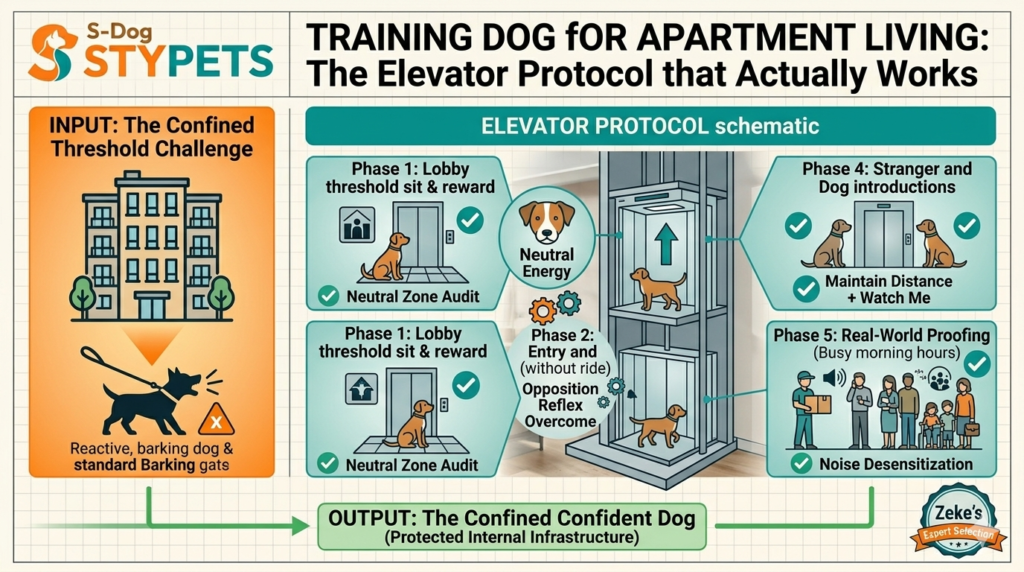
The Elevator Protocol: 5 Phases for Training a Dog for Apartment Living
This protocol works for puppies and adult rescue dogs alike. When training a dog for apartment living, move to the next phase only when your dog is consistently calm—never rush the timeline.
Phase 1 — Lobby Threshold Work (Days 1–5)
Walk your dog to the elevator lobby and ask for a sit before approaching. This is where most successful training a dog for apartment living begins. Reward stillness as doors open and close.
Phase 2 — Entry and Exit Without Riding (Days 6–10)
Build the association: elevator threshold = high-value treat. In the context of training a dog for apartment living, threshold control is your primary safety mechanism.
Phase 3 — Short Single-Floor Rides (Days 11–15)
Enter, ride one floor, exit. Keep your own energy neutral. Never comfort anxious behavior verbally; this is a critical rule when training a dog for apartment living.
Phase 4 — Stranger and Dog Introductions (Days 16–25)
Practice “leave it” and “watch me” when a stranger enters. For dog-to-dog encounters, maintain distance. Confined-space social etiquette is a top priority in training a dog for apartment living.
Phase 5 — Proofing Under Real Conditions (Ongoing)
Train during busy morning hours. Practice during package deliveries and fire alarm tests to complete your blueprint for training a dog for apartment living.
Hallway Manners: A Core Skill When Training Dogs for Apartment Living
Hallway behavior is the most overlooked component of training a dog for apartment living. Dogs should move calmly without reacting to sounds leaking from neighboring units.
-
Use narrow hallways as a tool: The walls naturally guide your dog into a tighter “heel” position, which is a staple of training a dog for apartment living.
-
Sound Desensitization: Record hallway sounds (doors slamming, etc.) and play them at low volume during mealtimes to build neutral associations while training a dog for apartment living.
Controlling Barking: The Toughest Part of Training a Dog for Apartment Living
Barking is the number one complaint in high-density buildings. Effective training a dog for apartment living requires identifying the type of barking before treating it:
-
Alert Barking: Desensitize to the trigger through controlled exposure.
-
Separation Anxiety: Build independence with departure cue desensitization.
-
Boredom: Increase mental stimulation (puzzle feeders) as part of your routine for training a dog for apartment living.
Essential Commands for Training a Dog for Apartment Living
These six commands form the foundation of our masterclass. Every dog living in a multi-unit building should have proofed versions of:
-
Sit-stay: For lobby waiting.
-
Heel: For hallway navigation.
-
Place: For a designated calm zone, a mandatory skill when training a dog for apartment living.
Essential Commands for Training Your Dog for Apartment Living
These six commands form the foundation of apartment dog training. Every dog living in a multi-unit building should have solid, proofed versions of each:
- Sit-stay: For elevator boarding, lobby waiting, and greeting strangers
- Heel: For tight hallway navigation and elevator rides
- Leave it: For ignoring dropped food, other dogs, unfamiliar people
- Watch me: For refocusing attention during high-distraction moments
- Place: For a designated calm zone inside elevators or doorways
- Quiet: For managing barking in thin-walled shared environments
Gear That Supports Training a Dog for Apartment Living
Choosing the right equipment makes apartment dog training safer and more effective. Avoid retractable leashes in hallways and elevators — they create unpredictable reach and increase entanglement risk in confined spaces.
- A 4-foot or 6-foot fixed-length leash for building navigation
- A front-clip harness to reduce pulling in tight corridors
- A treat pouch clipped to your hip for instant reinforcement timing
- A white noise machine near your front door for sound-sensitive dogs
- Puzzle feeders and snuffle mats for mental enrichment before you leave
FAQ: Expert Insights on Training a Dog for Apartment Living
Conclusion: Training Your Dog for Apartment Living Is an Investment
Every hour you spend training a dog for apartment living pays dividends for years in calmer elevator rides and better neighbor relationships. The Elevator Protocol works because it builds on how dogs actually learn. Start with Phase 1 today; the difference in training a dog for apartment living will be visible within two weeks.
Dog Scent Work for Anxiety: The Neuro-Stim Protocol for Brain Resilience
External Authoritative Sources to Mention: