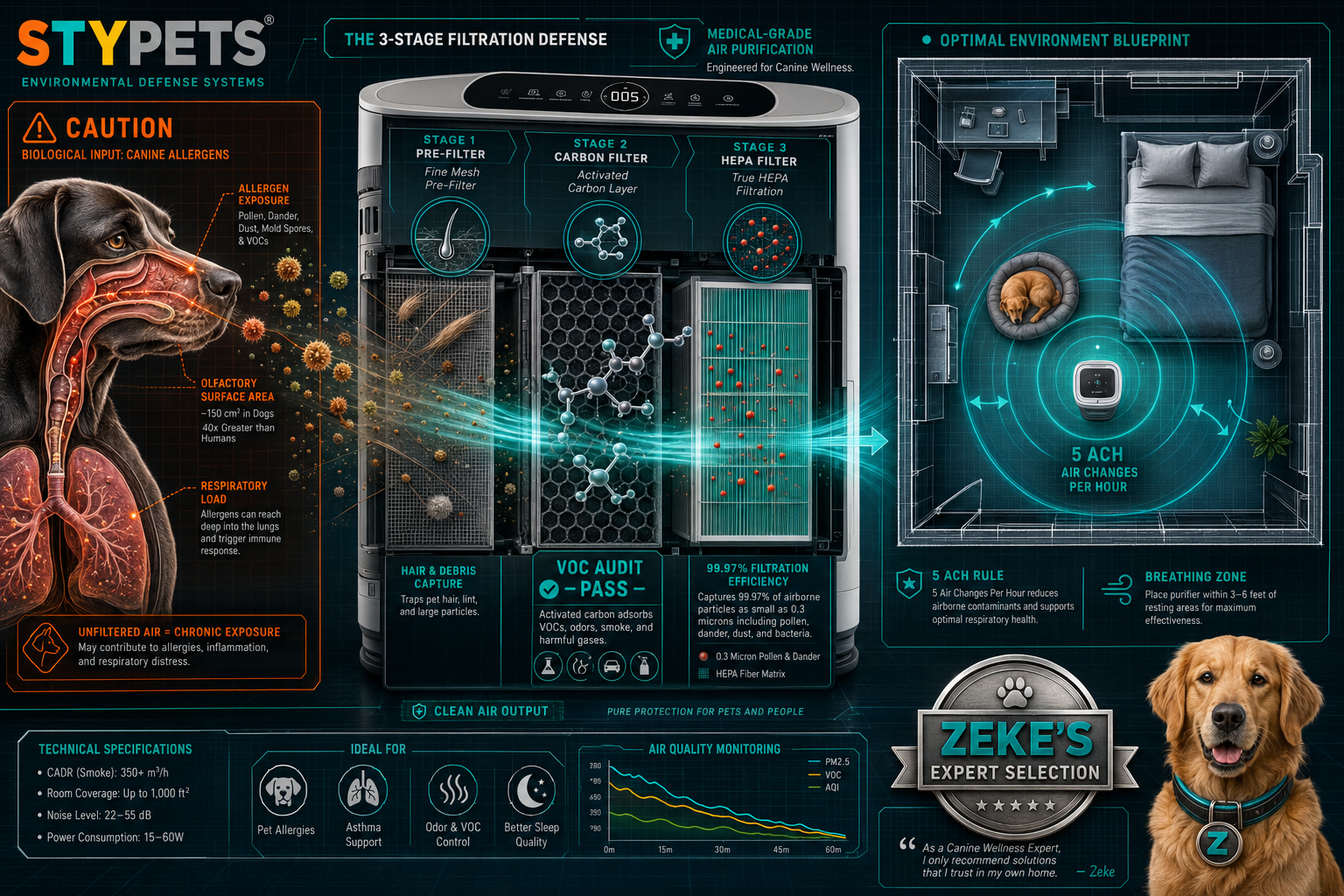
You’ve optimized their diet, audited their bowls for microplastics, and mastered the urban walk, but there is one variable you likely haven’t engineered yet: the $15,000$ liters of air your dog breathes every single day. For a dog living in a modern home, the air is often a soup of dander, pollen, mold spores, and volatile organic compounds (VOCs). If you aren’t utilizing high-efficiency air purifiers for dogs with allergies, your dog’s lungs are acting as the primary filter for your home’s environmental toxins.
In this STYPETS masterclass, we are moving beyond “freshening the air.” We are performing a deep dive into air quality engineering. We will audit the impact of HEPA filtration on canine respiratory architecture and show you how to choose the right technology to protect your dog’s internal infrastructure. This is about more than comfort—it’s about biological defense.
1. The Canine Respiratory Audit: Why They Are More Vulnerable
A dog’s proximity to the floor puts them in the “Sediment Zone.” Dust mites, heavy allergens, and chemical cleaning residues settle on surfaces and low-lying air pockets. While we breathe air from five to six feet up, our companions are vacuuming up the highest concentration of particulates.
The Olfactory Surface Area
A dog’s nasal cavity is a complex engineering marvel designed for scent, but this increased surface area also means more contact with airborne irritants. When these irritants bypass the natural defenses, they trigger systemic inflammation. This is why air purifiers for dogs with allergies are a mandatory component of a proactive Dog care strategy.
2. Decoding HEPA: The Gold Standard for Air Purifiers for Dogs with Allergies
Not all filters are created equal. To achieve a true medical-grade baseline, you must understand the “Minimum Efficiency Reporting Value” (MERV) and the HEPA standard.
What is True HEPA?
A True HEPA (High-Efficiency Particulate Air) filter is engineered to capture $99.97\%$ of particles as small as $0.3$ microns. This includes the most common triggers in Dog care:
-
Pet Dander: Microscopic skin flakes that stay airborne for hours.
-
Pollen: Seasonal invaders that enter through windows and on fur.
-
Mold Spores: Highly inflammatory triggers often found in damp corners or basements.
The Role of Activated Carbon
HEPA captures physical particles, but it cannot stop gases. To combat “Dog Smell” and toxic VOCs from floor cleaners, your air purifiers for dogs with allergies must include a heavy layer of activated carbon. This acts as a chemical sponge, neutralizing odors at the molecular level rather than just masking them with artificial scents (which often contain phthalates).
3. Engineering Your Home: The 3-Step Air Quality Protocol
To maximize the ROI of your air quality tech, you must treat your home like a clean-room environment.
Step 1: CADR Calculation (Clean Air Delivery Rate)
Before buying air purifiers for dogs with allergies, audit the square footage of your primary living area. You need a machine that can perform at least five “Air Changes Per Hour” (ACH). If the unit is too small, the particulate load will always stay ahead of the filtration.
Step 2: Strategic Placement
Don’t hide your purifier behind a sofa. For optimal Dog care, place the unit in the “Transition Zone”—near the dog’s bed or the entrance to the room. Ensure there is at least $18$ inches of clearance on all sides to allow for maximum kinetic airflow.
Step 3: Source Control
Filtration is a secondary defense. Your primary defense is source control:
-
High-Efficiency Vacuuming: Use a vacuum with its own sealed HEPA system.
-
Washable Textiles: Audit your dog’s bedding. If it isn’t washable at high temperatures to kill dust mites, replace it.
-
Humidity Management: Keep indoor humidity between $35\%$ and $50\%$. Anything higher encourages mold; anything lower dries out canine mucous membranes.
4. The Biological Impact: Signs Your Dog Needs Better Air
How do you know if your Dog care routine is failing on the respiratory front? Look for these bio-signals:
-
The “Reverse Sneeze”: Often a sign of localized irritation in the nasopharynx.
-
Clear Ocular Discharge: Watery eyes are a classic response to airborne pollen or dust.
-
Excessive Paw Licking: Allergens settle on the paws; the dog licks them, ingesting the triggers and causing localized itching.
-
Chronic Ear Infections: Systemic inflammation often manifests in the ears before the lungs.
5. Advanced Tech: Ionizers, UV-C, and Ozone Hazards
In the search for air purifiers for dogs with allergies, you will encounter “bonus” features. Be wary.
-
Ozone Generators: STAY AWAY. Ozone is a powerful lung irritant. What is “fresh” to humans is toxic to a dog’s sensitive respiratory tissue.
-
Ionizers: These can produce trace amounts of ozone. If you use one, ensure it is CARB-certified (California Air Resources Board).
-
UV-C Light: Effective for killing airborne viruses and bacteria, but only if the air stays in front of the light long enough. It’s a “nice to have,” but the HEPA filter is the “need to have.”
FAQ: Mastering Air Purifiers for Dogs with Allergies
1. Can an air purifier help with dog odors?
Yes, but only if it has a thick activated carbon filter. HEPA alone will not remove smells.
2. Where is the best place to put an air purifier for a dog with allergies?
In the room where they spend the most time, typically the bedroom or living room, placed on the floor or a low surface.
3. Do air purifiers help with “dog hair”?
Only the floating “micro-hairs.” Large clumps of fur are too heavy to be pulled into the filter. You still need to vacuum!
4. How often should I change the HEPA filter?
In a home with dogs, audit your filter every $3$ months. Most need replacement every $6$ to $12$ months depending on the particulate load.
5. Are air purifiers loud enough to scare dogs?
Most modern units have a “Sleep Mode” that is near-silent. Introduce the machine on its lowest setting to avoid spooking a sound-sensitive dog.
6. Can I just use a furnace filter instead?
High-MERV furnace filters help, but they don’t provide the localized, high-turnover filtration that standalone air purifiers for dogs with allergies offer.
7. Is it okay to use essential oil diffusers with an air purifier?
No. Diffusers release VOCs into the air that your purifier will then try to scrub out. Furthermore, many essential oils are toxic to dogs when inhaled.
Conclusion: Breathing as a Performance Metric
Engineering a 15-year baseline for your dog means looking at what is invisible. The air in your home is either supporting your dog’s cellular health or taxing their immune system. By investing in high-quality air purifiers for dogs with allergies and following the STYPETS Air Quality Protocol, you are removing a massive burden from their biological infrastructure.
[Allergy Equation: Why Your Dog’s Constant Licking is a Bio-Signal]
[Neuro-Stim Protocol: Building Brain Resilience Through Scent]