Does your dog have a “perfect” sit in the living room, only to develop “selective hearing” the moment a squirrel crosses the street? This common frustration isn’t a lack of intelligence; it’s a failure in the mechanical transition from acquisition to fluency. In the world of high-performance canine engineering, we call this the “Generalisation Gap.” Success in high-entropy environments requires a rigorous commitment to proofing dog training commands through the systemic application of Distance, Duration, and Distraction.
To move beyond basic Dog Training and reach a state of “Bulletproof Reliability,” you must treat your dog’s brain like an advanced processor that needs to be stress-tested. In this STYPETS Masterclass, we will provide the blueprint for engineering reliability, ensuring that your cues remain the strongest signal in a world full of noise.
1. The Engineering of Reliability: What is Proofing?
In the acquisition phase of Dog Training, your dog learns what a word means. In the proofing phase, they learn that the word means the same thing regardless of the environmental variables. Proofing dog training commands is the process of gradually increasing the difficulty of a task until the dog can perform it under extreme pressure.
Without proofing, a command is merely a “suggestion” that the dog weighs against the value of environmental rewards (like a passing dog or a discarded pizza crust). Our goal is to make the cue an “automatic response”—a hardwired behavioral reflex that bypasses the dog’s impulse to scan for distractions.
2. The 3Ds of Proofing: Distance, Duration, and Distraction
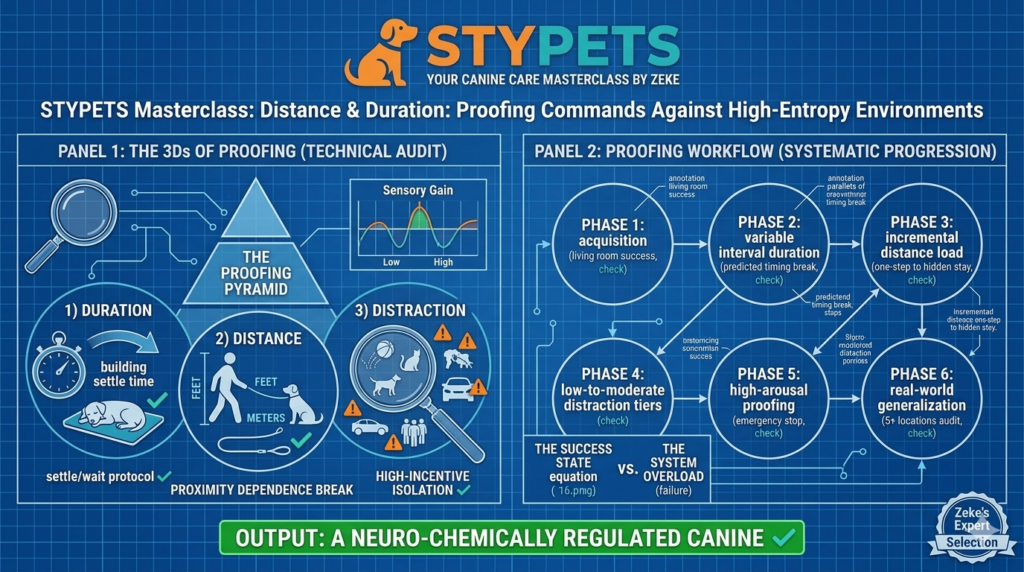
To build a robust system, we must manipulate three primary variables. The golden rule of proofing dog training commands is: Only increase one “D” at a time.
-
Duration: How long the dog maintains the position.
-
Distance: How far the human can move away from the dog.
-
Distraction: The level of “Environmental Noise” present during the cue.
If you try to move 50 feet away (Distance) while your dog is in a stay at a busy park (Distraction), the system will suffer a “Critical Failure.” We must build the load incrementally to ensure the dog remains in a “Success State.”
3. Engineering Duration: Building the “Stay” Muscle
Duration is the “Internal Clock” of the dog. Many dogs can “Sit,” but few can “Settle” for five minutes while life happens around them. When proofing dog training commands for duration, we are teaching the dog that the “Release Word” is the only thing that ends the task—not their own boredom.
Step-by-Step Duration Load:
-
The Micro-Second Phase: Reward the dog for holding the position for just 2 seconds.
-
The Variable Interval: Instead of counting 1-2-3-4-5, reward at 3 seconds, then 1, then 5, then 2. This prevents the dog from “predicting” the end of the task.
-
The “Neutral Activity” Phase: Can you fold laundry or read a book while your dog maintains a “Down”? This teaches the dog that your lack of attention isn’t a cue to move.
4. Distance Dynamics: Breaking the Proximity Magnet
Most dogs are “Proximity Dependent.” They feel the pressure of your presence and obey because you are within their immediate “Control Zone.” Proofing dog training commands for distance requires breaking this invisible tether.
-
The “One-Step” Method: Take one step back, then immediately return to the dog to reward.
-
The 360-Degree Pivot: Instead of walking away, walk around the dog. Losing sight of you for a split second is a massive psychological hurdle for a canine.
-
The Out-of-Sight Challenge: The ultimate test of distance proofing is the “Hidden Stay.” Can your dog maintain a position while you go behind a tree or into another room?
5. Distraction Management: Navigating High-Entropy Zones
This is where most Dog Training systems fail. A distraction is any “High-Incentive” stimulus that competes with your cue. When proofing dog training commands, we categorize distractions into “Tiers.”
-
Tier 1 (Low): A toy on the floor, a quiet person in the room.
-
Tier 2 (Moderate): A bouncing ball, someone eating, a distant dog barking.
-
Tier 3 (High): A running squirrel, a bicycle passing at high speed, a group of playing children.
Zeke’s Expert Tip: Use a “Long Line” (15-30 feet) during Tier 3 proofing. It provides a safety net that prevents the dog from “rewarding themselves” by chasing the distraction if they break the command.
6. The “Success State” Blueprint: Setting the Criteria
If your dog fails three times in a row, you have “Overloaded the System.” In proofing dog training commands, a failure is a data point telling you to “Split the Criteria.”
If your dog breaks a stay because a dog walked by 10 feet away, don’t just keep trying. Move back to 20 feet. Re-establish the “Success State,” and then gradually close the gap. We want the dog to have a high “Win-Loss Ratio” to keep their motivation peaked.
7. Generalization: The “Location Audit”
Dogs are “Context-Specific” learners. “Sit” in the kitchen does not inherently mean “Sit” at the beach. To achieve true fluency in proofing dog training commands, you must train in at least five different locations.
-
Home Base: Low distraction, high focus.
-
The Driveway: Increased olfactory (scent) triggers.
-
The Quiet Park: Visual distractions at a distance.
-
The Pet Store: High social and olfactory pressure.
-
The High-Entropy Zone: A busy downtown or a local sporting event.
8. Proofing Through Play: The Emergency Stop
The ultimate test of proofing dog training commands is the “Interrupted Play.” While your dog is in a high-arousal state—chasing a ball or playing tug—issue a “Down” or “Settle” cue.
This requires the dog to move from “High-Octane Arousal” to “Total Inhibition” in a split second. If your dog can do this, they are truly “Proofed.” This is a literal life-saver if your dog ever bolts toward a moving vehicle.
9. Dealing with Regression: The “Stress Stacking” Factor
Canine performance isn’t linear. Some days, your dog will seem to have “forgotten” everything. In Dog Training, we call this a “Regression Spike.”
Often, this is due to “Stress Stacking”—the dog’s sensory cup is already full from a previous event (like a vet visit or a loud thunderstorm). When proofing dog training commands on these days, lower your criteria. Go back to basics and prioritize “Connection” over “Performance.”
10. Rewards and Reinforcement in High-Entropy Environments
As the “Difficulty Rating” of the environment increases, so must the value of your “Paycheck.”
-
Low Difficulty: Standard kibble or a verbal “Good.”
-
Moderate Difficulty: High-value treats (freeze-dried liver, cheese).
-
High Difficulty: Functional rewards (releasing the dog to go sniff, a high-intensity game of tug, or a “Jackpot” of premium treats).
When proofing dog training commands in a busy park, you are competing with the entire world. Make sure your “Offer” is the most lucrative one available to the dog.
11. The Role of “Averaging” in Reliable Recall
Reliability is an average of past successes. To ensure you are proofing dog training commands for recall (coming when called), never call your dog for something “Negative” (like a bath or ending a fun play session) until the command is 100% proofed.
Always pair the recall with a high-value “Life Reward.” This builds a massive “Bank Account” of positive associations that you can draw upon when an emergency occurs.
12. FAQs: Solving the Proofing Puzzle
Q: My dog is perfect at home but won’t listen outside. Why? A: This is a lack of proofing dog training commands. Your dog hasn’t “Generalized” the behavior yet. You need to start at “Step 1” in the new environment and build back up.
Q: Should I use corrections when my dog fails a proofed command? A: Focus on “Negative Punishment” (removing the reward) rather than physical corrections. If they break a stay, the “Reward Window” closes and you reset the task.
Q: How long does it take to fully “Proof” a dog? A: For most dogs, achieving 95% reliability across all environments takes 6 to 12 months of consistent, varied practice.
Q: Can I proof an older dog? A: Absolutely. While puppies are “Clean Slates,” older dogs can be proofed effectively, though it may take more “Counter-Conditioning” if they have practiced bad habits for years.
Q: What is the most important command to proof? A: Recall (Come) and The Emergency Down. These are the “Safety Valves” of canine management.
Q: My dog gets “Shut Down” by distractions. What do I do? A: This isn’t a training failure; it’s an “Emotional Threshold” issue. Move further away from the distraction until the dog can “disengage” and take food again.
Q: Do I always have to carry treats for proofed commands? A: Eventually, you move to a “Variable Reinforcement Schedule” (like a slot machine), but during the heavy proofing phase, frequent “Paychecks” are required to maintain the behavior.
Conclusion: Engineering the Bulletproof Canine
Proofing dog training commands is the difference between a dog that “knows tricks” and a dog that is a reliable partner in the real world. By systematically manipulating Distance, Duration, and Distraction, you are not just teaching a behavior—you are building a “Neural Infrastructure” of focus and self-control.
Stop settling for “Living Room Reliability.” Take your Dog Training into the high-entropy world and engineer a dog that listens when it matters most.
-
[The “Off-Switch” Protocol] for building the foundational calm needed for duration work.
-
[Sensory Processing: Low-Stress Environments] to understand why some dogs struggle more with environmental noise.
-
Certification Council for Professional Dog Trainers (CCPDT): For standards on behavioral fluency.
-
Karen Pryor Clicker Training: For technical insights into “Shaping” and “Criteria Setting.”