You invest in the best raw diets, track every REM cycle, and optimize their exercise, but a hidden threat may be sitting right in your living room. Per- and polyfluoroalkyl substances (PFAS), known as “forever chemicals,” are frequently used in water-resistant coatings for crates and toys. To truly protect your companion, transitioning to pfas free dog products is no longer an optional luxury—it is a critical requirement for long-term Dog Health.
These chemicals don’t just stay on the fabric; they bioaccumulate in your dog’s tissues through skin contact and “mouth-feel” play. This audit provides a technical deep dive into identifying these toxins and engineering a clean, “non-toxic” environment for your canine.
1. What are PFAS and Why Are They in Dog Products?
PFAS are a group of synthetic chemicals prized in manufacturing for their ability to resist heat, water, and grease. In the world of pet supplies, they are the secret ingredient behind “stain-resistant” beds and “weather-proof” leashes.
-
The Durability Trap: Many “heavy-duty” fabrics achieve their strength through chemical coatings that shed microscopic particles over time.
-
The Bioaccumulation Factor: Dogs have a higher surface-area-to-mass ratio than humans, meaning their exposure through bedding is significantly more impactful.
-
The “Forever” Problem: These chemicals do not break down in the environment or the body, leading to chronic inflammatory responses.
2. The Impact of Toxic Bedding on Dog Health
Your dog spends up to 14 hours a day with their nose pressed against their bed. If that bed is treated with stain-guards, they are inhaling and absorbing endocrine disruptors during their most vital recovery periods.
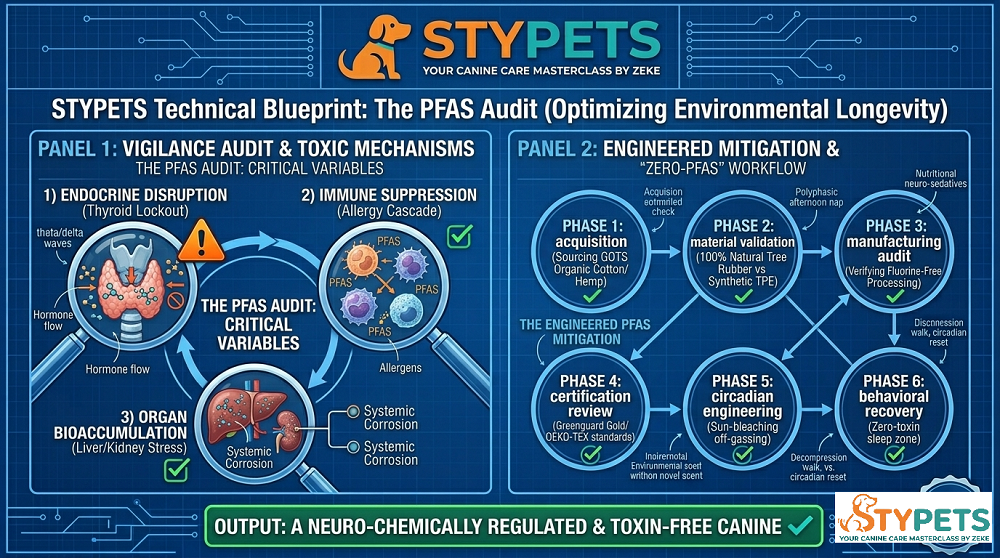
Endocrine Disruption
PFAS interfere with the endocrine system, specifically the thyroid. In dogs, this can manifest as metabolic slowing, lethargy, and unexplained weight gain.
Immune System Suppression
Chronic exposure to these chemicals can “distract” the immune system, making dogs more susceptible to allergies and reducing the efficacy of vaccinations.
Organ Bioaccumulation
The liver and kidneys are the primary “filters” of the body. PFAS bind to blood proteins and accumulate in these organs, potentially leading to chronic organ stress.
3. How to Audit Your Home for PFAS
To move toward a home filled with pfas free dog products, you must first conduct a “toxin audit” of your current inventory.
-
The Water Bead Test: Drop a small amount of water on your dog’s bed or plush toys. If the water beads up perfectly and rolls off, it likely has a fluorinated DWR (Durable Water Repellent) coating.
-
Check for “Stain-Resistant” Labels: Any product marketed as “permanently stain-resistant” without specifying its material is a red flag.
-
The Smell Test: Highly processed, “factory-smelling” plastic toys often contain phthalates and PFAS used as processing aids.
4. Engineering a Clean Environment: Choosing PFAS Free Dog Products
Transitioning to a non-toxic lifestyle requires a shift toward natural fibers and transparent manufacturing.
Bedding: The Natural Fiber Mandate
Look for beds made from GOTS-certified organic cotton, hemp, or wool. These materials are naturally breathable and do not require chemical water-proofers.
-
Core Material: Choose organic latex or high-density wool batting over cheap “treated” foams.
-
Covers: Look for “untreated” canvas or denim.
Toys: Mouth-Safe Standards
Since dogs use their mouths to explore, toys are the most direct route for chemical ingestion.
-
Natural Rubber: Opt for 100% natural tree rubber over synthetic TPE (Thermoplastic Elastomer).
-
Organic Hemp Rope: A safer alternative to dyed synthetic ropes that may contain PFAS in the coloring agents.
5. The Link Between PFAS and Behavioral Fraying
At STYPETS, we focus on the “Neuro-Chemically Regulated Canine.” Chemical toxicity is a primary driver of “behavioral noise.”
-
Neuro-Inflammation: Trace toxins can cross the blood-brain barrier, causing low-grade inflammation that manifests as irritability or “brain fog.”
-
Sleep Interruption: If a dog’s skin is irritated by chemical off-gassing, they will shift more frequently, losing out on critical deep-sleep cycles.
-
Optimization: You cannot reach a “Success State” in training if your dog’s internal chemistry is fighting off environmental pollutants.
6. Identifying “Greenwashing” in Pet Supplies
Not all “natural” products are pfas free dog products. Many companies use “Greenwashing” to hide chemical use behind vague marketing terms.
-
“Non-Toxic”: This is a legally loose term. Look for specific certifications like OEKO-TEX Standard 100.
-
“Eco-Friendly”: This often refers to the recycling process, not the chemical safety of the end product.
-
“BPA-Free”: While good, this does not mean the product is PFAS-free. Always look for a specific “Fluorine-Free” or “PFAS-Free” guarantee.
7. Actionable Steps for a Toxin-Free Recovery Zone
-
Discard Treated Fabrics: If you cannot verify the safety of a water-resistant bed, replace it with an organic alternative.
-
Air Out New Products: If you must buy synthetic, leave the product in a well-ventilated area or sun-bleach it for 48 hours to help off-gas VOCs.
-
Frequent Washing: Wash bedding with fragrance-free, plant-based detergents to remove environmental dust that can trap PFAS particles.
-
Use Stainless Steel or Ceramic: Avoid plastic food bowls, which can leach various chemicals over time.
8. FAQ: Navigating Forever Chemicals in Dog Care
Q: What exactly are pfas free dog products? A: These are products manufactured without the use of fluorinated chemicals for water or stain resistance, focusing instead on natural materials like organic cotton, hemp, or natural rubber.
Q: Can PFAS affect my dog’s lifespan? A: Chronic exposure is linked to organ stress and immune suppression, which are significant factors in long-term Dog Health and longevity.
Q: Are all waterproof dog beds toxic? A: Not all. Some use PU (Polyurethane) laminates which, while synthetic, are often PFAS-free. However, natural fibers are always the safest bet.
Q: How do I know if a toy is safe? A: Look for “100% Natural Rubber” and avoid toys with a strong chemical odor or those made from “mystery plastics.”
Q: Does washing a bed remove PFAS? A: No. PFAS are “forever chemicals” because they are structurally stable. Washing may remove surface dust, but the chemical coating remains on the fibers.
Q: Are there specific brands that are PFAS-free? A: Brands that hold OEKO-TEX, GOTS, or Greenguard Gold certifications are generally the most transparent and safest choices.
Q: Is “Dog Health” affected more by diet or environment? A: They are inseparable. A clean diet provides the fuel, but a clean environment ensures the “engine” (the dog) isn’t being corroded by external toxins.
9. Conclusion: The Clean Room Strategy
Protecting your dog’s biology requires a 360-degree approach. By auditing your home and switching to pfas free dog products, you remove a significant invisible barrier to their health and performance. Remember, a dog’s world is defined by what they touch, smell, and taste. Make sure their world is as clean as the bond you share.
-
[The Sleep Audit: Optimizing REM Cycles] – Learn why clean bedding is essential for neurological recovery.
-
[Nutrigenomics: Engineering Longevity] – Support your dog’s liver in detoxifying environmental pollutants.
-
Mention the Environmental Working Group (EWG) for PFAS research and the OEKO-TEX Association for textile safety standards.