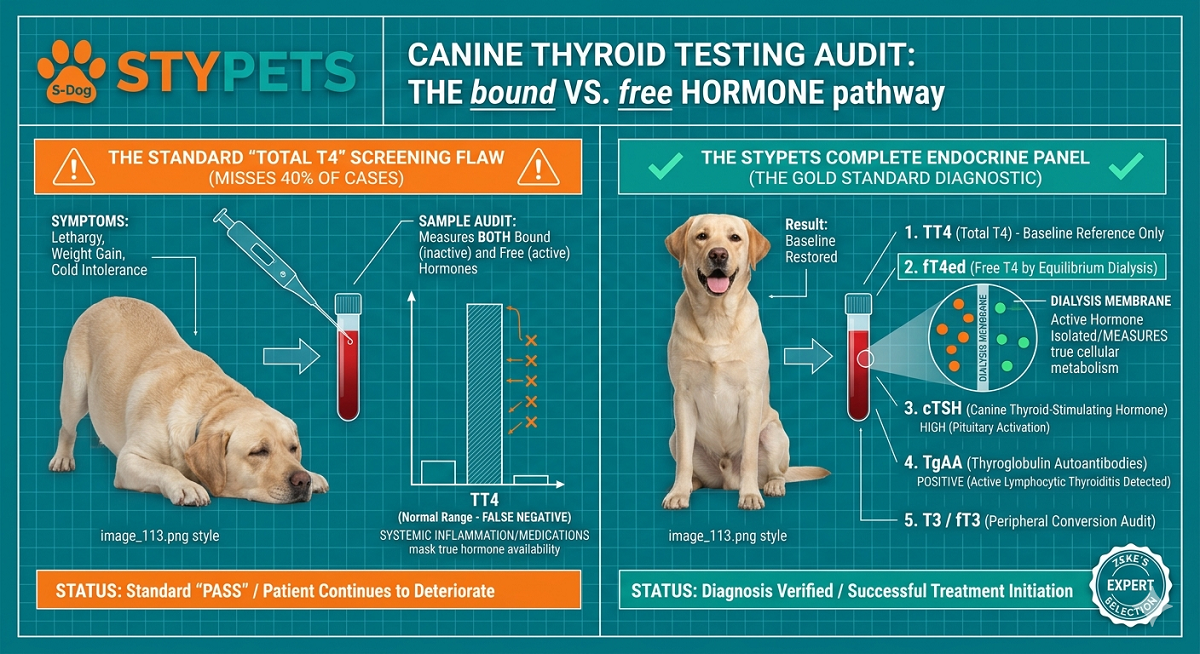
Walking into your living room, you notice your once-vibrant Golden Retriever is sleeping—again. It is her third four-hour nap of the day. When she does get up, she moves with a heavy, tragic stiffness, and her beautiful coat looks dull, brittle, and patchy. You have increased her exercise and cut her rations, yet she continues to gain weight.
You take her to the clinic, the vet runs a basic blood test, and the verdict comes back: “Her thyroid levels are normal.”
This is the exact moment thousands of pet parents fall into a dangerous diagnostic trap. In the world of clinical canine endocrinology, standard testing misses up to 40% of metabolic issues. If your companion is suffering from undetected endocrine decline, understanding the true scope of hypothyroidism in dogs symptoms is the only way to advocate for their health and reclaim their vitality.
This comprehensive audit will expose the flaws of standard testing, decode the clinical signs of low thyroid function, and provide an actionable diagnostic roadmap to restore your dog’s metabolic health.
1. The Broken Thermostat: What is Canine Hypothyroidism?
To understand how a disease can hide in plain sight, we must look at the underlying biology. The thyroid is a small, butterfly-shaped gland located in your dog’s neck. Think of it as the master thermostat for their entire cellular engine.
The thyroid produces hormones—primarily thyroxine ($T_4$) and triiodothyronine ($T_3$)—that dictate how fast cells convert nutrients into usable energy. When the thyroid gland slows down, every biological system slows down with it.
In dogs, this down-regulation is typically caused by two primary conditions:
-
Lymphocytic Thyroiditis: An autoimmune condition where the dog’s immune system mistakenly attacks and destroys the thyroid tissue (accounting for roughly 80% of cases).
-
Idiopathic Thyroid Atrophy: A degenerative condition where normal thyroid tissue is spontaneously replaced by adipose (fat) tissue.
When either condition takes hold, the metabolic fire begins to die, presenting a classic yet frequently misdiagnosed cluster of symptoms.
2. Decoding the Red Flags: Hypothyroidism in Dogs Symptoms
The clinical picture of a hypothyroid dog is rarely sudden. It is a slow, insidious theft of energy and health that unfolds over months or even years. Because the symptoms mirror the natural aging process, many owners write them off as “just slowing down.”
To protect your dog’s long-term Dog Health, you must watch for these primary physiological markers:
The Metabolic Freeze: Unexplained Weight Gain and Lethargy
The classic hallmark of thyroid decline is a dog that gains weight on air. If you have strictly regulated your dog’s caloric intake and maintain a consistent exercise routine, yet their body condition score continues to climb, their metabolism is compromised. This is universally paired with profound, structural lethargy—a distinct lack of interest in playing, exploring, or interacting.
The Dermatological Shift: Tragic Expression and Alopecia
Your dog’s skin and coat consume up to 30% of their daily protein intake. When hormone levels plummet, the body cuts off resources to these non-essential tissues to save the vital organs.
-
Symmetrical Alopecia: Hair loss that occurs evenly on both sides of the body, particularly along the flanks and the tail (often referred to as a “rat tail”).
-
The “Tragic Expression”: Myxedema—an accumulation of fluid and mucopolysaccharides under the skin of the face—causes the eyelids and jowls to droop, giving the dog a distinctively sad or worried look.
-
Chronic Infections: Recurrent bacterial skin infections and systemic yeast overgrowths that fail to resolve permanently with topical treatments.
Behavioral and Neurological Fraying
What happens in the endocrine system directly dictates brain chemistry. Long before physical signs manifest, a hypothyroid dog may display sudden, uncharacteristic behavioral shifts:
-
Unprovoked Aggression: Sudden irritability or resource guarding driven by metabolic discomfort and shifting neurotransmitter levels.
-
Mental Dullness: A profound loss of alertness, responsiveness to commands, or cognitive engagement during training.
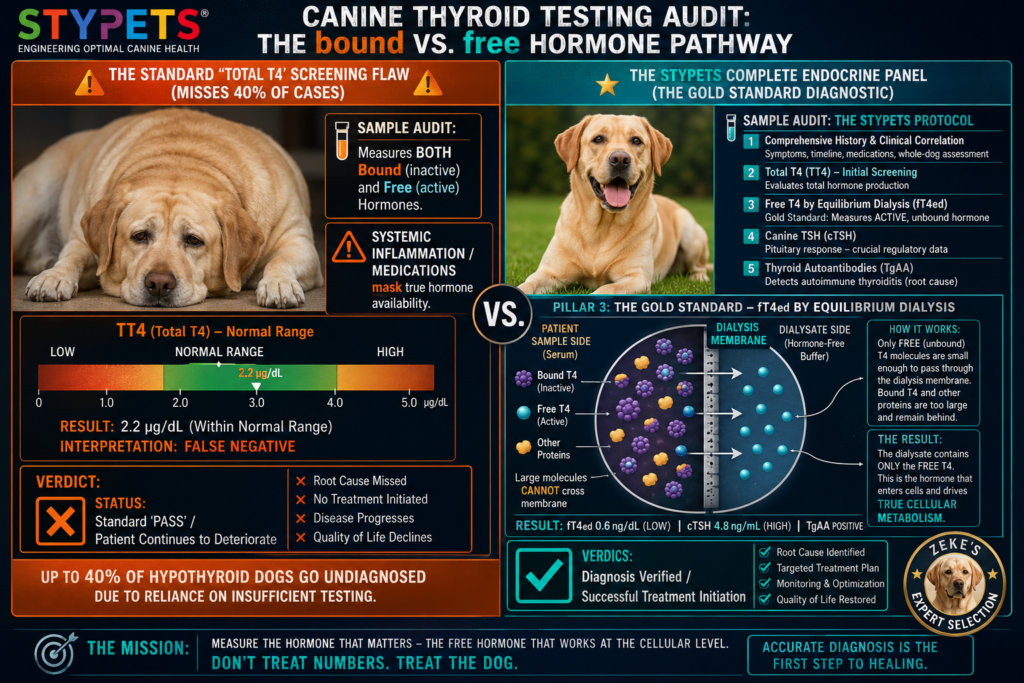
3. The 40% Blind Spot: Why “Standard” Tests Fail
If your dog is showing clear hypothyroidism in dogs symptoms, why did their bloodwork come back “normal”?
Most standard veterinary panels rely solely on a single metric: Total $T_4$ (TT4). While a low TT4 reading is a strong indicator of hypothyroidism, a “normal” reading does not rule it out. Here is why this basic screening creates a massive clinical blind spot:
1. Euthyroid Sick Syndrome
When a dog suffers from any chronic underlying illness—such as allergies, gut inflammation, or osteoarthritis—the body automatically down-regulates thyroid production to conserve resources. Conversely, certain medications (like steroids, phenobarbital, or NSAIDs) artificially alter baseline readings. A standard test cannot distinguish between a truly diseased thyroid and a temporarily depressed one.
2. Cellular-Level Resistance
A dog’s blood may contain circulating hormones, but if those hormones cannot effectively bind to cellular receptors, the dog remains functionally hypothyroid. Measuring total volume in the bloodstream tells you nothing about efficiency at the tissue level.
3. The Autoimmune Cushion
During the early stages of lymphocytic thyroiditis, the body creates autoantibodies. Paradoxically, these antibodies can bind to the test reagents, causing laboratory equipment to misread them as actual thyroid hormones. This creates a falsely elevated, completely inaccurate “normal” result while the gland is actively being destroyed.
4. The Complete Thyroid Audit: A Advanced Diagnostic Protocol
To achieve a definitive baseline for your dog’s endocrine performance, you must insist on a comprehensive Full Thyroid Panel. Do not accept a single TT4 draw. Request that the blood sample be sent to a dedicated veterinary endocrinology laboratory for the following six markers:
+--------------------------+---------------------------------------------------------+
| Test Marker              | Clinical Purpose                                                                    |
+--------------------------+---------------------------------------------------------+
| 1. Total T4 (TT4)        | Measures the total volume of bound and unbound hormone. |
| 2. Free T4 by ED (FT4D)  | Isolates the active hormone able to enter cells.        |
| 3. Total T3 (TT3)        | Assesses the secondary metabolic thyroid hormone.       |
| 4. Free T3 (FT3)         | Measures cellular-level active T3 volume.               |
| 5. Canine TSH (cTSH)     | Checks if the brain is screaming at the thyroid to work.|
| 6. TgAA Antibodies       | Screens definitively for active autoimmune attacks.     |
+--------------------------+---------------------------------------------------------+
Interpreting the Interplay
A truly healthy dog will show balanced, robust numbers across all metrics. A functionally hypothyroid dog will frequently display a low-normal Free T4 paired with an elevated cTSH, indicating that the pituitary gland is working overtime trying to stimulate a failing thyroid. If the TgAA (Thyroglobulin Autoantibody) test comes back positive, your dog is in the middle of an active autoimmune decline, requiring proactive intervention regardless of what the standard TT4 suggests.
5. Zeke’s 3-Step Metabolic Restoration Protocol
If your dog’s complete audit confirms metabolic deceleration, management requires a precise blend of medical stabilization and targeted biological support.
Step 1: Precision Hormone Replacement
The foundational treatment for true canine hypothyroidism is oral administration of synthetic levothyroxine ($L$-thyroxine).
-
The Goal: To safely replace the missing hormone volume and restore cellular metabolic rates.
-
The Action: Administer the medication exactly as prescribed, ideally on an empty stomach to optimize absorption rates through the intestinal walls. Re-test blood panels 4 to 6 weeks after starting to calibrate the dosage.
Step 2: Anti-Inflammatory Dietary Reset
Because the vast majority of thyroid issues are rooted in autoimmune dysfunction, reducing systemic inflammation is critical to preserving remaining glandular tissue.
-
The Goal: Lowering cellular stress and removing dietary triggers that stimulate immune system hyper-reactivity.
-
The Action: Transition away from high-carbohydrate, heavily processed kibbles that promote systemic inflammation. Introduce clean, species-appropriate whole foods rich in selenium, zinc, and bioavailable iodine (such as pasture-raised meats and kelp derivatives).
Step 3: Progressive Exercise Adaptation
A hypothyroid dog cannot handle intense physical strain immediately. Their cardiovascular system and muscles have been running on low power for months.
-
The Goal: Safely rebuild lean muscle mass and stimulate natural metabolic activity without triggering adrenal exhaustion.
-
The Action: Implement low-impact, deliberate “sniff-ari” walks. Focus on cognitive enrichment over purely physical exhaustion until blood values stabilize within target therapeutic ranges.
6. How Hypothyroidism Impacts Long-Term Behavioral Resilience
At STYPETS, we view the canine as a unified, interconnected biological network. You cannot isolate structural health from mental output. Endocrine decline is a massive, invisible driver of behavioral degradation.
When cellular energy drop-offs hit the central nervous system, dogs lose their capacity to cope with environmental stressors. A minor sound that they used to ignore can suddenly trigger an intense fear response or reactive outburst. Because their body is physically exhausted, they may resort to defensive behaviors (such as growling or snapping) to keep space between themselves and perceived threats.
Optimizing your companion’s thyroid function isn’t just about weight loss or coat quality; it is a fundamental requirement for emotional stability and mental comfort.
7. Actionable Blueprint for Pet Parents
If you suspect your dog’s metabolism is stalling, execute this sequential workflow:
-
Log the Benchmarks: Video your dog’s movement, calculate their exact weekly calorie intake, and document any changes in coat quality.
-
Order the Advanced Panel: Contact your veterinarian and specifically request a full panel including Free T4 by Equilibrium Dialysis and TgAA Antibodies.
-
Eliminate Endocrine Disruptors: Remove chemically treated lawn products, synthetic home scents, and plastic food bowls, which can leach compounds that disrupt hormone reception.
-
Track the Recovery: Once treatment begins, monitor behavioral shifts, mental alertness, and shedding patterns. Hair regrowth often begins with a soft “puppy coat” texture before transitioning back to adult density.
8. FAQ: Critical Insights Into Canine Thyroid Performance
Q: What are the most common hypothyroidism in dogs symptoms?
A: The most prominent symptoms include unexplained weight gain (despite caloric restriction), profound lethargy, cold intolerance, symmetrical hair loss on the body, a dry/brittle coat, and a characteristically sad or “tragic” facial expression.
Q: Can a standard blood test reliably diagnose canine hypothyroidism?
A: No. Standard veterinary panels typically check only Total T4. This single marker misses roughly 40% of cases due to variations caused by secondary illnesses, early-stage autoimmune disease, or cellular-level resistance.
Q: Is hypothyroidism in dogs curable?
A: It is not curable, but it is highly treatable and manageable. Daily oral administration of synthetic hormones typically fully restores a dog’s normal lifespan, energy levels, and vital quality of life.
Q: How long does it take to see improvement once treatment starts?
A: Mental alertness and energy levels often surge within 7 to 14 days. Dermatological recovery, including hair regrowth and skin healing, takes significantly longer, typically showing major progress between 4 to 8 weeks.
Q: Are certain breeds more predisposed to thyroid issues?
A: Yes. Medium to large breeds are highly predisposed. Golden Retrievers, Doberman Pinschers, Irish Setters, Boxers, Great Danes, and Cocker Spaniels show statistically higher rates of autoimmune thyroiditis.
Q: Can dietary changes fix a low thyroid without medication?
A: If the thyroid tissue has been structurally destroyed by an autoimmune attack, dietary changes alone cannot replace the necessary hormone volume. Diet is a vital supportive strategy, but hormone replacement therapy remains the primary medical requirement.
Q: Does hypothyroidism cause sudden behavioral issues or anxiety?
A: Absolutely. Metabolic deceleration alters neurotransmitter pathways. Undiagnosed hypothyroid dogs frequently exhibit sudden anxiety, unprovoked irritability, noise phobias, or uncharacteristic reactivity.
9. Conclusion: The Master of the Metabolic Engine
Your dog depends on you to look past the surface of a basic lab report. If their behavior, energy, and physical state point toward a metabolic freeze, do not let a single “normal” line item on a standard screening derail their recovery.
By demanding a comprehensive Thyroid Audit and analyzing the deep interplay of cellular hormones, you take full control of your companion’s biological trajectory. Clear away the diagnostic fog, restore their internal engine, and give your dog the vibrant, energetic life they were engineered to enjoy.
- The American College of Veterinary Internal Medicine (ACVIM) for updated endocrine consensus statements.