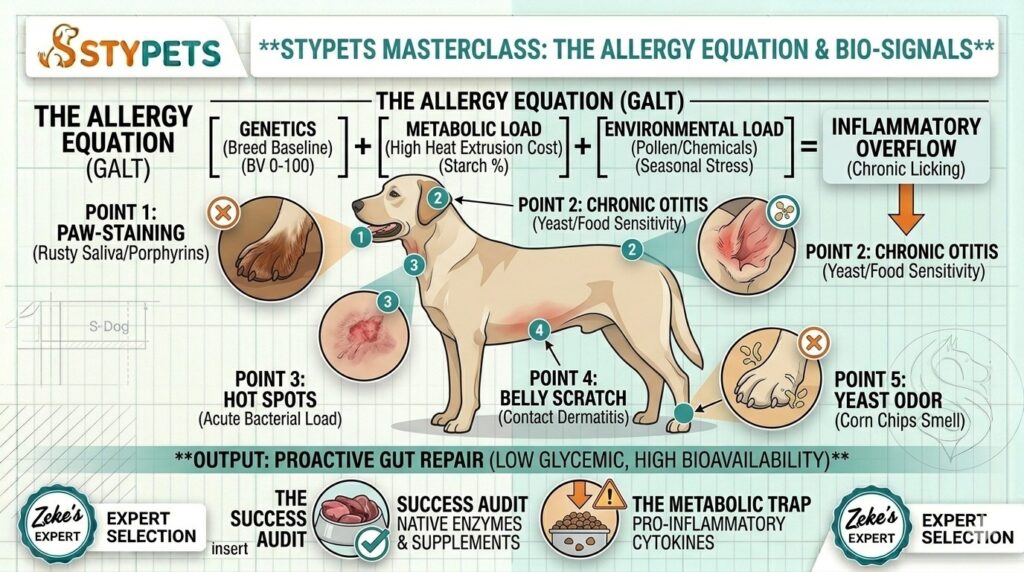
In the world of professional canine management, few symptoms are as widely misunderstood—and mismanaged—as the “itchy dog.” Most owners view constant paw licking, belly scratching, or ear flapping as a nuisance to be suppressed with a quick steroid shot or a bag of “sensitive skin” kibble. However, at STYPETS, we define this chronic irritation through The Allergy Equation.
Constant licking is not a habit; it is a bio-signal. It is the outward manifestation of an internal system in a state of hyper-vigilance. When your dog licks their paws raw, their immune system is shouting that it has lost the ability to distinguish between a harmless protein and a genuine pathogen. To solve the equation, we must move past the symptom and audit the biological root.
1. The Biological Root: The Gut-Skin Axis
To understand why your dog is licking their paws, you must first look at their digestive tract. Approximately 70-80% of a dog’s immune system resides in the Gut-Associated Lymphoid Tissue (GALT).
When the gut lining is compromised—often due to high-heat processed “dead” foods, over-vaccination, or chronic stress—it becomes “leaky.” This allows undigested protein molecules and toxins to escape into the bloodstream. The immune system flags these intruders as enemies, triggering a systemic inflammatory response.
Because the skin is the body’s largest organ of elimination, the inflammation often migrates there. The licking you see at 11:00 PM is actually the final stage of a biological chain reaction that began at 7:00 AM in the food bowl.
2. Decoding the Bio-Signals: Location Matters
A professional audit of an “allergic” dog begins with a Topographical Scan. Where the dog licks tells us which part of the Allergy Equation is out of balance.
The Paw Licker (Environmental vs. Yeast)
-
The Signal: Constant gnawing at the front or back paws.
-
The Audit: Is the fur stained a rusty red? This is “paws-staining” caused by porphyrins in the saliva, but it often masks a secondary Yeast (Malassezia) Overgrowth.
-
The Equation: If the licking is seasonal, it’s likely environmental (pollen/grass). If it’s year-round and smells like “corn chips,” it is a metabolic yeast issue fueled by a high-carbohydrate diet.
The Ear Flapper (Food Sensitivity)
-
The Signal: Chronic “dirty” ears or frequent yeast infections.
-
The Audit: Deep-seated ear issues are almost always a bio-signal of Food Sensitivity. The ears are an extension of the digestive system’s inflammatory path.
The Belly Scratcher (Contact Dermatitis)
-
The Signal: Redness and heat on the hairless parts of the abdomen.
-
The Audit: This is often a direct reaction to floor cleaners, lawn chemicals, or laundry detergents used on the dog’s bedding.
3. The Protein Carousel: The Bioavailability Trap
Many owners believe their dog is “allergic to chicken.” While specific protein allergies exist, what we often see is Protein Sensitivity caused by low-quality, denatured proteins found in standard kibble.
As discussed in our Ingredient Audit, the high-heat extrusion process alters the molecular structure of proteins. When a dog is fed the same denatured protein (like chicken meal) for years, the immune system eventually develops a “memory” of it as an irritant.
The STYPETS Fix: Transition to a Protein Carousel (rotating protein sources every 3 months) and prioritizing High-Bioavailability Proteins (Biological Value of 90+) to reduce the metabolic load on the immune system.
4. The Carbohydrate Catalyst
If protein is the “target” of the allergy, carbohydrates are the “fuel.”
Most “Allergy-Friendly” dog foods replace grains with peas, lentils, or potatoes. While “grain-free,” these ingredients are still starch-heavy.
-
The Yeast Connection: Starch breaks down into sugar. Sugar is the primary fuel source for yeast.
-
The Inflammation Loop: High-glycemic carbs trigger insulin spikes, which promote the production of pro-inflammatory cytokines.
If your dog is licking their paws and eating a diet that is 40% starch, you are essentially trying to put out a fire while pouring gasoline on the embers.
5. Environmental Loading: The “Bucket” Theory
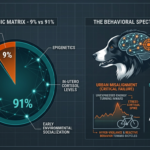
Think of your dog’s immune system as a bucket.
-
The bottom layer is filled by genetics (their “Genetic Lottery” predisposition).
-
The middle layer is filled by their diet (kibble quality and starch levels).
-
The top layer is filled by environmental triggers (pollen, dust, chemicals).
Your dog doesn’t start licking when the bucket is half full. They start licking when the bucket overflows.
The Professional Strategy: We cannot always change the genetics (the bottom) or the pollen in the air (the top), but we have 100% control over the diet (the middle). By lowering the metabolic and inflammatory load in the gut, we “empty the bucket” enough so that the environmental triggers no longer cause an overflow.
6. The 4-Step Recovery Blueprint
To silence the licking bio-signal, you must follow the STYPETS Audit Recovery Protocol:
-
Eliminate the Catalyst: Remove all high-starch treats and foods. Switch to single-ingredient, air-dried or fresh toppers.
-
Mechanical Removal: After walks, wipe paws with a 50/50 water and organic apple cider vinegar mix. This alters the pH of the skin, making it inhospitable for yeast and removing environmental pollens.
-
The Gut Reset: Introduce high-quality probiotics and digestive enzymes to repair the gut lining and break down proteins more efficiently.
-
The Omega Audit: Increase Omega-3 fatty acids (specifically EPA and DHA from small, oily fish like sardines). These act as natural “fire extinguishers” for systemic inflammation.
Zeke’s Final Word:
“Stop looking for a magic pill to stop the itch. The itch is just the smoke; the fire is in the gut. If you want a dog that is comfortable in its own skin, you have to audit what you’re putting under that skin every single day. Solve the equation, and the licking will stop.” — Zeke