For a reactive dog, the world isn’t just a place to live; it is a relentless barrage of sensory data that the brain cannot properly filter. Imagine living in a room where the lights are constantly flickering, the music is at maximum volume, and you never know when someone might startle you. This state of hyper-vigilance is the daily reality for many canines.
As a professional in canine engineering, I look at reactivity not as a “behavioral flaw,” but as a systemic sensory overload. To fix the software (the behavior), we must first stabilize the hardware’s surroundings. Creating a low stress environment for reactive dogs is the foundational blueprint for any successful rehabilitation.
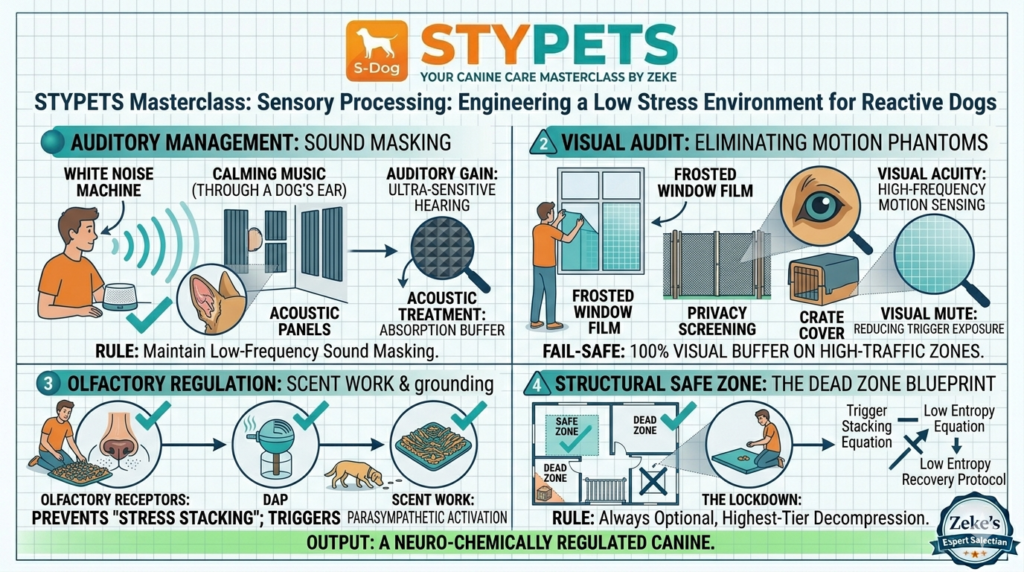
In this STYPETS Masterclass, we will move beyond “just avoiding triggers.” We are going to perform a full sensory audit of your home, optimizing auditory, visual, and olfactory inputs to reduce your dog’s cortisol levels and build a sustainable “Safe Zone.”
1. The Physics of Reactivity: Understanding Sensory Processing
Reactivity is often a symptom of poor Dog Care regarding sensory management. In engineering, we speak of “Signal-to-Noise Ratio.” For a reactive dog, the “Noise” (distractions) is so loud that they cannot hear the “Signal” (your cues).
When we create a low stress environment for reactive dogs, we are essentially lowering the noise floor. Sensory Processing Disorder (SPD) in dogs means that their nervous system reacts to neutral stimuli as if they were life-threatening hazards. By the time your dog lunges at a passerby, their “Sensory Cup” has already been filled to the brim by the morning’s events.
2. The Visual Audit: Eliminating “Motion Phantoms”
Visual triggers are the most common driver of household arousal. To build a low stress environment for reactive dogs, you must audit what your dog sees from their “rest” positions.
The Window Trap
Dogs that spend all day watching the street are in a constant state of “Active Guarding.” This isn’t relaxation; it’s an unpaid job that keeps their adrenaline spiked.
-
The Fix: Use frosted window film on the lower half of windows. This allows light in but eliminates the visual “triggers” of squirrels, mail carriers, or other dogs.
-
The Blueprint: If your dog “fence fights,” use privacy screening to break the visual line.
The Crate Placement
Don’t place a reactive dog’s crate in a high-traffic hallway. Every time a family member walks by, the dog’s “startle reflex” is triggered. Place the crate in a “Dead Zone”—a corner with two solid walls.
3. How Trigger Stacking Disrupts a Low Stress Environment for Reactive Dogs
When multiple triggers occur in rapid succession, the biological ‘load’ becomes too heavy. Maintaining a low stress environment for reactive dogs requires understanding that every small sound or sight eats away at their cognitive headroom.
To maintain a low stress environment for reactive dogs, we use Auditory Masking:
-
White Noise: Consistent, low-frequency sound that covers sharp spikes in noise.
-
Calming Music: Studies show that “Through a Dog’s Ear” or specific classical arrangements can physically lower heart rates.
-
Acoustic Treatment: Soft surfaces (rugs, heavy curtains) absorb sound bounce, making the home feel “quieter” to a sensitive canine ear.
4. Olfactory Regulation: The Nose-Brain Connection
A dog’s nose is their primary interface with the world. While we focus on what they see, we often ignore what they smell. A low stress environment for reactive dogs should utilize “Olfactory Grounding.”
-
Scent Work as a Cool-Down: After a walk (a high-arousal event), scatter kibble in a snuffle mat. Sniffing triggers the parasympathetic nervous system, acting as a mechanical “Off-Switch.”
-
Synthetic Pheromones: Using a DAP (Dog Appeasing Pheromone) diffuser can mimic the scent of a nursing mother, providing a subtle bio-signal of safety.
5. The “Safe Zone” Blueprint: Structural Requirements
In STYPETS engineering, the “Safe Zone” is a designated area where the dog is legally “off the clock.” No training, no guests, and no surprises.
How to Build the Zone:
-
Boundary Definition: Use an X-pen or a baby gate. Physical boundaries help the dog understand they don’t need to monitor the whole house.
-
The “Place” Anchor: As discussed in our Off-Switch Protocol, a raised cot provides a clear sensory boundary.
-
Low-Entropy Lighting: Avoid flickering LED bulbs or harsh fluorescent lights, which some reactive dogs find irritating to their visual processing.
6. Daily Bio-Rhythms and Stress Stacking
You cannot have a low stress environment for reactive dogs if you are “Stress Stacking.” This is the cumulative effect of small stressors over a 72-hour period.
If your dog sees a cat (Trigger 1), hears the doorbell (Trigger 2), and then you try to clip their nails (Trigger 3), they will likely “explode.” This isn’t because of the nail clippers; it’s because the system reached its Critical Failure Point.
Zeke’s Tactical Recovery:
-
Decompression Days: If your dog has a major reactive episode, the next 48 hours should be “Low-Entropy.” No walks, no visitors, just sniffing games and sleep.
-
Predictable Schedules: Complexity is the enemy of calm. Engineering a rigid schedule for feeding, potty, and rest reduces the dog’s need to “anticipate” and guard.
7. Trigger Stacking: The Mathematical Model of an “Explosion”
In standard Dog Care, owners often wonder why their dog “snapped for no reason.” In engineering, we know there is always a reason—it is a cumulative load failure.
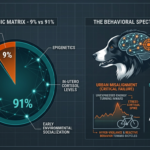
The Stress Equation:
When creating a low stress environment for reactive dogs, your goal is to keep the “Baseline Stress” so low that when Trigger A occurs, the dog has enough “Cognitive Headroom” to process it without reacting.
-
The Recovery Period: Cortisol (the stress hormone) can take up to 72 hours to leave a dog’s system.
-
The Zeke Rule: If your dog has a high-arousal event on Monday, their environment must be “Ultra-Low Entropy” until Thursday.
8. Proprioceptive Input: Heavy Work for Neurological Grounding
One often overlooked aspect of a low stress environment for reactive dogs is proprioception—the dog’s sense of where their body is in space. Reactive dogs are often “disconnected” from their rear ends, which increases anxiety.
Adding “Heavy Work” to the Home:
-
Weighted Vests: Under professional guidance, a lightly weighted vest can provide “Deep Pressure Therapy,” similar to a weighted blanket for humans.
-
Tug-of-War (Controlled): This provides resistance training that helps “ground” the dog’s nervous system.
-
The “Licking” Station: Licking releases endorphins. A frozen lick mat in the Safe Zone is a mechanical tool to lower blood pressure.
9. Lighting and Frequency Audit: The “Invisible” Triggers
We often forget that dogs see at a higher flicker-fusion frequency than humans.
-
The LED Issue: Some cheap LED bulbs flicker at a rate invisible to us but highly irritating to a dog’s visual cortex. If your dog is restless in a specific room, check the lighting.
-
The TV Refresh Rate: Modern 4K TVs are much clearer to dogs than older models. If your dog reacts to animals on screen, you may need to use “Visual Muting” (turning the TV off or blocking the view) to maintain a low stress environment for reactive dogs.
10. Zeke’s “Decompression” Protocol: After the Overload
When the environment fails and a reactive episode occurs, you must execute a Hardware Reset.
-
Immediate Darkening: Move the dog to their Safe Zone and cover the crate or dim the lights.
-
Hydration Check: Stress causes dehydration. Ensure fresh, filtered water is available.
-
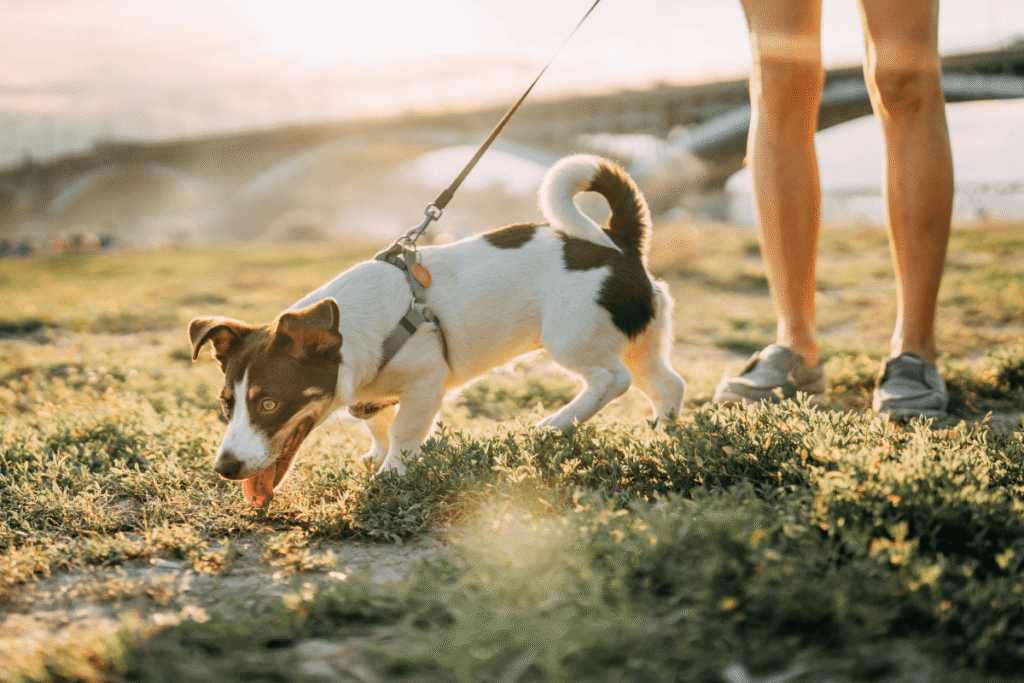
The “Scatter Feed”: Instead of a bowl, scatter their meal in grass or a plush rug. The act of searching and sniffing is the fastest way to manually override the “Fight or Flight” response.
11. The “Guest Protocol” Architecture
A low stress environment for reactive dogs is most tested when “Foreign Elements” (guests) enter the system.
-
The Barrier Rule: Never allow a guest to walk directly toward a reactive dog. Use a baby gate to create a “Social Buffer.”
-
The “Ignore” Instruction: Instruct guests to offer “Zero Social Pressure”—no looking, no talking, and no touching. This allows the dog to audit the guest’s scent without the pressure of a social interaction.
Zeke’s Expert Strategic Note
“By expanding on the Biological Stress Equation, you are teaching your readers that reactivity isn’t a choice the dog is making—it’s a mechanical outcome of their environment. This shifts the owner’s perspective from ‘frustrated’ to ‘architect,’ which is the core of the STYPETS mission.”
12. FAQs: Sensory Processing & Reactivity
Q: Can a low stress environment for reactive dogs actually cure reactivity? A: It provides the foundation for a cure. You cannot train a dog whose brain is marinated in cortisol. You lower the stress first, then you begin counter-conditioning.
Q: My dog is only reactive on leash. Do I still need to audit the home? A: Yes. “Leash reactivity” is often the result of “Home Stress” boiling over. A dog that is well-rested in a low-entropy home has more “patience” on the leash.
Q: Is “Dog Care” different for reactive breeds like Shepherds or Malinois? A: These breeds have higher “sensory gain.” They notice everything. Their environment needs to be even more strictly controlled than a lower-drive breed.
Q: Should I use a crate cover? A: For many reactive dogs, a crate cover acts as a “Visual Mute” button. It is highly recommended to create that “Safe Zone” feeling.
Q: Will a white noise machine hurt their ears? A: No, as long as it is kept at a moderate volume. It should be a background hum, not a loud roar.
Q: Does diet affect sensory processing? A: Absolutely. As seen in our Microbiome Blueprint, gut inflammation can make a dog more sensitive to sensory input.
Q: How do I handle guests in a low stress environment? A: Guests should be managed via “Visual Barriers” (baby gates) and the dog should be given a high-value chew in their Safe Zone before the guest arrives.
Q: Can I use essential oils? A: Be careful. Lavender is often calming, but many oils are toxic to dogs. Stick to canine-specific pheromones or consult a vet.
The Fear Free Pets initiative: Mention their protocols for low-stress handling.
Dr. Karen Overall’s Protocol for Relaxation: A gold standard in behavioral engineering.