Does your dog go from zero to sixty the moment a leash appears? For owners of high-drive breeds, living with a dog that has no “off-switch” can feel like living with a live wire. Mastering dog impulse control exercises isn’t just about better manners; it’s about biological regulation.
By the end of this STYPETS Masterclass, you will move beyond basic obedience and learn the “Off-Switch Protocol”—a professional engineering approach to canine calm.
1. The Science of the High-Drive Brain
High-drive dogs (Herding, Sporting, or Working breeds) are genetically wired for high output. Their brains are “pre-loaded” with a bias toward action.
The Impulse Control Deficit
In a “Standard” dog, the prefrontal cortex quickly inhibits impulsive reactions. In a high-drive dog, the amygdala—the brain’s emotional center—often overrides the “logical” brain.
When we perform dog impulse control exercises, we are literally strengthening the neural pathways between these two regions. We are teaching the dog to “pause” before they “act.”
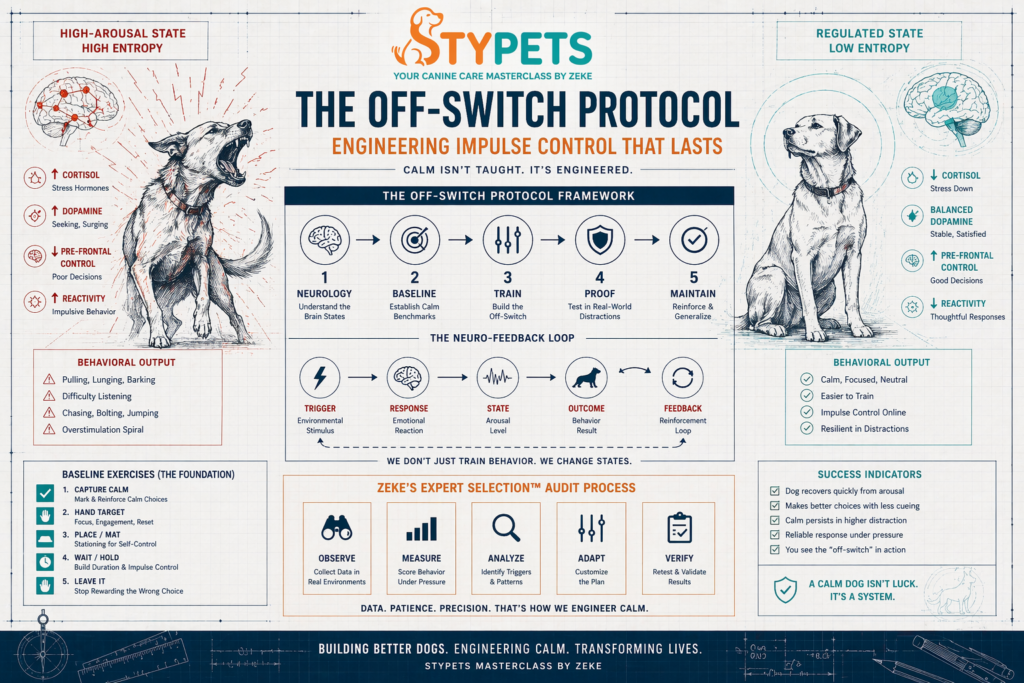
2. The STYPETS “Off-Switch” Protocol
In the STYPETS Masterclass, we treat impulse control as a mechanical system. If a dog is constantly “on,” the system is overheating.
The Three Pillars of Control
-
Bio-Feedback: Recognizing the physical signs of arousal (dilated pupils, stiff posture).
-
Threshold Management: Ensuring the dog stays below the point of “explosion.”
-
The Reward Anchor: Using the dog’s drive as the very reward for being calm.
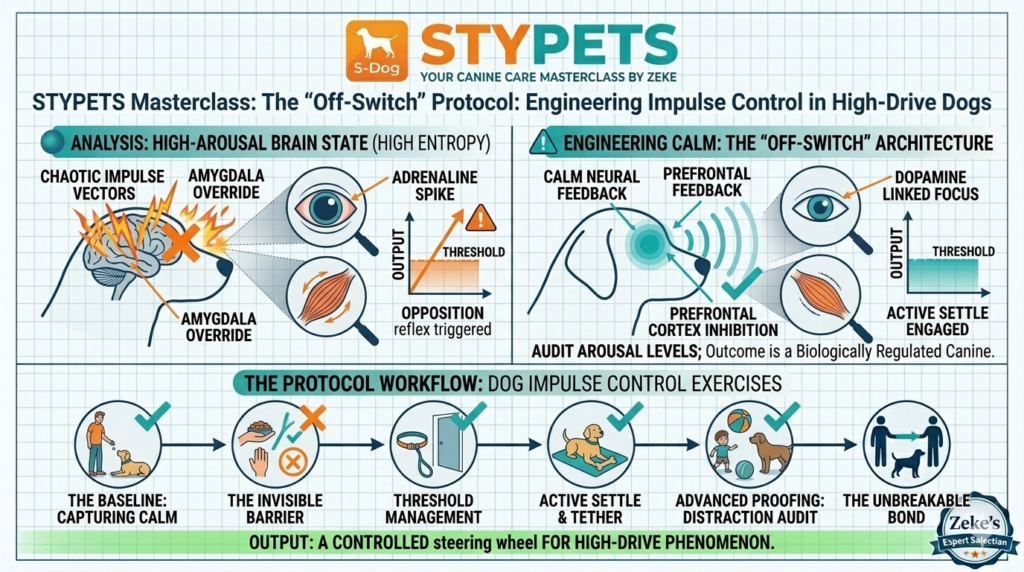
A sophisticated, single-view blueprint visually summarizing the technical “Off-Switch” Protocol for canine impulse control. The graphic compares diagrams of a high-energy dog with high entropy versus a calm dog with regulated behavior, highlighting neuro-feedback loops, baseline exercises, and the ‘Zeke’s Expert Selection’ audit process.
3. The Baseline: Capturing Calm
Before we can ask a dog to control themselves during a squirrel chase, we must reward “The Baseline.”
What is Capturing?
This is the process of marking and rewarding your dog when they choose to be bored.
-
Keep a bowl of kibble on a high shelf.
-
Wait for your dog to lie down on their own accord.
-
Calmly drop a piece of food between their paws.
-
Do not speak or give enthusiastic praise; you want to reward the low-energy state.
4. Step-by-Step Dog Impulse Control Exercises
Here are the core dog impulse control exercises used in the STYPETS “Unbreakable Bond” training series.
Exercise A: The “Invisible Barrier” (Food Control)
-
Place a high-value treat on the floor.
-
Cover it with your hand if the dog lunges.
-
The moment the dog looks away or sits back, remove your hand.
-
The Secret: The dog only gets the treat when they stop trying to “take” it.
Exercise B: The “Threshold Door” (Leash Control)
-
Put your dog on a leash and walk toward the front door.
-
If the dog pulls ahead, stop and step back.
-
The door only opens when the dog offers eye contact and a loose leash.
Exercise C: The “Active Settle”
-
Tether your dog to a heavy piece of furniture with a 4-foot leash.
-
Give them a chew toy or a mat.
-
Perform chores around the room.
-
Every few minutes, drop a “Value Deposit” (treat) if they remain settled.
5. The Environmental Audit: Reducing Visual Chaos
Just as we performed a Hazard Audit for pet-proofing, we must perform an Arousal Audit for the home.
-
Visual Access: Block the bottom half of windows if your dog “fence fights” or barks at passersby.
-
Toy Management: High-drive dogs shouldn’t have constant access to squeaky toys. These keep the “hunting” brain engaged.
-
Safe Havens: Ensure the dog has a crate or “place” located away from high-traffic zones like the kitchen or front door.
6. Advanced Proofing: The Real-World Test
“Proofing” is the engineering term for testing a system under stress.
-
Introduce Motion: Practice your dog impulse control exercises while someone rolls a ball or runs past.
-
Distance Training: Can your dog stay in a “down” while you are 20 feet away?
-
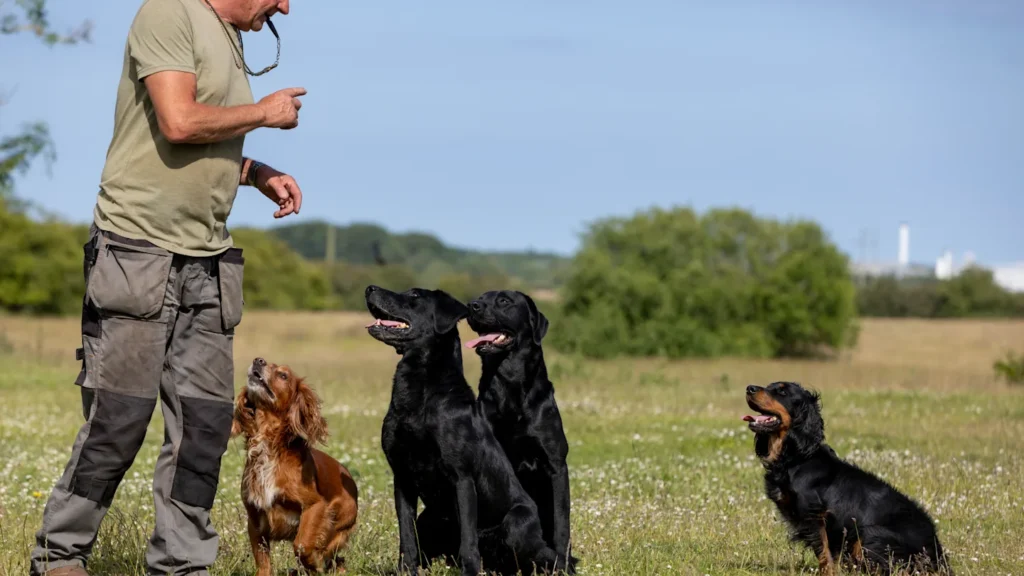
The Toy Release: Use a game of tug as the reward. The dog must sit calmly to start the game, and “drop it” instantly to continue.
7. FAQs: Solving High-Arousal Issues
Q: My dog is too “hyper” for treats. What do I do? A: Use their “Work” as the reward. If they want to chase a ball, they must sit calmly before you throw it.
Q: At what age should I start impulse control? A: Immediately. Puppies as young as 8 weeks can learn that “calm” is the key that unlocks their world.
Q: Is “Off-Switch” training the same as exhausting them? A: No. Exercise tires the body; impulse control tires the brain. High-drive dogs often need more “brain work” than physical running.
Q: Can I use a whistle for this? A: Yes. As we discussed in our Emergency Recall Masterclass, a whistle is a neutral, high-value signal that cuts through arousal.
Q: Will this change my dog’s personality? A: It won’t remove their “drive,” but it will give them a “steering wheel” for that drive.
Conclusion: From Chaos to Control
Engineering an “off-switch” in a high-drive dog is the ultimate sign of a master trainer. By consistently applying these dog impulse control exercises, you aren’t just teaching commands—you are restructuring how your dog perceives the world.
8. The Entropy of Arousal: Zeke’s Behavioral Stress Test
In engineering, entropy represents a move toward disorder. In a high-drive dog, entropy is the “fizzle” of the brain when it can no longer process commands due to high adrenaline. To mitigate this, we use a Layered Stress Audit.
-
The Baseline Test: Can your dog settle on a mat while you eat dinner? (Low Stress)
-
The Operational Test: Can your dog settle on a mat while you toss a tennis ball to yourself? (Medium Stress)
-
The Critical Failure Test: Can your dog settle on a mat at a busy park with other dogs nearby? (High Stress)
If your dog fails the “Critical Failure Test,” do not blame the dog. You have a System Overload. You must dial back the environment until the “Off-Switch” architecture is strong enough to handle the load.
9. Biological Resource Management: The “Spoon Theory” for Dogs
Every high-drive dog starts the day with a limited amount of Inhibitory Energy.
Think of it as a battery. Every time your dog has to “leave it,” “wait,” or “settle,” they use a portion of that battery. If you spend the whole morning at a chaotic dog park, their battery is empty by noon. This is why many dogs “misbehave” in the evening—they aren’t being bad; they are biologically depleted.
Zeke’s Efficiency Tips:
-
Scheduled Downtime: Force a 2-hour nap after high-intensity play. This allows the cortisol to drop and the battery to recharge.
-
Low-Arousal Transitions: After a game of fetch, do 5 minutes of “Sniff-Work.” Sniffing lowers the heart rate and acts as a mechanical “cool-down” for the brain.
10. The “Place” Command as a Mechanical Anchor
A “Place” command isn’t just a “Stay.” It is a Boundary Constraint.
By training your dog to stay on a specific raised cot or mat, you are giving them a physical “Safe Zone” where they are not responsible for guarding the house or chasing the cat. This reduces their Cognitive Load.
-
Select the Hardware: Use a raised cot; the physical edge helps the dog understand the boundary better than a flat rug.
-
The Anchor Protocol: High-value chews (Bully sticks, frozen kongs) should only be given on the “Place.”
-
Duration over Distance: Focus on keeping the dog on the mat for 30 minutes while you work, rather than calling them from 100 feet away.
11. Advanced Troubleshooting: The “Opposition Reflex”
If you try to force a high-drive dog to lie down, you often trigger the Opposition Reflex—the natural instinct to push back against pressure.
Zeke’s Solution: Never push. Instead, use Incentive Alignment. Make the floor the most rewarding place to be. If the dog stands up, the “Jackpot” stops. When the belly touches the floor, the “Value Deposit” resumes. You are engineering a dog that wants to settle because it is the most logical path to a reward.
Zeke’s Final Audit: The “Off-Switch” Checklist
Before you publish, ensure your readers understand that this is a lifestyle architecture, not a 5-minute fix.
-
[ ] Morning: Bio-Feedback check. Is the dog “vibrating” with energy? Start with a settle exercise before breakfast.
-
[ ] Mid-day: Sensory audit. Is the house too loud? Turn on white noise.
-
[ ] Evening: Resource check. Is the dog’s “Inhibitory Battery” empty? Avoid high-stress training in the late evening.