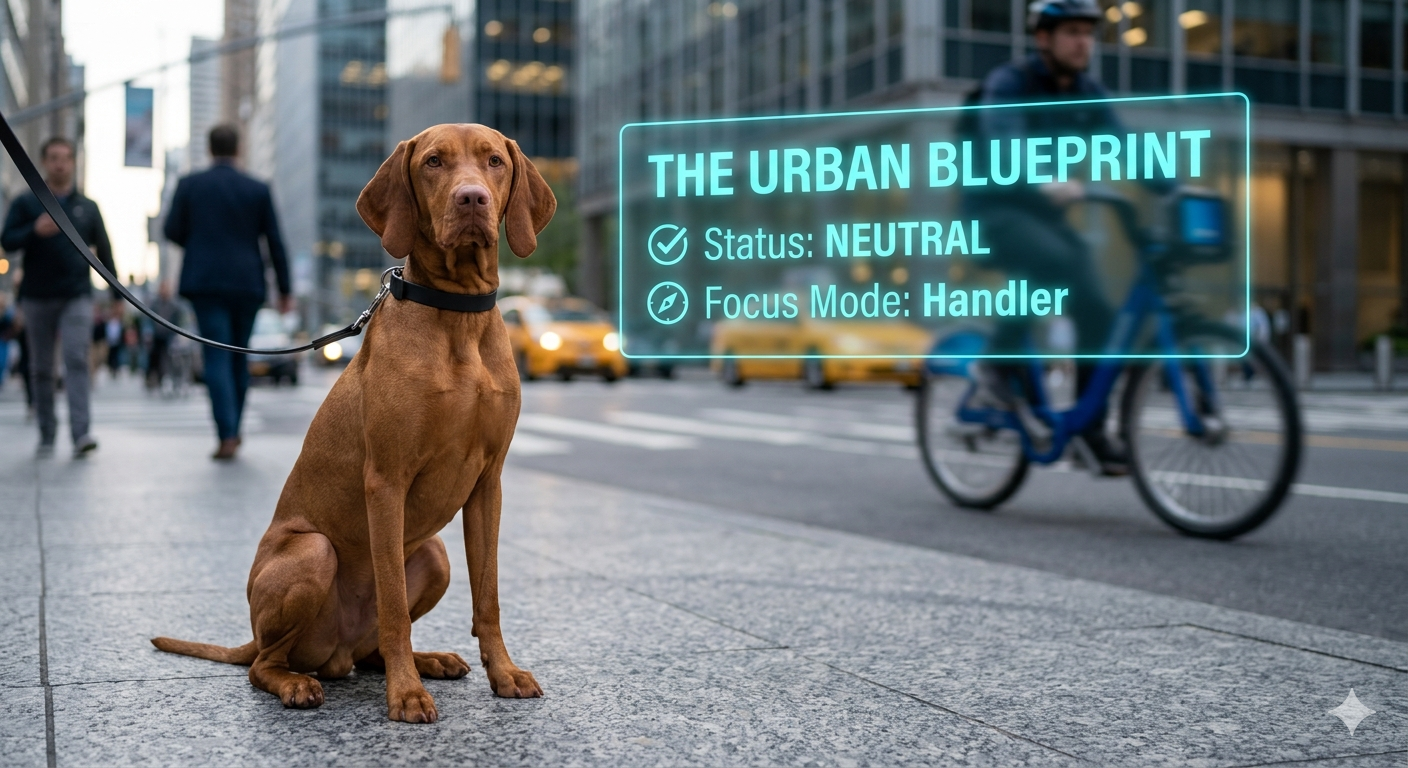
You’re walking down a bustling city sidewalk. A siren wails, a skateboarder zips past, and a stranger’s lunging Labrador is barking incessantly just three feet away. In this high-stakes environment, does your dog try to drag you toward the commotion, or do they simply glance and return their focus to you? The difference lies in a shift from traditional “socialization” to the professional standard: dog neutrality training.
For years, the pet industry pushed the idea that a “socialized” dog must greet every person and pup they encounter. In 2026, we know better. Over-socialization often creates reactive, over-stimulated dogs that can’t function in urban settings. This blueprint will teach you how to move beyond basic dog training and engineer a dog that is calm, focused, and profoundly neutral to the chaos of the world.
1. Defining Dog Neutrality Training vs. Socialization
Before we build the blueprint, we must define our terms. Traditional socialization is often misunderstood as “interaction.” Dog neutrality training, however, is the art of teaching your dog that the world is background noise.
The Socialization Trap
Traditional socialization focuses on engagement. Owners take puppies to parks to “play” with everyone. This often creates a dog that expects interaction, leading to “frustrated greeting” reactivity when they are restricted by a leash, a problem easily solved by switching to dog neutrality training.
The Power of Neutrality
Neutrality is about indifference. A neutral dog acknowledges a stimulus (a cat, a bike, a barking dog) but chooses to remain emotionally level. In terms of professional dog training, neutrality is the ultimate goal for service animals and high-level working dogs because it ensures reliability in any environment.
2. The Urban Exposure Blueprint: Phase 1 – The “Watch the World” Protocol
The first step in dog neutrality training isn’t active work; it’s passive observation. This phase builds the foundation of your dog’s emotional regulation through specialized dog training techniques.
Step-by-Step Observation
-
Find a “Medium” Environment: Don’t start at a busy cafe. Choose a park bench 50 feet away from a walking path.
-
The Anchor Method: Sit on the bench and step on the leash (leaving enough slack for the dog to sit or lie down comfortably).
-
Zero Pressure: Do not ask for “Sit” or “Stay.” Let the dog make their own choices.
-
Reward the “Check-In”: Every time your dog looks at a distraction and then looks back at you, provide a high-value reward. You are reinforcing the idea that not reacting is the most profitable choice.
3. Mastering the “Look and Late” Technique
To achieve high-level dog neutrality training, you must master the timing of your reinforcements. This is a classic dog training technique used to change a dog’s underlying emotional response to triggers.
-
The Trigger Appears: Your dog notices a cyclist.
-
The Three-Second Rule: Allow your dog to look for up to three seconds.
-
The Mark: Just before the dog decides to react (stiffen, stare intently, or bark), use a marker word like “Yes!” or a clicker.
-
The Reward: Deliver a treat. You are teaching the dog: “I see the distraction, and I choose to look to my handler instead.”
4. Environmental Engineering: Navigating High-Stressor Zones
Urban environments are unpredictable. Professional dog training in 2026 utilizes “Environmental Engineering” to prevent a dog from being overwhelmed during their dog neutrality training.
Distance is Your Best Friend
If your dog reacts, you are too close for effective dog neutrality training. Increase distance until focus returns.
Surface and Sound Conditioning
Neutrality isn’t just about other living things; it’s about the physical world.
-
Proprioception Work: Encourage your dog to walk over grates, manhole covers, and uneven construction plates.
-
Audio Desensitization: Use 2026 smart-home tech to play “City Sounds” at a low volume during meal times, gradually increasing the volume over weeks.
5. The “No-Greeting” Policy: Setting Boundaries for Success
The hardest part of dog neutrality training isn’t the dog—it’s the other humans. Stop letting strangers pet your dog on walks, as constant “on-leash greetings” teach your dog to expect high-arousal interaction, which is the enemy of dog neutrality training.
Expert Tip: Stop letting strangers pet your dog on walks. Constant “on-leash greetings” teach your dog that every human is a potential source of high-arousal interaction, which is the enemy of neutrality.
How to Say No
-
“We’re in training right now, sorry!”
-
“He’s working on his focus today.”
-
“She needs her space, thank you.”
6. Advanced Focus: Engagement in the Presence of Chaos
Once your dog is neutral to passive triggers, the final stage of dog training for urban life is maintaining engagement while moving. Utilize the Figure-Eight Drill to force the dog to prioritize your cues over environmental stimuli, a core tenet of dog neutrality training.
The Figure-Eight Drill
Find an area with moderate distractions (like a pet store entrance). Walk in large figure-eight patterns. Every time you cross the center of the eight, ask for a quick “Heel” or a “Touch” command. This forces the dog to prioritize your cues over the environmental stimuli.
7. Environmental Auditing: Beyond 2D Desensitization
While Phase 1 focused on observation, Phase 2 is an environmental audit that addresses the third dimension of urban complexity: unpredictable movement. Traditional dog training often desensitizes dogs to static objects (like trash cans) or simple movement (a jogger). Neutrality training requires engineering immunity to complex chaos.
The Proprioception Puzzle
Professional handlers don’t just walk on flat pavement. We audit and improve a dog’s proprioception (awareness of body position) on unpredictable urban “furniture”:
-
Tactile Immunity: Walk your dog across metal grates, construction plates, and wobbly manhole covers. A dog confident in their footing is 40% less likely to react to external auditory or visual triggers, as their baseline anxiety remains low.
-
Vertical Engineering: Utilize low retaining walls or park benches for “Place” work in high-traffic zones. This vertical distance reduces the stress of close-proximity triggers, creating a safe “bio-pocket” of neutrality.
8. Integration with 2026 Bio-Signal Technology
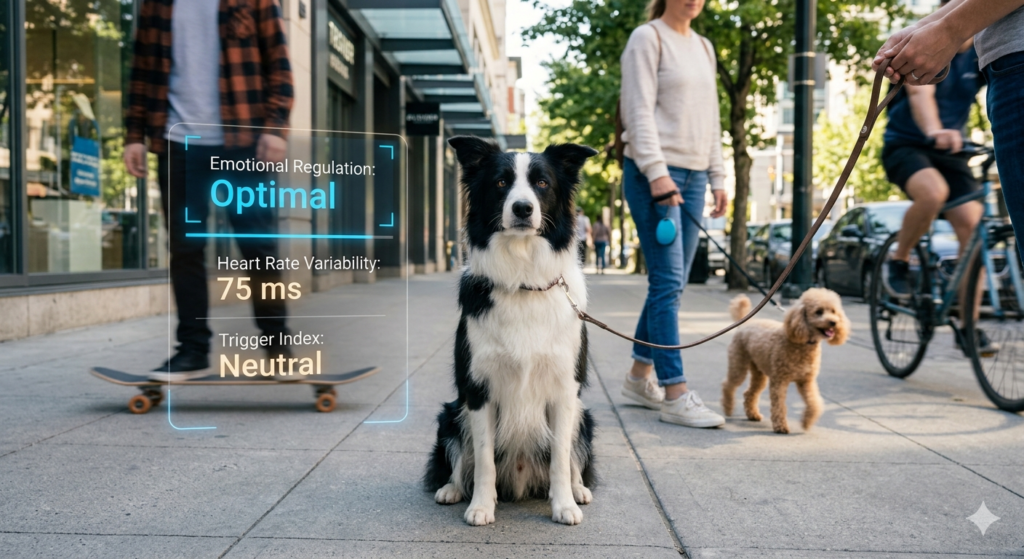
The most robust innovation in 2026 dog training is auditing a dog’s internal emotional state using wearable tech. We now monitor Heart Rate Variability (HRV) as a definitive indicator of stress during dog neutrality training. If HRV plummets while the dog remains still, the dog neutrality training has moved into “Shut Down,” and you must withdraw. see our guide on [Auditing Your Dog’s 2026 Health Tech: Best Wearable Trackers].”
HRV: The Internal Neutrality Metric
As detailed in our recent deep-dive, Wearable Data: Auditing Your Dog’s 2026 Health Tech, Heart Rate Variability (HRV) is the definitive physiological indicator of stress.
-
The Blueprint Hack: Monitor your dog’s HRV during urban exposure. A successful dog neutrality training session isn’t just about lack of reaction; it is about maintaining a stable, high HRV even when a large trigger (like a siren) passes. If the HRV plummets while the dog remains physically still, you are witnessing “Shut Down,” not neutrality. This requires an immediate withdrawal to a safer environment.
9. Engineering Calmness: Utilizing 2026 Canine Nutrition and Hydrotherapy
Modern neutrality isn’t just behavioral; it is biological. If a dog’s microbiome is in dysbiosis or their body is stiff, achieving true mental neutrality is nearly impossible.
Biological Blueprint Enhancements:
-
Nutrition: “Modern dog training protocols include hydrolyzed collagen peptides to reduce systemic inflammation. To learn how to time these nutrients for maximum mental clarity, check out our report on [Intermittent Fasting for Dogs: Can the Fast-Mimicking Diet Extend Life?]”
-
Hydrotherapy: Utilizing temperature-regulated hydrotherapy pools is essential for senior dogs or high-performance breeds. Warm water hydrotherapy increases circulation and builds supportive muscle without stressing the joints, providing the physical foundation necessary for mental calm. For athletic breeds, a quick, post-hydrotherapy “Cold Rinse” as part of their Dog Care routine helps prevents delayed onset muscle soreness, keeping their movement fluid during urban audits.
10. The “Ghosting” Defense: Professional Counter-Surveillance
Urban dog neutrality training requires active defensive maneuvering. The 2026 blueprint teaches owners how to utilize “Environmental Ghosting” to avoid conflict and maintain their dog’s emotional threshold.
The Blueprint Evasion Strategy:
Urban dog neutrality training requires active defensive maneuvering. Use the “Ghost Turn”—immediately executing a 180-degree turn away from a distraction—to engineer immediate re-engagement during your dog training sessions.
-
The Ghost Turn: Upon sighting an approaching trigger (such as an uncontrolled, barking dog), immediately execute a silent 180-degree turn away from the distraction. This is a non-verbal command that engineers immediate re-engagement with the handler, effectively making you and your dog “ghosts” in the chaos.
11. From Neutral to Active: The Final 2026 Audit
The blueprint concludes with the shift from passive neutrality to active focus. Once your dog is neutral (indifferent) to the noise, you can engineer elite-level engagement while moving through complex environments.
The Active Audit Drill:
-
Select Chaos: Find an environment with high unpredictability (e.g., outside a subway entrance).
-
Continuous Motion: Maintain a consistent walking pace (do not stop).
-
Active Engagement Cues: As you pass triggers, immediately ask for highly reinforcing cues such as “Spin” or “Hand Touch.” The goal is for the dog to prioritize your cue faster than their environment, reinforcing that their focus should always return to the leader of the partnership.
FAQ: Dog Neutrality Training & Urban Exposure
Q: Is dog neutrality training the same as being “anti-social”? A: Not at all. A neutral dog can still have “friends” and enjoy play sessions. Neutrality simply means they don’t have to greet everyone they see on the street.
Q: At what age should I start neutrality training? A: Day one. Puppies are sponges. Teaching a puppy to sit and watch the world go by is far more valuable than teaching them to shake paws.
Q: My dog is already reactive. Is it too late? A: Never. Reactivity is often just an extreme lack of neutrality. You may need to start at a much further distance, but the blueprint remains the same.
Q: Can I use a harness for this training? A: While harnesses are fine for some, many professional dog training experts prefer a well-fitted flat collar or a martingale to provide clearer communication during urban exposure.
Q: How long does it take to see results? A: Neutrality is a lifestyle, not a six-week course. Most owners see a significant shift in “leash manners” within 3-4 weeks of consistent “Look and Late” work.
Q: Should I use food for every distraction? A: Initially, yes. You are building a “bank account” of positive associations. As the dog becomes more proficient, move to a variable reinforcement schedule.
Q: What if a loose dog approaches us? A: Use the “Treat Scatter” technique. Throw a handful of treats at the approaching dog to distract them while you and your dog calmly create distance.
Conclusion: The Quiet Confidence of a Neutral Dog
The goal of the Urban Exposure Blueprint isn’t to create a robot; it’s to create a dog that feels safe and confident in a chaotic world. When you prioritize dog neutrality training over forced socialization, you give your dog the gift of peace. You aren’t just doing dog training; you are engineering a partnership built on focus, trust, and the quiet confidence that no matter what the city throws at you, you have each other’s back.
“The 2026 Guide to High-Value Training Treats.”