The canine world is currently obsessed with the portmanteau. From the ubiquitous Goldendoodle to the pint-sized Pomsky, “Designer Breeds” have transitioned from niche crosses to a billion-dollar global industry. They are marketed as the ultimate “life hack”—the personality of a beloved family dog paired with the non-shedding coat of a Poodle.
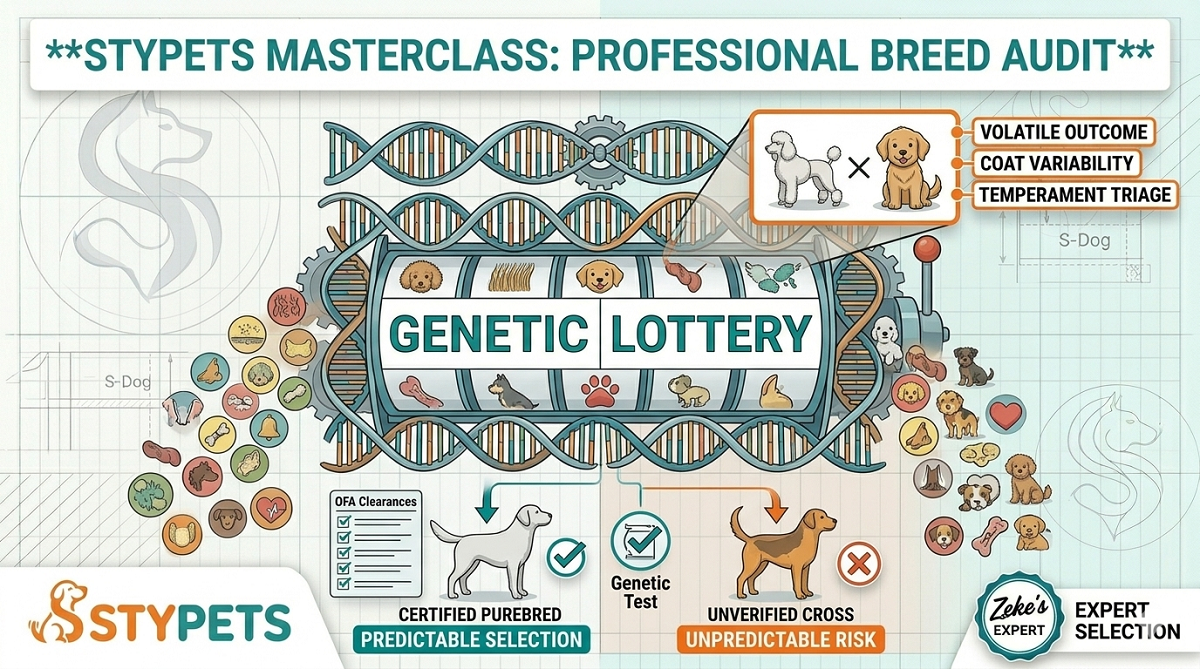
But at STYPETS, we don’t look at the cute names; we look at the chromosomal reality. As an expert in canine genetics and behavior, I am here to tell you that the marketing often outpaces the biology. When you cross two distinct purebreds, you aren’t just blending them; you are engaging in a high-stakes game of genetic roulette.
1. The Baseline: Why the “Designer” Label is a Misnomer
To understand the designer dog, we must first define what it actually is. In professional circles, these are known as F1 Crosses (first generation).
The Myth of “Best of Both Worlds”
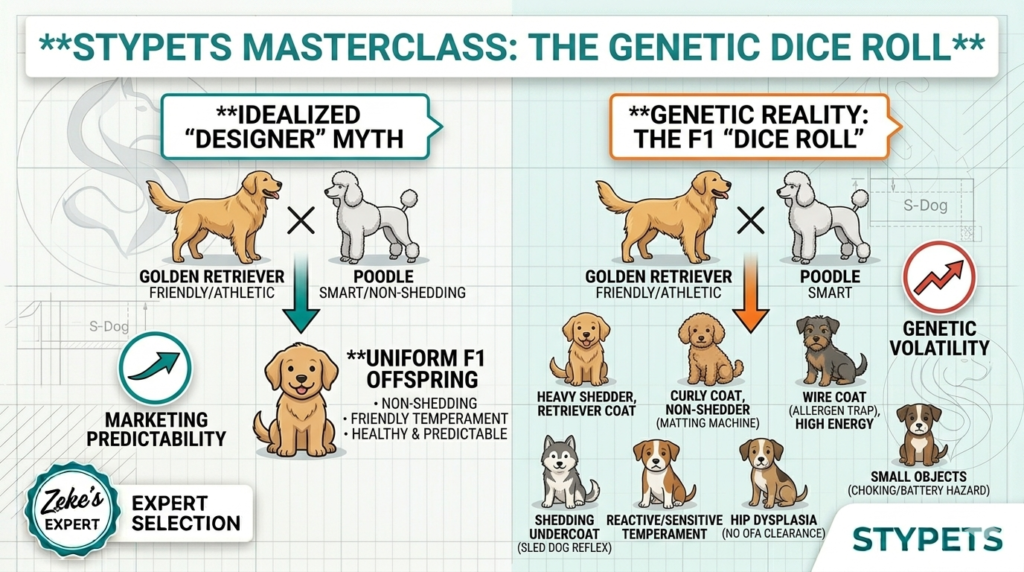
Most prospective owners believe that an F1 cross results in a perfect 50/50 split of traits. They expect the athleticism of a Labrador and the hypoallergenic coat of a Poodle.
The Reality: Genetics follows the laws of probability, not a recipe book. An F1 cross can inherit the Labrador’s heavy-shedding double coat and the Poodle’s sensitive, high-energy temperament. In a single litter of seven puppies, you might find three that don’t shed, two that shed moderately, and two that shed just as much as a standard Golden Retriever. Until you reach the F3 or F4 generation (where crosses are bred back to other crosses), predictability is nearly zero.
2. The Hypoallergenic Fallacy: Dander vs. Fur
The primary driver of the designer dog market is the search for a “safe” dog for allergy sufferers. This has led to the widespread belief that Poodle-mixes are inherently hypoallergenic.
The Science of Saliva and Dander
Human allergies are rarely triggered by the hair itself. The true culprits are Can f 1 and Can f 2 proteins found in a dog’s dander (dead skin) and saliva.
-
The Trap: While a “non-shedding” coat keeps the hair off your sofa, it actually traps the dander against the dog’s skin. If that dog isn’t groomed perfectly, the allergen load increases.
-
The Saliva Factor: No amount of Poodle genetics can eliminate the protein in a dog’s saliva. If your allergy is triggered by licks or “kisses,” a $5,000 Doodle will cause the same reaction as a shelter mutt.
3. The “Hybrid Vigor” Defense: Fact vs. Friction
Breeders of designer dogs frequently cite Heterosis, or “Hybrid Vigor,” as a reason why their dogs are healthier than purebreds.
The Genetic Bottleneck
Hybrid vigor is a real biological phenomenon where crossing two unrelated populations can reduce the expression of recessive genetic diseases. However, this only applies if the parents themselves are genetically diverse and healthy.
The STYPETS Warning: If a breeder crosses a Cavalier King Charles Spaniel (prone to heart mitral valve disease) with a Poodle (also prone to heart issues), the offspring are at higher risk because the same genetic weaknesses are present in both lines. Hybrid vigor is not a magic shield against poor breeding practices. Without OFA (Orthopedic Foundation for Animals) clearances on both parents, you are buying a dog with an unknown expiration date.
4. The Grooming “Tax” and the Matting Crisis
If you choose a designer breed with a curly or “fleece” coat, you are signing up for the most difficult grooming requirement in the canine kingdom.
The “Wire-Fleece” Collision
When you mix a shedding breed (like a Cocker Spaniel) with a non-shedding breed (a Poodle), the dead hair from the Spaniel side falls out but gets trapped by the curls of the Poodle side. This creates mechanical matting that begins at the skin level.
-
The Pain Factor: Mats aren’t just ugly; they pull on the skin like a constant, localized migraine. They trap moisture, leading to “hot spots” and fungal infections.
-
The Pro Maintenance: To avoid a “shave-down,” a designer breed requires a full “line-brushing” (down to the skin) every 48 hours and a professional groom every 6 weeks. This is a financial and time commitment that marketing often fails to mention.
5. Behavioral Volatility: The Temperament Triage
Purebreds were developed for specific jobs: Retrievers retrieve, Shepherds herd, and Terriers hunt. When you cross these working drives, the behavioral results can be volatile.
The “Aussiedoodle” Example
Consider the cross of an Australian Shepherd (a high-drive herding dog) and a Poodle (a high-intelligence water retriever).
-
The Goal: A smart, active family dog.
-
The Risk: A dog with the Poodle’s neuro-sensitivity and the Aussie’s intense “herding nip.” Without professional-grade mental stimulation, these crosses often develop severe separation anxiety and obsessive-compulsive behaviors (like shadow chasing or light lunging).
6. How to Spot a “Greed-er” in the Designer Market
Because these dogs fetch premium prices, the market is flooded with unethical “backyard breeders” and puppy mills. Here is the STYPETS Professional Red Flag List:
-
Pricing by “Rare” Color: Charging extra for “Merle” or “Phantom” coats. In many breeds, the Merle gene is associated with deafness and blindness if not handled by an expert.
-
No Multi-Generational History: If they can’t show you the grandparents or great-grandparents, they haven’t put in the work to stabilize the breed.
-
The “Mini” Trap: “Teacup” or “Mini” versions of large breeds are often created by breeding the “runts” of litters, which frequently carries underlying endocrine or cardiac issues.
-
Guardian Home Overuse: If a breeder has 15 different “doodle” varieties living in other people’s homes, they are a factory, not a caretaker.
Zeke’s Final Word:
“There is nothing wrong with a mixed-breed dog—some of the best companions I’ve ever trained were ‘mutts.’ The issue arises when we pay purebred prices for unpredictable genetics. If you want a designer dog, do it for the right reasons, buy from a breeder who does full orthopedic testing, and be prepared for the grooming brush. Your dog’s health is worth more than a catchy name.” — Zeke