Choosing a dog is one of the most significant lifestyle commitments you will ever make. It is a 10-to-15-year contract that dictates how you spend your mornings, how you plan your vacations, and even the state of your living room furniture. Yet, most people choose their canine companion based on a “love at first sight” moment at a shelter or a beautiful photo in a breed encyclopedia.
As a Dog Care Expert, I see the fallout of these visual-based decisions every week. The most common phrase I hear is: “He’s a great dog, he just has too much energy.”
The truth? The dog doesn’t have “too much” energy. The dog has the exact amount of energy his DNA programmed him to have. The mismatch lies in the owner’s lifestyle. At StyPets, we believe that a “Good Dog” is simply a dog whose biological engine matches the speed of their owner’s life.
1. The Biological Engine: Energy vs. Drive
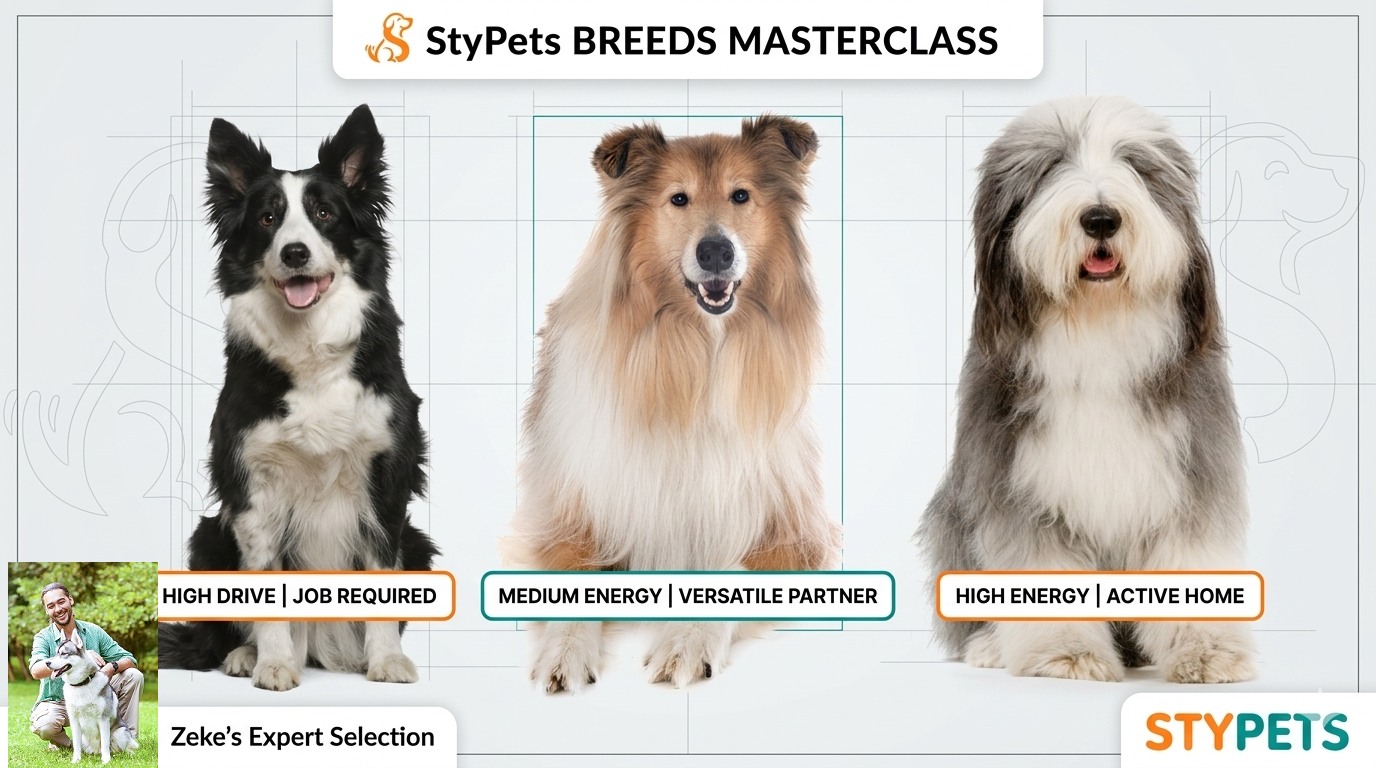
To understand breed compatibility, we first have to speak the language of professional trainers. Most owners use the word “energy” to describe everything from a dog that runs circles to a dog that barks at the mailman. But for an expert view, we must separate Energy from Drive.
What is High Energy?
High energy is physical stamina. Think of a Labrador Retriever or a Vizsla. These dogs have huge “fuel tanks.” They can run for miles, swim for hours, and play fetch until your arm falls off. They are the marathon runners of the dog world.
What is High Drive?
High drive is a psychological need to perform a task. This is the Border Collie or the Belgian Malinois. These dogs don’t just have physical energy; they have an “Internal Employee” that needs to work. If a high-drive dog doesn’t have a job (herding, protecting, or searching), they will experience mental distress that manifests as destructive behavior.
2. The “Space Myth”: Why Your Apartment Doesn’t Matter
“I live in a small apartment, so I need a small, low-energy dog.” This is the single most common lie in the pet industry.
As a Dog Care Expert, let me let you in on a secret: Square footage does not exercise a dog. A dog with a 2-acre backyard will often just sit on the porch waiting for their owner. Exercise happens with the human, not in the yard.
-
The Apartment Paradox: A Great Dane is widely considered one of the best apartment dogs. Why? Because they are low-energy “floor heaters.” Once they have had a 20-minute walk, they park themselves on the sofa and stay there for six hours.
-
The Suburban Nightmare: A Jack Russell Terrier in a 4,000-square-foot house with a massive yard can still be a nightmare if they aren’t mentally engaged. They will dig up the garden, chew the baseboards, and pace the halls.
The Zeke Rule: Your dog’s energy level should match the time you spend outside the house, not the size of the house itself.
3. Categorizing the Engines: Where Does Your Favorite Breed Fall?
To help you navigate the hundreds of recognized breeds, we’ve broken them down into four “Metabolic Zones.”
Zone 1: The High-Octane Workers (The “Life is Work” Group)
-
Breeds: Border Collie, Belgian Malinois, Siberian Husky, Australian Shepherd, Jack Russell Terrier.
-
Requirements: 2+ hours of vigorous physical activity PLUS 1 hour of mental “work” (puzzles, training, or nose-work).
-
Best For: Marathon runners, hikers, and people who want a dog as a “hobby.”
Zone 2: The Active Companions (The “Weekend Warriors”)
-
Breeds: Labrador Retriever, Golden Retriever, Boxer, English Springer Spaniel, Dalmatians.
-
Requirements: 1 to 1.5 hours of daily activity. They love to play and are great for active families, but they have a functional “off switch” indoors.
-
Best For: Families with kids, active suburbanites, and social hikers.
Zone 3: The Moderate Idlers (The “Daily Strollers”)
-
Breeds: Cavalier King Charles Spaniel, Poodle (Standard/Mini), Boston Terrier, Greyhound.
-
Requirements: 30 to 60 minutes of walking. They enjoy being active but are just as happy to nap while you work from home.
-
Best For: Urban professionals and first-time owners.
Zone 4: The Low-Power Sleepers (The “Professional Nappers”)
-
Breeds: Bulldog (English/French), Basset Hound, Saint Bernard, Great Dane, Chow Chow.
-
Requirements: Two short “sniff-ari” walks a day. They are prone to overheating and prefer air conditioning over athletics.
-
Best For: Homebodies, seniors, and busy professionals who want a calm presence.

4. The “Lifestyle Audit”: A Brutal Reality Check
At StyPets, we want you to be happy with your dog on a rainy Tuesday morning in November, not just on a sunny Saturday. Answer these three questions honestly before you choose:
Question A: What do you do at 6:00 PM?
If you walk through the door and immediately want to hit the gym or go for a jog, a Zone 1 or 2 dog is your soulmate. If your first move is to order takeout and open Netflix, a Zone 1 dog will make you miserable.
Question B: How much do you value your “Stuff”?
Under-exercised high-energy dogs are “creative.” They find ways to entertain themselves by deconstructing your remote controls, shoes, and pillows. If you are a minimalist who loves a pristine home, look toward Zone 3 or 4.
Question C: Are you a “Trainer” or a “Pet Parent”?
High-drive breeds require a leader. They need consistent, daily training to keep their brains sharp. If you just want a “buddy” to hang out with without having to do “drills,” avoid the herding and working groups.
5. The “Energy Leak”: Signs of a Mismatch
How do you know if your current dog’s energy level is higher than your lifestyle can handle? Look for these “Energy Leaks”:
-
Destructive Chewing: Especially focusing on exit points (windows/doors).
-
Demand Barking: Your dog barks at you the moment you sit down.
-
Hyper-Arousal: The dog can’t settle down even after a walk.
-
“Zoomies” at Night: A frantic burst of energy at 10 PM is a sign that the “fuel tank” wasn’t emptied during the day.
6. Zeke’s Expert Recommendation: The “Greyhound Curve”
If you want a large, impressive dog but live a low-energy lifestyle, look at the Greyhound. Known as the “45-mph Couch Potato,” they are the ultimate “cheat code” in breed selection. They satisfy the “big dog” aesthetic while having the energy level of a senior Pug.
Conversely, if you want a small dog that can hike for 10 miles, look at the Papillon or the Cocker Spaniel. Don’t let the “pretty” looks fool you; these are athletes in small packages.
7. Conclusion: Choosing for the Life You Have
The most successful dog-owner relationships are built on metabolic compatibility. When you choose a breed that matches your natural rhythm, the “work” of owning a dog disappears. Instead of a chore, exercise becomes a shared joy. Instead of a source of stress, your dog becomes your greatest source of relaxation.
Before you fall in love with a face, fall in love with a lifestyle. Your future self (and your drywall) will thank you.
The STYPETS Expert Series
-
Training: Stop Leash Pulling: The 3-Step Protocol
-
Adoption: The 3-3-3 Rule for Rescue Success