
You lock your front door, step toward the elevator, and the countdown begins. Within minutes, your dog is pacing, panting, or howling—trapped in the agonising cycle of separation anxiety. Most owners try to mask this panic by leaving a television on or playing a random internet playlist. However, basic background noise is not a biological solution. To truly soothe a panicked canine nervous system, you must understand dog calming music science and engineer a precise, data-driven bio-acoustic environment.
At STYPETS, we don’t look at sound as mere entertainment for pets. We analyze sound waves as neurological triggers that can either escalate or de-escalate a dog’s internal stress response. Leaving a generic audio track playing can actually spike hyper-vigilance if it contains hidden high-frequency triggers. This masterclass provides a comprehensive technical audit of bio-acoustics, giving you an actionable blueprint to implement dog calming music science and reverse isolation distress at the cellular level.
1. The Neurological Auditory Base: How Canine Lungs and Ears Process Sound
To harness the power of dog calming music science, we must first look at the anatomical differences between human and canine auditory systems. A dog’s hearing infrastructure is a hyper-sensitive tracking system.
Frequency Range and Entrainment
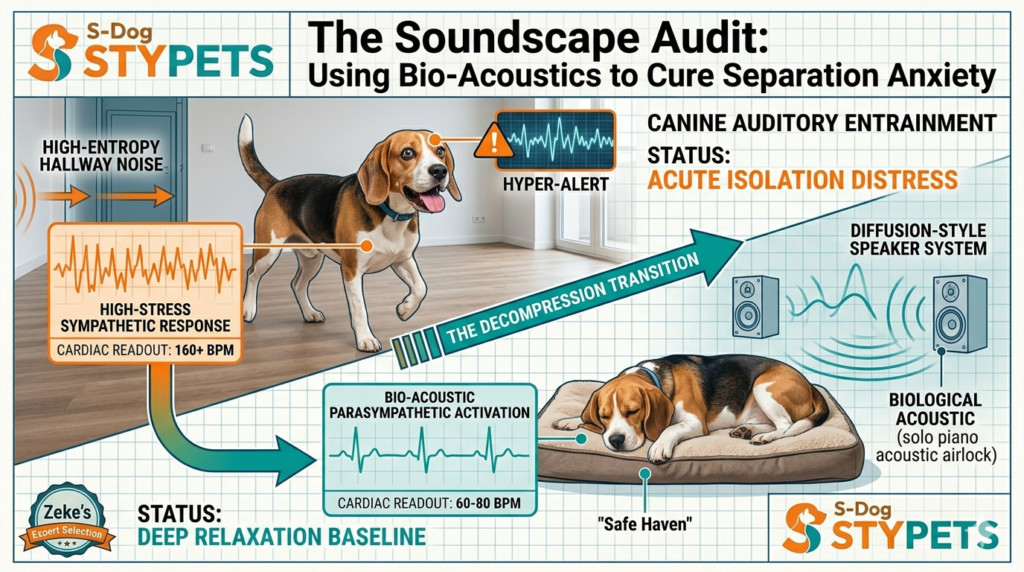
Dogs hear frequencies up to $45,000\text{ Hz}$, compared to the human limit of $20,000\text{ Hz}$. This means your home’s electronics, appliances, and passing street traffic create a constant, high-frequency hum that you cannot perceive, but your isolated dog cannot ignore.
-
Auditory Entrainment: This is the biological process where mammalian heart rates and brainwaves naturally synchronize with external rhythmic tempos.
-
The Cardiac Target: By introducing specific bio-acoustic arrangements, we can force a high-stressed, tachycardic heart rate ($120\text{–}160\text{ BPM}$) to down-regulate toward a resting, parasympathetic baseline ($60\text{–}80\text{ BPM}$).
2. The Anatomy of Bio-Acoustics: 3 Pillars of Dog Calming Music Science
A standard pop song or television broadcast has too much acoustic entropy (unpredictability) for an anxious dog. According to documented dog calming music science, effective therapeutic canine audio must be engineered around three rigid pillars:
Pillar 1 — Structural Simplicity and Minimal Instrumentation
Complex arrangements featuring multiple instruments, heavy percussion, or sudden vocal shifts trigger alert states. The canine brain is constantly auditing sound for potential threats.
-
The Standard: True therapeutic music relies on single-instrument arrangements, primarily solo piano or classical harp. The clean, unclustered wave patterns allow the nervous system to relax its scanning mechanism.
Pillar 2 — The Physiological Tempo Baseline
The tempo of the audio must actively mirror a calm dog’s resting heart rate. Fast-paced tracks elevate neurological alertness.
-
The Standard: Audio tracks must be arranged at precisely $50\text{ to }60\text{ BPM}$ (Beats Per Minute). This low-tempo structure leverages auditory entrainment, smoothly pulling the dog’s internal cardiac rhythm down into a deep, restful state.
Pillar 3 — Frequency Modulation and Psychoacoustic Grounding
High-pitched instruments like flutes or violins can inadvertently mimic prey squeaks or distress cries, causing hyper-arousal.
-
The Standard: Dog calming music science utilizes lower-register frequencies. Rich, warm tones found in triplet-rhythm arrangements provide a grounding effect that directly stimulates the vagus nerve, signaling safety to the brain.
3. The 4-Step Soundscape Engineering Protocol
Simply turning on a speaker as you walk out the door will fail. If the music only plays when you leave, the sound itself becomes a “Predictive Trigger” for panic. Follow this 4-step deployment protocol to properly implement a premium Dog Care soundscape.
Step 1: Baseline Conditioning (Days 1–7)
You must pair the therapeutic audio with high-value, low-stress experiences while you are actively at home.
-
Action: Play your chosen scientifically engineered canine playlist during regular feeding times, grooming sessions, or when your dog is already resting on their “Safe Haven” mat.
-
The Goal: Build a positive, safe neurological association with the acoustic frequency before using it during isolation.
Step 2: The Acoustic Masking Audit
Before deploying your audio, you must identify and mask external environmental sounds that puncture the home’s boundary line.
-
Action: Measure the decibel levels near your front door or windows. Place your primary sound system between your dog’s resting area and the main source of external noise (like a shared apartment hallway).
-
The Goal: Use the music as a defensive acoustic shield to prevent startle responses caused by sudden outside noises.
Step 3: Micro-Departure Testing (Days 8–14)
Introduce the soundscape into your active separation training loop.
-
Action: Activate the audio track 15 minutes before you begin your departure cues (such as grabbing your keys or putting on shoes). Step outside the door for short, controlled durations ranging from 2 to 10 minutes.
-
The Metric: Monitor your dog via a remote camera. You should observe them moving to their bed and settling within 180 seconds of your departure.
Step 4: The 3-Hour Continuous Decompression
For long-term isolation management, understand that a dog’s stress peak typically occurs within the first 30 minutes of being left alone.
-
Action: Program your sound system to run continuously for at least 3 hours. Do not use repeating loop tracks that are shorter than 60 minutes, as the canine brain can detect rapid acoustic loops, which breaks the decompression cycle.
4. Auditing Your Tech: White Noise vs. Pink Noise vs. Classical Music
Many owners ask if they can simply use a standard white noise machine instead of diving into dog calming music science. Let’s perform a technical material audit on these sound profiles.
White Noise: The Static Wall
White noise distributes energy equally across all audible frequencies. While it is effective at masking sudden spikes in sound, the constant, unvarying high-frequency hiss can cause mild sensory fatigue in dogs over extended periods.
Pink Noise: The Biological Curve
Pink noise carries deeper, richer sound waves because the power decreases as the frequency increases. This creates a sound profile that mimics natural systems, such as rushing waterfalls or wind through trees. It is highly effective for long-term acoustic grounding in professional Dog Care.
Specially Arranged Classical: The Ultimate Sedative
True dog calming music science outperforms basic noise profiles. Research demonstrates that while standard classical music (like Mozart or Beethoven) successfully reduces canine cortisol levels initially, dogs can become habituated to it after 7 days. You must utilize specifically re-arranged, micro-designed canine compositions for sustained behavioral recovery.
5. 3 Lethal Soundscape Flaws to Eliminate Immediately
When auditing your home’s acoustic environment, eliminate these three dangerous mistakes that undermine your separation anxiety protocols:
-
Flaw #1: Leaving the Television On. Commercial broadcasts feature highly unpredictable volume spikes, sirens, barking dogs, and sudden commercial breaks. This high-entropy audio environment keeps your dog’s adrenal glands firing in an attempt to process the changing data.
-
Flaw #2: Excessive Speaker Volume. Because a dog’s hearing is vastly superior to yours, blasting music to drown out street noise can cause physical ear discomfort and elevate panic. Keep the volume at a moderate, conversational level ($50\text{–}60\text{ dB}$).
-
Flaw #3: Relying on Streaming Ads. Free streaming accounts insert loud, energetic commercial advertisements between tracks. A high-value calming track followed by a loud, high-tempo advertisement causes immediate trigger stacking, completely destroying hours of decompression.
FAQ: Advanced Questions on Dog Calming Music Science
1. Does dog calming music science actually work, or is it a marketing myth?
It is heavily backed by peer-reviewed veterinary science. Studies show that playing specifically arranged bio-acoustic music leads to measurable drops in heart rate, decreased pacing, and increased resting behaviors in kenneled canines compared to ambient noise.
2. Can I leave the music playing for 8 hours straight while I’m at work?
Yes, but it is highly recommended to use a system that allows you to schedule or fade the music out after 3 or 4 hours. Once a dog enters a deep sleep cycle, maintaining a totally silent, low-entropy environment is perfectly acceptable.
3. Why does my dog howl when I play classical music?
Howling is a deeply rooted communication reflex. Certain sustained wind instruments or high-string frequencies can mimic the pitch of a distant pack call. If your dog howls, immediately switch to solo piano or pink noise tracks to bypass that specific behavioral circuit.
4. Is it better to use a Bluetooth speaker or a full home audio system?
A full home system or strategically split speakers are preferred. Point source audio from a single small speaker can cause a dog to hyper-focus on that one spot. Creating a diffuse, multi-directional sound field throughout the living area provides better psychological comfort.
5. Should I use a specific soundscape for a newly adopted rescue dog?
Absolutely. A newly adopted dog has highly volatile cortisol levels. Implementing dog calming music science during their initial 90-day decompression phase provides a steady acoustic anchor that helps prevent separation anxiety from developing.
6. Can I combine calming music with pheromone diffusers?
Yes. Combining targeted bio-acoustics with synthetic canine appeasing pheromones (DAP) creates a highly effective multi-sensory safety zone, accelerating the down-regulation of their sympathetic nervous system.
7. Can I use human meditation music for my dog?
Some human meditation tracks feature simple arrangements that work well. However, many include chimes, flutes, or synthetic sub-bass frequencies that can alert or confuse a dog. Relying on tracks explicitly calculated for canine physiology is always the safest option.
Conclusion: The Automated Auditory Airlock
Treating separation anxiety requires a thorough audit of every environmental variable. The sounds filling your home while you are away are either actively soothing your dog’s brain or keeping them trapped in a cycle of panic and hyper-vigilance. By leveraging dog calming music science and applying a structured deployment protocol, you transform your entryway into a secure behavioral airlock.
Do not allow your home to become a sensory vacuum of stressful external noises. Control the frequency, engineer the tempo, and provide your companion with the invisible biological protection they need to feel entirely safe in your absence.
- School of Veterinary Medicine at the University of Glasgow (Pioneering studies on canine musical preferences).