In the modern canine marketplace, the “Designer Dog” has become the ultimate consumer commodity. From Labradoodles to Pomskies, these hybrids are marketed as the perfect “genetic compromise”—hypoallergenic, healthy, and temperamentally balanced. However, at STYPETS, we don’t buy into marketing narratives. We perform a Genetic Audit.
The reality of crossbreeding is not a deliberate selection of the best traits; it is a Genetic Lottery. When you mix two distinct breeds with specialized evolutionary blueprints, you aren’t guaranteed a “best of both worlds” outcome. Instead, you are introducing a chaotic variable into your dog’s biological foundation. This Masterclass decodes the science of hybridization and provides a professional blueprint for auditing the risks of the designer dog phenomenon.
1. The Mendelian Trap: Why Hybrids Aren’t “Half and Half”
The primary marketing myth of the designer dog is that a 50/50 cross results in a 50/50 split of traits. If you cross a Poodle (hypoallergenic/intelligent) with a Golden Retriever (friendly/high-shedding), the consumer expects a non-shedding, friendly companion.
The Law of Independent Assortment
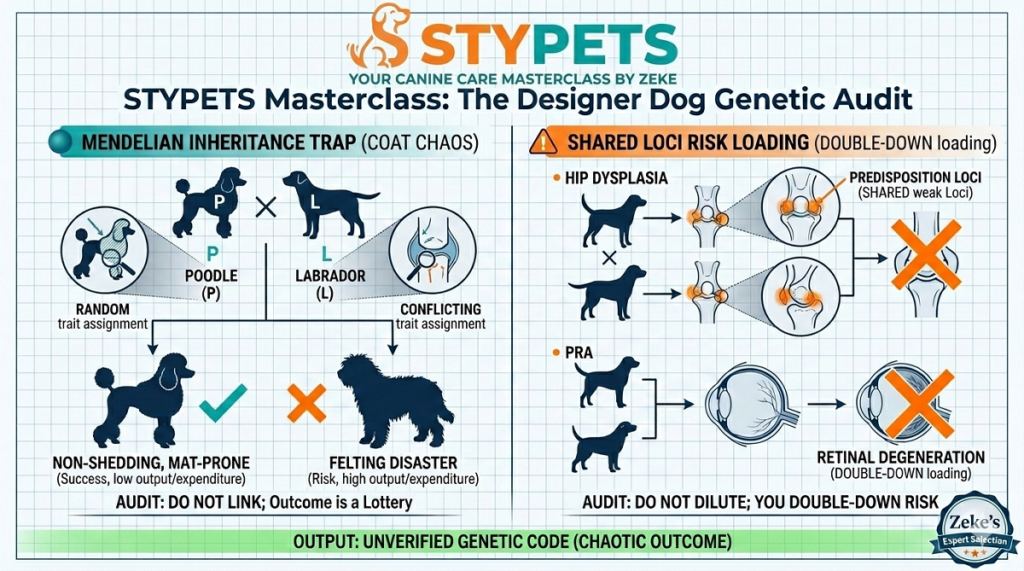
Canine genetics follow Mendelian laws, specifically the law of independent assortment. Traits like coat type, hip morphology, and prey drive are not “linked” in a package deal.
-
The Chaos Variable: You may end up with a dog that has the high-shedding undercoat of a Retriever trapped beneath the tight, curly guard hairs of a Poodle. This results in “The Felting Disaster”—a coat that mats to the skin within 48 hours, creating chronic dermatological stress.
-
The Audit: You cannot predict the phenotype (physical appearance) or the genotype (genetic makeup) of an F1 (first generation) cross. You are essentially rolling the dice on a biological merger.
2. The Hybrid Vigor Myth vs. The Double-Down Risk
“Hybrid Vigor” (heterosis) is the scientific term for the improved biological function often seen in outbred populations. While this is a real phenomenon, it is widely misused in the designer dog industry to excuse a lack of health testing.
Double-Down Genetic Loading
Hybrid vigor only works if the two parent breeds do not share the same genetic weaknesses. Unfortunately, many popular designer crosses involve breeds that share high-risk “Loci” (locations on a chromosome).
-
The Labradoodle Example: Both Labradors and Poodles are genetically predisposed to Hip Dysplasia and Progressive Retinal Atrophy (PRA).
-
The Audit: If you cross two breeds that share the same structural or ocular weaknesses, you aren’t “diluting” the bad genes; you are doubling down on them. A hybrid dog from untested parents is at a higher risk than a purebred dog from a “Cleared” lineage.
3. Neurological Friction: Temperament Mismatch
At STYPETS, we view a dog’s mind as a Processor. Different breeds have different “operating systems.” When you cross a high-drive working breed with a low-drive companion breed, you create Neurological Friction.
The “Aussie-Doodle” Conflict
Consider the Australian Shepherd (a high-intensity herding dog designed for 12 hours of motion) crossed with a Poodle (a high-intelligence water retriever).
-
The Result: You often get a dog with the “Herding Eye” and “Nipping Instinct” of the Shepherd but without the “Off-Switch” or the specific job to focus that energy.
-
The Behavioral Breach: This leads to a dog that is “hyper-responsive” to environmental stimuli—barking at shadows, nipping at children’s heels, and living in a constant state of high cortisol. This is not a “bad dog”; it is a dog with a mismatched neurological blueprint.
4. The Hypoallergenic Fallacy
The “hypoallergenic” label is the most successful marketing lie in canine history. No dog is 100% hypoallergenic because the primary allergens are not the hair—they are the Can f 1 protein found in dander (skin cells) and saliva.
The Dander Audit
A curly-coated hybrid may shed less hair into the environment, but it still produces dander. In fact, because these dogs require intensive grooming, the dander is often trapped against the skin, becoming a concentrated allergen source.
-
The Blueprint: Before investing in a designer breed for allergy reasons, you must perform a Saliva Test. Spending 30 minutes with the specific puppy to check for a biological reaction is the only way to audit this variable.
5. The STYPETS Designer Dog Audit Checklist
If you are considering a designer hybrid, you must move past the “Cute Factor” and execute a technical audit of the breeder. A professional breeder of hybrids should be doing more work than a purebred breeder, not less.
| Audit Point | Requirement | Why It Matters |
| OFA/PennHIP | Both parents must have “Excellent” or “Good” scores. | Prevents structural mechanical failure. |
| Genetic Panel | Clear tests for PRA, vWD, and DM for both breeds. | Prevents “Double-Down” genetic diseases. |
| F2+ Generation | The breeder should be working on F2 or F3 (multigen) dogs. | Increases predictability of coat and temperament. |
| Temperament Match | A “Volhard” or “Puppy Aptitude” test must be provided. | Ensures the dog’s “Processor” fits your lifestyle. |
6. Engineering the Future: Purebred vs. Purpose-Bred
The “Designer Dog” phenomenon is often a search for a dog that fits a modern, urban lifestyle. While the marketing is flawed, the desire for a healthier, more balanced dog is valid.
The Professional Pivot
Instead of looking for a “Doodle” as a status symbol, we recommend looking for Purpose-Bred dogs where the breeder can explain the why behind the cross.
-
The Audit: Is this cross being made to improve health, or is it being made because “Doodles” sell for $4,000? If the primary driver is profit, the biological audit has been ignored.