Stop Leash Pulling: Zeke’s Masterclass on Loose-Leash Walking
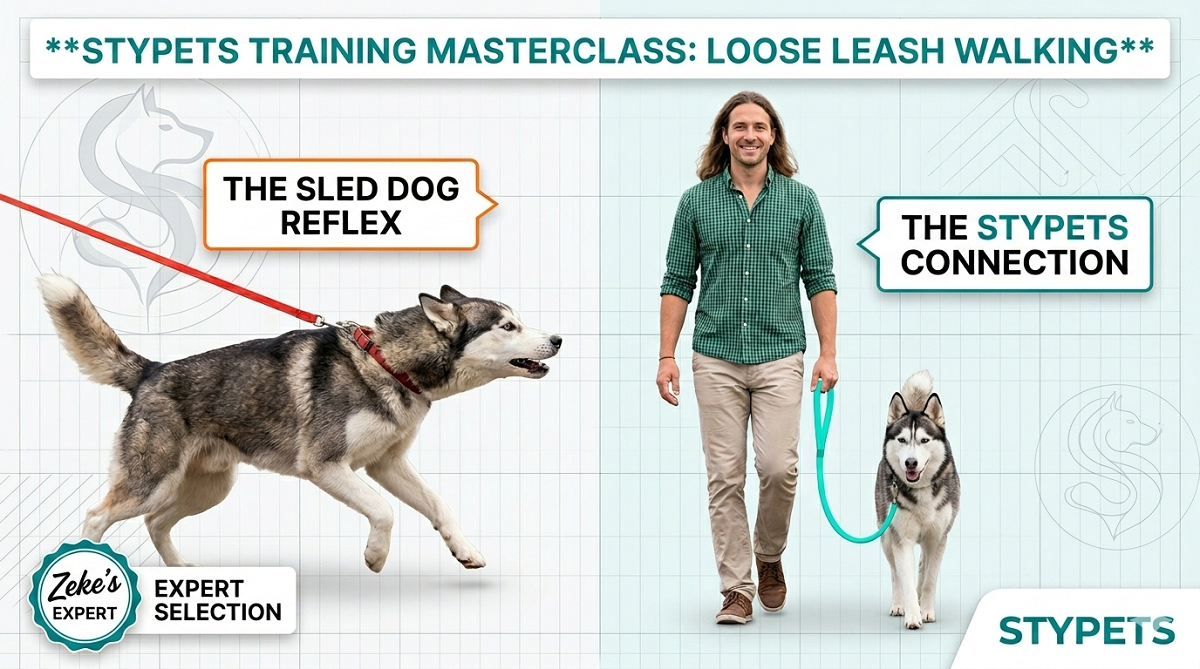
We have all been there. You step out of your front door, heart full of hope for a peaceful, sunset stroll through the neighborhood. Within thirty seconds, your shoulder is being wrenched from its socket, your dog is wheezing like a steam engine at the end of a taut nylon tether, and you are effectively being water-skied across the pavement. It is embarrassing, it is physically draining, and for the dog, it is a high-stress way to experience the world.
Most owners respond to this by pulling back harder. This creates a literal tug-of-war where the human loses and the dog’s neck takes the brunt of the force. At STYPETS, we don’t believe in training through physical dominance or brute strength. We train through engagement. Loose-leash walking is not just a “trick”; it is the ultimate expression of your relationship with your dog. It is the moment your dog decides that the person on the other end of the leash is more interesting than the squirrel, the neighbor’s trash, or the scent of a passing poodle.
In this STYPETS Masterclass, I am going to dismantle the biological “Opposition Reflex,” audit your gear with surgical precision, and walk you through a proven training protocol that will turn your sled dog into a synchronized partner.
1. The Biology of the Pull: Understanding Thigmotaxis
Before we can fix the behavior, we must understand the physics of the canine body. Why is pulling their default setting? It isn’t because they want to be “alpha,” and it isn’t because they are trying to annoy you. It is a combination of biology and unintended reinforcement.
The Speed Mismatch
The average human walking speed is approximately 5 km/h. The average dog’s comfortable “trot”—their most efficient gait—is closer to 8-10 km/h. From the moment you clip that leash on, you are moving in slow motion compared to your dog. They aren’t being “bad”; they are simply trying to reach their natural cruising speed.
The Opposition Reflex
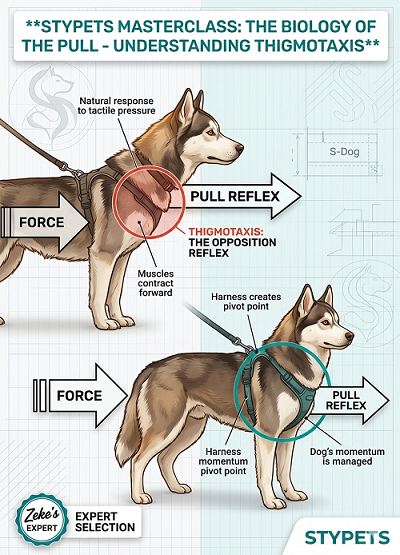
Dogs possess a biological hard-wiring called Thigmotaxis, commonly known as the Opposition Reflex. If you apply pressure to a dog’s chest or neck, their natural, involuntary instinct is to lean forward and push into that pressure. This is why sled dogs are so effective; the harness provides the very pressure their brain needs to signal “dig in and pull.” When you tug the leash back, you are literally telling your dog’s nervous system to accelerate.
The Reinforcement Loop
The biggest reason dogs pull? Because it works. If your dog pulls toward a fire hydrant and you continue walking—even if you are complaining or pulling back—the dog has successfully reached the hydrant. They have learned a simple equation: Pressure = Progress. To fix this, we must flip the script entirely and ensure that pressure results in a total lack of progress.
2. The STYPETS Gear Audit: Tools for Success
If you are using the wrong equipment, you are fighting against the laws of physics. As a Dog Training Expert, I see many owners accidentally sabotaging their progress with “management” tools that actually encourage the pull.
Tools to Reconsider
-
Retractable Leashes: These are the enemy of loose-leash walking. They provide constant, slight tension on the collar to keep the line from sagging. This teaches the dog that a tight leash is the “normal” state of existence.
-
Back-Clip Harnesses: Unless you are actually asking your dog to pull a cart or a sled, avoid these for training. By clipping the leash to the top of the ribcage, you are giving the dog the maximum mechanical advantage to drag you forward.
Recommended Equipment
-
The 1.8-meter (6-foot) Fixed Leash: I prefer leather or Biothane. They have a specific weight that allows the dog to “feel” the slack. A heavier leash provides better tactile feedback to the dog when they are in the correct position.
-
The Front-Clip Harness: This is the game-changer. When the leash is clipped to the center of the dog’s chest, any forward surge causes the dog’s body to pivot back toward you. It removes their mechanical advantage without causing pain or restricting their natural movement.
3. The Pre-Walk Routine: Managing the Energy Tank
You cannot teach a dog to walk calmly if they are vibrating with pent-up physical energy. If your dog has been inside for eight hours while you were at work, their “Energy Tank” is overflowing. Expecting them to walk at a slow human pace is like asking a professional sprinter to walk through a grocery store behind a slow-moving cart.
Zeke’s Expert Tip: Before the training walk, give your dog a 10-minute “Decompression Session.” Play a high-intensity game of tug or fetch in the yard, or do some indoor nose-work. Empty the physical tank first so you can work on the mental connection.
If you are working with a high-energy breed, refer to our Breeds Masterclass to see if your dog’s specific metabolic drive requires more intense pre-work. A dog that has already burned off their initial “zoomies” is much more capable of focusing on your cues.
4. The Engagement Protocol: A 3-Step Method
We are going to move away from the idea of “The Walk” and move toward “Engagement Games.” Do not try this for the first time on a busy street. Start in your hallway, then your backyard, then a quiet cul-de-sac.
Step 1: The Stop-and-Go Method
This is about teaching the dog that Pressure = The End of the Fun. The moment the leash becomes taut—even by a centimeter—you stop walking immediately. Do not jerk the leash; do not say “No.” Just become a literal statue.
Your dog will eventually stop, wonder why the forward motion has ceased, and look back at you or step back toward you to investigate. The instant the leash goes slack, say “Yes!” and move forward. Forward motion is the primary reward here. You are teaching them that a loose leash is the only “key” that unlocks the world.
Step 2: The Change of Direction
If your dog is hyper-focused on a distraction ahead, they won’t care that you have stopped. You need to become more relevant than the environment. Just before the leash goes tight, say “This way!” in a cheery voice and turn 180 degrees, walking in the opposite direction.
The dog has to scramble to catch up with you. When they reach your side, deliver a high-value treat. You are teaching the dog that they need to keep one eye on you at all times because you might change direction at any moment. This builds a habit of checking in with the handler rather than scanning the horizon for distractions.
Step 3: Rewarding the Heel Position
Imagine there is a “Pay Zone” floating right next to your left leg. While walking on a loose leash, continuously drop small, pea-sized pieces of high-quality protein (like boiled chicken or freeze-dried liver) right next to your pant seam.
You want the dog to think that staying by your side is the most rewarding place to be. Over time, you reduce the frequency of the treats, but the dog remains in the zone out of habit and anticipation.
5. The “Sniff-ari” vs. The Focused Walk
One of the biggest mistakes owners make is expecting a perfect heel for the entire duration of a 30-minute walk. This is mentally exhausting for a dog. At STYPETS, we recommend the 80/20 Rule.
-
80% Sniff-ari: Let the dog have a long leash. Let them sniff the bushes. Sniffing lowers a dog’s heart rate and provides vital mental stimulation. This is their “social media” time where they catch up on the neighborhood news.
-
20% Focused Training: Use a specific cue, like “Let’s Work,” to signal that for the next two blocks, we are in a focused heel.
This clear distinction prevents the dog from getting frustrated. They know that if they give you five minutes of focus, they will be rewarded with five minutes of freedom to sniff.
6. Troubleshooting: The Reactive Puller
What if your dog isn’t pulling to get to a smell, but is pulling to get to (or away from) another dog? This is Leash Reactivity, and it requires a different approach. Every dog has a “Threshold”—the distance at which they can see a trigger without losing their mind.
If your dog starts lunging at a dog 10 meters away, your threshold is 15 meters. Work at the distance where your dog can see the other dog but still take a treat from you. Gradually, over weeks of training, you will be able to decrease that distance while maintaining a loose leash. Never punish a reactive dog for pulling; you will only confirm their fear that other dogs cause bad things to happen.
7. Conclusion: The Leash is a Telephone Wire
At the end of the day, the leash is a communication tool, not a towing cable. If you are always “shouting” through the leash by pulling and jerking, your dog will eventually stop listening and just try to “shout” back harder.
When you master the loose-leash walk, you aren’t just saving your shoulder; you are building a partnership based on mutual focus. You are telling your dog, “I see the world is exciting, but we are experiencing it together.” Consistency is the only currency dogs understand. If you let them pull you to the park “just this once,” you have taught them that pulling sometimes works—and they will keep trying it.
Zeke’s Final Word: “A perfect walk isn’t measured in miles; it’s measured in eye contact. If your dog is looking at you, they aren’t pulling away from you.” — Zeke
Medical & Safety Disclaimer: I am a Dog Care Expert, but I am not a certified veterinary behaviorist. These techniques are for educational purposes. If your dog’s pulling is accompanied by lunging, redirected biting, or extreme fear-based aggression, please consult a professional positive-reinforcement trainer for an in-person assessment. Never use equipment that causes pain or restricts breathing.
The STYPETS Expert Series
-
Training: Stop Leash Pulling: The 3-Step Protocol
-
Adoption: The 3-3-3 Rule for Rescue Success