In the world of professional canine care, there is a distinct difference between “obedience” and “reliability.” Most dogs can perform a sit-stay in a quiet kitchen for a piece of kibble. However, the true test of your training architecture occurs the moment a leash snaps, a gate is left ajar, or a deer darts across a high-speed roadway. In these high-stakes intervals, you don’t need a command; you need a Bulletproof Emergency Recall.
An emergency recall is a specialized, high-intensity vocal or auditory signal that functions as a “fail-safe” for your dog’s life. It is the ultimate insurance policy. Engineering this bond requires a move away from casual pet ownership and into the realm of behavioral hazard analysis.
1. The Anatomy of a Fail-Safe: Why Standard Commands Fail
Standard recall commands like “Come” or “Here” are often “poisoned” by daily life. We use them to end playtime, to start a bath, or we repeat them fruitlessly while a dog is sniffing a bush, effectively training the dog that the command is optional.
An Emergency Recall is different because:
-
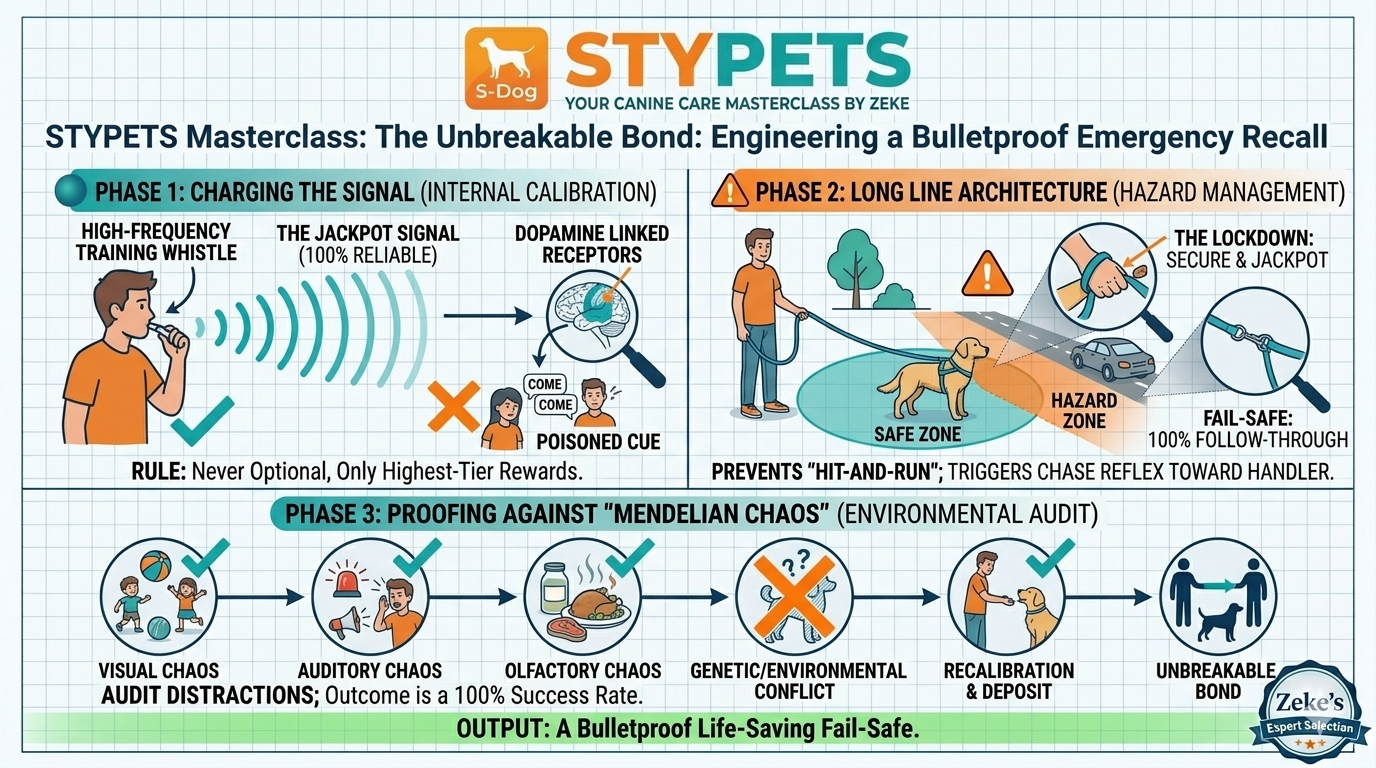
It is never optional: It is built on a 100% success rate protocol.
-
It is never “poisoned”: It is only associated with the highest-tier rewards.
-
It is distinct: It uses a sound or word never heard in casual conversation.
2. The Behavioral Economics of Motivation
To engineer a bulletproof return, we must analyze the Bank Account Theory of training. Every interaction is either a deposit or a withdrawal. A dog choosing to ignore a squirrel and return to you is making a massive withdrawal of their own natural instinct. To facilitate this, your “deposit” (the reward) must exceed the value of the distraction.
In this masterclass, we move beyond standard treats. For the Emergency Recall, we utilize “Level 10” rewards: fresh steak, squeeze-cheese, or high-intensity play—items the dog never receives under normal circumstances.
3. Phase 1: The “Charging” Protocol (Internal Calibration)
Before testing this in the field, you must “charge” the signal. Whether you choose a high-frequency whistle or a unique word like “TERMINUS!”, the sound must initially mean only one thing: The Jackpot.
-
Step A: Stand next to your dog in a zero-distraction environment.
-
Step B: Deploy the signal.
-
Step C: Immediately deliver a “jackpot” reward (multiple treats in succession).
-
Step D: Repeat 5–10 times daily for one week without asking the dog to “come” from a distance. You are simply wiring the brain to associate the sound with dopamine.
4. Phase 2: The Long Line Architecture (Hazard Management)
Transitioning to the outdoors requires a Long Line (15–30 feet) to act as your safety net. This tool prevents the dog from “winning” the game of self-reward by ignoring you.
-
Safety Netting: Allow the dog to reach the end of the line.
-
The Deployment: Signal the emergency command once.
-
The Response: If the dog turns, use “backward movement” (running away from the dog) to trigger their natural chase instinct.
-
The Lockdown: When the dog reaches you, gently take hold of their collar before rewarding. This prevents the “hit-and-run” maneuver where a dog grabs a treat and bolts back into the hazard zone.
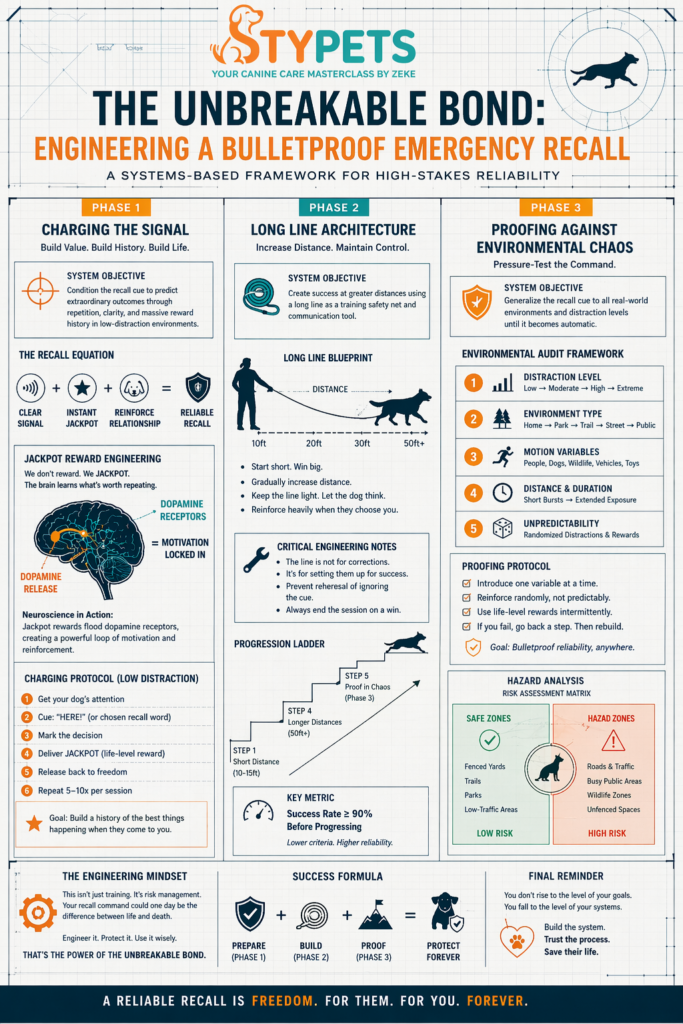
5. Phase 3: Proofing Against “Mendelian Chaos”
Just as we audit genetic risks in designer breeds, we must audit environmental risks. “Proofing” is the process of testing the recall against increasingly chaotic variables.
-
Visual Distractions: Rolling balls, running children, or other dogs.
-
Auditory Distractions: Sirens, shouting, or high-pitched toys.
-
Olfactory Distractions: Fresh scents or discarded food.
If your dog fails at any stage, you have encountered a “Genetic-Environment Conflict.” You must move back to a lower-stakes environment and increase the “Value Deposit” before attempting that level of distraction again.
6. The Emergency Whistle: The Professional’s Choice
While a vocal command is good, a high-frequency whistle is superior for a bulletproof recall. Human voices fluctuate with emotion; if you are panicked because your dog is running toward a car, your voice will reflect that fear. A dog may perceive your panicked “COME!” as a threat or a bark, causing them to move away.
A whistle is emotionally neutral. It pierces through wind, traffic noise, and distance in a way the human vocal cord cannot.
7. Correcting the “Catch-Me-If-You-Can” Loop
If your dog is currently loose and ignoring you, the worst thing you can do is move toward them. This confirms the “Chase Game”. To break this loop:
-
Drop to the ground: Many dogs will return out of curiosity.
-
Run in the opposite direction: Trigger the chase reflex toward you.
-
Use a “Neutral Noise”: Clap or whistle—do not use your poisoned “Come” command.
8. Maintenance: Keeping the Fail-Safe Active
A bulletproof recall is not a “set it and forget it” tool. It requires monthly maintenance. Once a month, “re-charge” the signal by calling your dog in a safe area and providing a jackpot that reminds them why you are the most valuable asset in their life.