
In the professional audit of canine ownership, the most common point of failure is not a lack of love, but a Metabolic Mismatch. Most prospective owners choose a breed based on aesthetic appeal or historical sentiment. However, at STYPETS, we view a dog not as an ornament, but as a kinetic system with specific energy requirements and recovery cycles.
If you are a “weekend warrior” who expects a high-drive Malinois to remain dormant in a 700-square-foot apartment from Monday to Friday, you are ignoring the biological reality of the breed. This Metabolic Matching guide is designed to help you audit your own “Kinetic Baseline” and find the canine counterpart that fits your lifestyle blueprint.
1. Defining the Kinetic Baseline
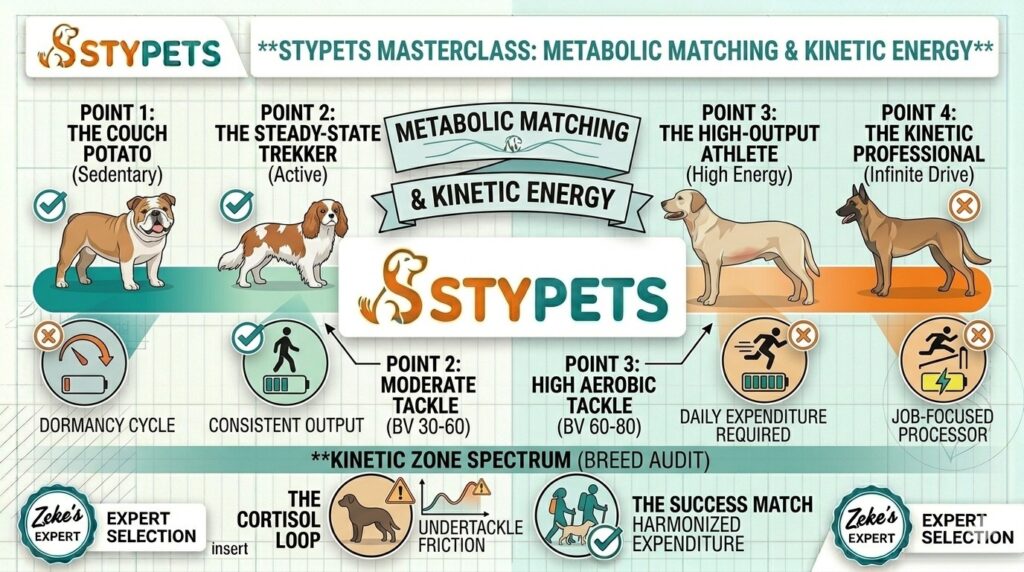
Before choosing a breed, you must perform a professional audit of your own daily energy expenditure. We categorize human lifestyles into four Kinetic Zones:
-
Zone 1: The Low-Impact Specialist (Sedentary/Moderate): Your primary activity is a 20-minute neighborhood stroll. You prioritize a calm home environment and intellectual stimulation over physical intensity.
-
Zone 2: The Steady-State Trekker (Active): You are consistent. You enjoy 45–60 minutes of daily walking or light hiking, but you don’t engage in high-intensity sprints or “job-focused” activities.
-
Zone 3: The High-Output Athlete (High Energy): You are an runner, an avid hiker, or someone who spends 2+ hours daily in physical motion. You need a partner who can keep pace without metabolic exhaustion.
-
Zone 4: The Kinetic Professional (Working/Sport): You aren’t just looking for a companion; you are looking for a teammate for agility, search and rescue, or high-level sport. This requires a dog with “Infinite Drive.”
2. The Three Pillars of Canine Energy
Every breed’s metabolism is built on three pillars. When these pillars are ignored, the “excess energy” manifests as destructive behavior, anxiety, and obsessive-compulsive disorders (like tail chasing or light snapping).
I. Physical Stamina (The “Gas Tank”)
This is the breed’s ability to perform sustained physical work. Sighthounds (like Greyhounds) have a “Small Tank, High Speed” metabolism—they are “45 mph couch potatoes.” Pointers and Setters have “Large Tank, Moderate Speed” systems, designed to hunt for 8 hours straight.
II. Intellectual Intensity (The “Processor”)
This is the breed’s need for “Cognitive Loading.” A Border Collie may have the stamina of an athlete, but their “Processor” is what truly drives them. If you don’t give the processor a job (solving the “Genetic Lottery” of their herding instinct), they will create their own job—usually by “herding” your children or the vacuum cleaner.
III. Recovery Rate (The “Recharge”)
Some breeds, like the Bulldog or Basset Hound, have a slow metabolic recovery. Once their energy is spent, they require 18–20 hours of sleep. High-drive working breeds have a “Rapid Recharge”—a 10-minute nap is enough to put them back at 100% capacity.
3. Auditing the Breed Groups
The “Steady State” Group (Zones 1 & 2)
-
Breeds: Cavalier King Charles Spaniel, Greyhound, Basset Hound, Great Dane.
-
The Blueprint: These breeds are “Low-RPM” systems. They are biologically wired for short bursts of energy followed by long periods of metabolic dormancy. They are the ideal match for apartment dwellers or those with a calm Kinetic Baseline.
The “Endurance” Group (Zone 3)
-
Breeds: Labrador Retriever, Vizsla, Rhodesian Ridge back, Boxer.
-
The Blueprint: These are “High-Bio availability” athletes. They require consistent, daily aerobic output to maintain psychological health. They are the perfect match for the daily runner or the long-distance hiker.
The “Infinite Drive” Group (Zone 4)
-
Breeds: Belgian Malinois, Border Collie, German Short haired Pointer, Jack Russell Terrier.
-
The Blueprint: These breeds have a “Working Focus.” Their metabolism is linked directly to their task-orientation. Without a “Job” (Agility, Scent Work, or Advanced Obedience), their kinetic energy will turn inward, leading to high-level cortisol spikes and behavioural degradation.
4. The Cost of the Mismatch
When a Zone 4 dog is placed in a Zone 1 lifestyle, the resulting Kinetic Friction is what leads to 70% of shelter surrenders.
-
The Cortisol Loop: A dog with “under expended” energy lives in a state of constant physiological stress. Their cortisol levels remain chronically elevated because their “Den Instinct” is being overruled by their “Work Drive.”
-
Destructive Auditing: When a dog isn’t given a job, they audit their environment for one. This usually results in “Renovating” your drywall, “Analysing” your shoes, or “Redirecting” their drive toward guests.
5. Metabolic Matching Checklist
Before you sign the adoption papers, ask these three “Audit Questions”:
-
What is my lowest kinetic output day? (Can the breed handle your “lazy Sunday” without losing their mind?)
-
How much “Cognitive Loading” can I provide? (Are you willing to do 20 minutes of brain games, or just 20 minutes of walking?)
-
Is my home a “Resting Zone” or a “Working Zone”?
Zeke’s Final Word:
“A dog is a biological commitment to a specific energy frequency. If you are a 2.0 and you buy a 10.0, you aren’t getting a pet; you’re getting a full-time job you didn’t apply for. Audit your life, match your metabolism, and the training becomes 90% easier.” — Zeke