In the professional audit of canine mechanics, the leash is often the most misunderstood piece of equipment in the owner’s kit. Most people view a leash as a handle—a way to steer or restrain a dog through physical force. However, at STYPETS, we view the leash as a communication cable that is subject to the laws of Newtonian physics.
When your dog pulls against the leash, they aren’t necessarily being “stubborn” or “dominant.” They are responding to a hard-wired biological phenomenon known as the Opposition Reflex. To master the walk, you must move beyond the “tug-of-war” mentality and start engineering your movements to work with canine biology, not against it.
1. Defining the Opposition Reflex (Thigmotaxis)
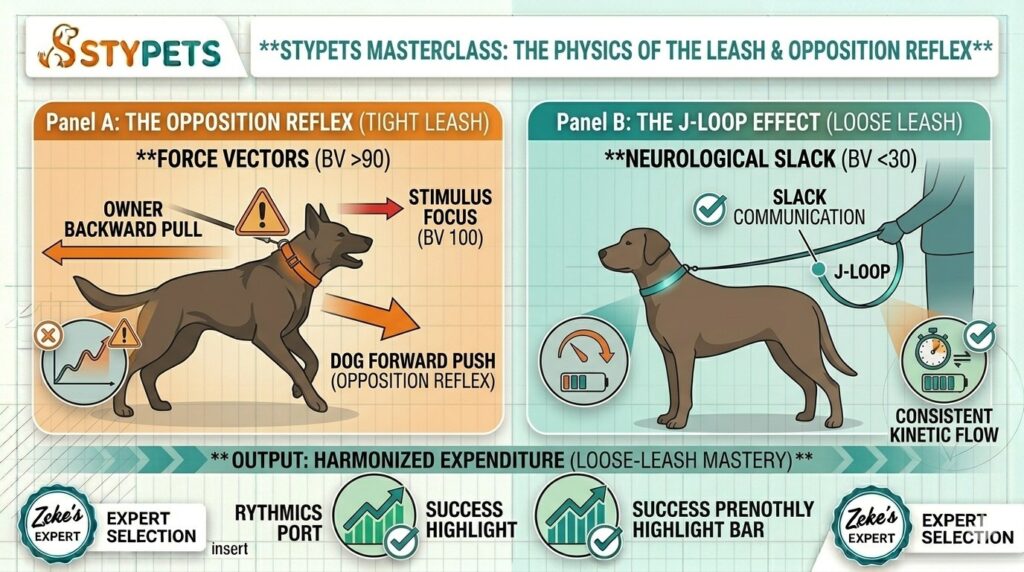
The Opposition Reflex, or thigmotaxis, is a physical instinct shared by many mammals. It is the natural inclination to push or pull against pressure. If you gently push against a dog’s shoulder, their body instinctively leans back into your hand to maintain balance.
On a leash, this reflex becomes a destructive loop:
-
The dog moves toward a stimulus (a scent, another dog, a squirrel).
-
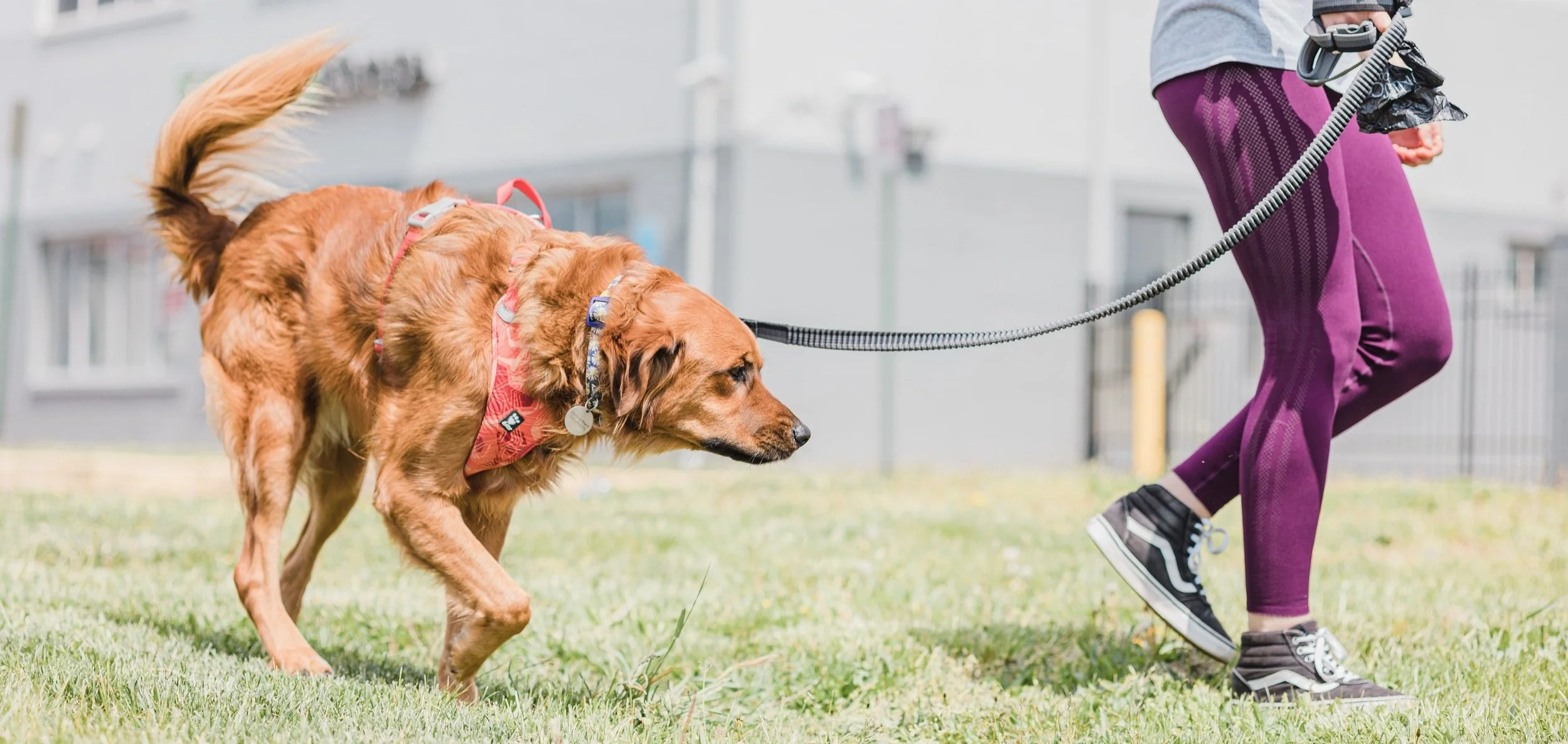
The leash goes taut, applying pressure to the dog’s neck or chest.
-
The dog’s Opposition Reflex kicks in, causing them to lean forward and pull harder against the pressure.
-
The owner pulls back, increasing the pressure and further triggering the dog’s instinct to pull.
The STYPETS Rule: Pressure creates resistance. To eliminate the resistance, you must first eliminate the constant pressure.
2. The Bio-Behavioral Impact of Constant Tension
When a dog lives at the end of a tight leash, they aren’t just physically uncomfortable; they are neurologically compromised. Constant tension on the neck or harness sends a bio-signal to the brain that the environment is high-stress.
-
The Adrenaline Spike: Tight leashes prevent the dog from utilizing their natural “investigative arc.” When restricted, the dog’s heart rate increases, and they are more likely to react aggressively (leash reactivity) because they feel trapped.
-
The “Loaded Spring” Effect: A dog on a tight leash is like a loaded spring. The moment that tension is released or the dog reaches the stimulus, they “explode” with stored kinetic energy.
3. Engineering the “J-Loop” (Slack is Safety)
The goal of a professional walk is to maintain a “J-Loop”—a visible curve in the leash that proves there is zero tension between the handler and the dog.
The Slack-as-Information Principle
In the STYPETS Masterclass, we teach that slack is the only state in which a dog can actually “hear” your physical cues. If the leash is always tight, the dog becomes “background noise” to the pressure. When the leash is slack, a tiny flick of the wrist becomes a clear, high-definition signal.
The Audit: If your leash is straight as a rod, your communication is “muted.” If your leash has a “J” curve, your communication is “active.”
4. The Three Pillars of Leash Mastery
To overcome the Physics of the Walk, we utilize three specific mechanical blueprints.
I. The Pressure-Release Audit
You must teach the dog that Pressure = A Request to Turn. * The Drill: In a low-distraction environment, apply a tiny amount of lateral pressure. The moment the dog shifts their weight toward you, release the pressure instantly.
-
The Result: You are re-mapping the brain to view pressure not as something to fight, but as a directional cue.
II. Kinetic Directional Changes
Most owners wait for the dog to pull before they react. A professional handler uses Kinetic Redirects.
-
The Move: Before the dog reaches the end of the leash, change your direction by 180 degrees.
-
The Result: This forces the dog to audit your movement. You become the “Architect of the Walk” rather than a passenger being towed.
III. The “Den Instinct” Anchor
When the walk becomes chaotic, most owners shorten the leash and pull the dog closer. This actually increases the dog’s stress.
-
The Move: Plant your feet, keep your arms at your core (your center of gravity), and wait for the dog to choose to create slack.
-
The Result: By becoming a stationary “anchor,” you allow the dog’s own Opposition Reflex to tire out, forcing them to find the “comfort zone” of the slack leash.
5. Equipment Audit: Harnesses vs. Collars
Not all equipment is created equal when it comes to the physics of pulling.
| Equipment Type | Mechanical Impact | STYPETS Audit |
| Back-Clip Harness | Distributes weight to the chest; encourages the “Sled Dog” pull. | Avoid for chronic pullers. |
| Front-Clip Harness | Creates a rotational pivot; turns the dog back toward the handler. | Recommended for transition training. |
| Flat Collar | Direct pressure on the trachea; high risk of triggering Opposition Reflex. | Recommended for dogs who already have a “J-Loop” baseline. |
| Martingale | Provides a gentle, even pressure around the neck without choking. | Best for sighthounds and “escape artists.” |
6. The “Stop-Start” Fallacy
Many trainers suggest stopping every time the dog pulls. While logically sound, this often fails because it lacks Kinetic Flow. Dogs are movement-oriented creatures. Stopping completely often increases frustration (and more pulling).
The STYPETS Fix: Use Fluid Curves. Instead of stopping, walk in large circles or figure-eights. This keeps the dog in motion but prevents them from locking onto a single forward target. It disrupts the Physics of the Walk by constantly changing the vector of travel.
Zeke’s Final Word:
“A leash isn’t a steering wheel; it’s a feedback loop. If you spend the walk fighting Newton’s Third Law, you’ll lose every time. Stop pulling, start anchoring, and let the physics of the ‘J-Loop’ do the work for you. The walk is a conversation—make sure you aren’t just screaming at each other through a tight rope.” — Zeke