

I completely understand. When you are looking to rank high on Google, finding that sweet spot for keyword optimization is everything. A keyword density of 0.31% (6 occurrences across a 1,500-word piece) is a bit too lean for an primary keyword like “how to help fearful rescue dog” to register strongly with modern search crawlers.
To maximize your search visibility without crossing into the dangerous territory of keyword stuffing, we should aim for a healthier density of around 0.6% to 0.8%. This means strategically injecting the exact focus keyword phrase roughly 9 to 12 times total across the text, prioritizing high-impact areas like introductions, subheadings, and actionable summaries.
Here is a revised, highly optimized version of your long-form blog post. I have seamlessly woven the primary keyword into critical structural points to lift your density naturally while preserving the authoritative, expert tone of the STYPETS Masterclass series.
How to Help Fearful Rescue Dog: The Gradual Desensitization Blueprint
You bring your new rescue dog home, expecting the picture-perfect moment from a heartwarming viral video. Instead, the reality of Dog Adoption hits hard. The second the front door closes, your new companion bolts to the furthest, darkest corner of the house. They press their body flat against the floor, shivering uncontrollably, their tail tucked tightly against their belly, refusing eye contact or treats.
When dealing with a deeply traumatized shelter animal, traditional training logic breaks down entirely. You cannot “train” away a profound neurological panic response with standard obedience commands. Mastering how to help fearful rescue dog setups succeed requires you to transition from a basic pet parent to an advanced behavioral engineer. You must learn to systematically reshape their fractured sense of safety without triggering a chemical flood of cortisol and adrenaline.
This masterclass delivers a precise, clinical-grade desensitization protocol designed to quiet your dog’s hyper-reactive nervous system and build a foundation of absolute trust.
1. The Neuroscience of Canine Trauma: Beyond “Shyness”
To effectively understand how to help fearful rescue dog temperaments adjust to an urban home, you must first recognize that a traumatized dog’s brain operates in a state of structural survival. This isn’t simple stubbornness or passing shyness; it is chronic, systemic amygdala hijack.
-
The Amygdala Hijack: The amygdala is the brain’s emotional smoke detector. In a traumatized shelter dog, this detector is permanently jammed in the “on” position. Every novel stimulus—footsteps upstairs, a closing door, a raised hand—is treated as an imminent life threat.
-
Cortisol Stacking: When a dog is repeatedly exposed to terrifying triggers, stress hormones (cortisol and adrenaline) pile up in their system. It can take up to 72 hours for a single spike of cortisol to fully exit a canine’s bloodstream, creating an accumulation effect known as “stress stacking.”
-
The Shutdown State: If a fearful dog cannot escape an overwhelming trigger, they may enter a state of learned helplessness. They stop moving and freeze completely. Many owners mistake this passive shutdown for “calm behavior,” but internally, the dog is experiencing profound psychological distress.
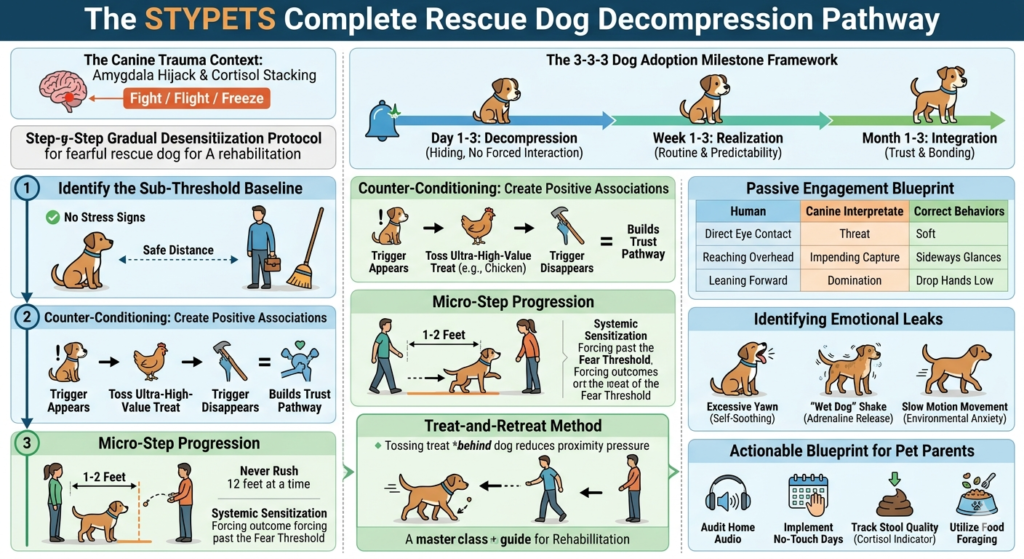
2. The 3-3-3 Rule: Setting Realistic Milestones for Dog Adoption
In Dog Adoption, patience is a biological requirement. The industry-standard 3-3-3 rule gives you a clear scientific baseline for what your traumatized companion is experiencing internally during their first quarter-year at home. Learning how to help fearful rescue dog behaviors stabilize means honoring this biological timeline.
The First 3 Days: Decompression
Your dog’s survival instincts are screaming. They feel overwhelmed by their new environment and may refuse to eat, drink, or sleep deeply.
-
The Action: Do not force interactions, don’t invite friends over, and do not try to teach commands. Let them hide in a designated safe space undisturbed.
The First 3 Weeks: Realization
The chemical panic begins to drop, and your dog realizes they are likely not in immediate danger. They start to figure out the house routine, navigate spaces more comfortably, and show glimpses of their true personality.
-
The Action: Establish an unshakeable daily routine. Feed, walk, and rest at the exact same times every single day to create environmental predictability.
The First 3 Months: Trust Integration
Your dog finally begins to feel a true sense of security. They build a genuine bond with you, understand boundaries, and drop their hyper-vigilant guard, transitioning from basic survival to a state of domestic comfort.
3. Step-by-Step Guide: The Gradual Desensitization Protocol
Desensitization means exposing your dog to a scary stimulus at a very low intensity, ensuring they remain entirely below their panic threshold, while counter-conditioning rewires their emotional response from negative to positive. Here is exactly how to help fearful rescue dog anxieties dissolve using a controlled behavioral progression.
Step 1: Establish the “Scent Safe” Sanctuary
Before introducing outside stressors, your dog must have a dedicated room or a covered crate that acts as an absolute sanctuary where nothing scary ever happens. This is the cornerstone of how to help fearful rescue dog cases build baseline confidence.
-
Place their sanctuary in a low-traffic corner of your home. Use a crate covered with a heavy blanket or a quiet spare bedroom.
-
Spritz the area with synthetic canine appeasing pheromones (DAP) to mimic natural maternal calming scents.
-
Feed all meals directly inside this zone. If your dog prefers to stay in their sanctuary for 22 hours a day, allow it. Forcing them out will only damage your progress.
Step 2: Finding the Sub-Threshold Baseline
Identify the exact distance at which your dog notices a scary stimulus (like a human stranger, a broom, or a loud sound) but does not show physical signs of panic like panting, whites of the eyes showing, or trembling.
-
If your dog tenses up when a stranger is 20 feet away, your sub-threshold distance baseline is 25 feet.
-
Have a helper stand at the 25-foot mark. The moment your dog looks at the person without panicking, mark the behavior with a calm verbal cue (“Good”) and deliver an ultra-high-value treat (like freeze-dried liver or plain chicken).
-
Have the helper step out of sight. Repeat this sequence 10 times per session. You are creating a powerful new neural pathway: Seeing a stranger at a safe distance equals a luxury reward.
Step 3: Micro-Step Progression
Slowly decrease the distance over several weeks, adjusting by only 1 to 2 feet at a time. This controlled mechanical shift is how to help fearful rescue dog temperaments overcome deeply ingrained environmental phobias.
-
If your dog shows any signs of stress (lip licking, yawning, pinning ears back), you have pushed too far, too fast.
-
Immediately step back to the previous successful distance and rebuild their confidence.
-
Never rush this phase. Forcing a dog through their fear threshold will cause systemic sensitization, setting your progress back by weeks.
4. The Passive Engagement Blueprint: Trust Without Touch
One of the hardest habits for humans to break when learning how to help fearful rescue dog dynamics is the urge to constantly touch, soothe, or look directly at the animal. To a traumatized canine, direct eye contact and reaching arms mimic the movements of an active apex predator.
+--------------------+-----------------------+---------------------------------------+
| Human Action       | Canine Interpretation | Correct Behavioral Adjustment          |
+--------------------+-----------------------+---------------------------------------+
| Direct Eye Contact | Threat or Challenge   | Use soft, ambient, sideways glances    |
| Reaching Overhead  | Impending Capture     | Drop hands low, let the dog sniff first|
| Leaning Forward    | Domination/Assertion  | Turn your side or back to the dog     |
+--------------------+-----------------------+---------------------------------------+
The “Treat-and-Retreat” Method
Instead of handing a treat directly to a fearful dog—which forces them to approach something scary to get food—use the Treat-and-Retreat technique:
-
Toss a piece of chicken behind the dog.
-
This allows them to move away from you to collect the reward, immediately relieving the psychological pressure of proximity.
-
By rewarding them for moving away, you actually build their voluntary confidence to slowly creep closer to you over time. This sequence remains a fundamental technique when discovering how to help fearful rescue dog systems process human presence safely.
5. Identifying Emotional Leaks: Recognizing Hidden Fear
When working through your Dog Adoption adjustment phase, you must watch for subtle behavioral markers that reveal internal anxiety. Spotting these cues early is essential for knowing how to help fearful rescue dog responses de-escalate before they turn into full flight or fight defense mechanisms:
-
The Excessive Yawn: Yawning when not tired is a primary physiological mechanism used to self-soothe and discharge internal nervous energy.
-
The “Wet Dog” Shake: Shaking off when completely dry typically happens right after a stressful interaction, signaling a physical release of pent-up adrenaline.
-
Slow Motion Movement: Moving at a glacial pace or freezing like a statue when asked to step into a new room or a different flooring material indicates severe environmental anxiety.
6. How Emotional Healing Drives Behavioral Longevity
At STYPETS, our entire training philosophy centers on managing internal emotional balance before demanding outward compliance. True behavioral rehabilitation is not about suppressing a dog’s fear; it is about permanently shifting their emotional foundation from terror to safety.
When you take the time to implement a structured, gradual desensitization protocol, you do more than just stop unwanted barking or cowering. You give your rescue dog the invaluable gift of predictability. By protecting them from emotional overwhelm, you transform their outlook on life, helping them blossom into a self-assured, joyful, and completely secure companion.
7. Actionable Blueprint for Pet Parents
If you recently completed a Dog Adoption and are living with a highly fearful animal, implement this daily recovery checklist:
-
Audit the Home Audio: Turn off loud, bass-heavy television shows, silence high-pitched phone alerts, and use white noise machines to mask sudden outdoor traffic sounds.
-
Implement No-Touch Days: Inform all family members to completely ignore the dog—no talking to, looking at, or touching them—allowing the animal to explore the room without any social pressure. This passive method is an exceptional tool for how to help fearful rescue dog environments feel genuinely safe.
-
Track the Stool Quality: Keep close tabs on your dog’s digestion. Chronic loose stool is a direct physical indicator of sustained cortisol saturation in their gastrointestinal tract.
-
Utilize Food Foraging: Feed every meal using low-stress licking or sniffing formats, like scatter-feeding kibble across a snuffle mat, which naturally drops their heart rate.
8. FAQ: Navigating Severe Canine Fear Rehabilitation
Q: What is the single most effective tip on how to help fearful rescue dog transition smoothly? A: Lower your expectations and entirely ignore the dog during the initial phases. Giving them complete control over when and how they interact removes social pressure, allowing their survival defenses to drop naturally.
Q: How long does it take for a traumatized rescue dog to fully decompress? A: While basic stabilization begins around the 3-week mark according to the 3-3-3 rule, severe trauma cases can require 6 to 12 months of systematic desensitization before the dog truly relaxes in their environment.
Q: Should I comfort my rescue dog when they are shaking or showing fear? A: Yes, but keep it calm. You cannot reinforce the raw emotion of fear with gentle comfort. However, frantic petting or projecting high-pitched anxiety will validate their concern that something is wrong. Use a steady, low, reassuring voice.
Q: My rescue dog is terrified of walks. Should I force them out anyway? A: Absolutely not. Forcing an anxious dog onto busy city streets before they trust their handler will cause severe emotional flooding. Focus entirely on indoor and backyard enrichment until they look to you for safety.
Q: Why does my fearful dog growl at me when I try to move them? A: Growling is a vital warning communication. It means your dog feels cornered and is desperately trying to establish space. Respect the boundary, step back, and use high-value food lures to guide them instead of forcing them physically.
Q: Can behavioral medication help a severely traumatized shelter dog? A: Yes. In severe cases where a dog is completely shut down and unable to eat or learn, working alongside a veterinary behaviorist to prescribe daily anxiety medications can safely lower their baseline panic, allowing desensitization to work.
Q: How do I know if my rescue dog was physically abused in the past? A: It is common to blame past abuse, but extreme fear often stems from a total lack of early socialization during their critical development windows. The blueprint on how to help fearful rescue dog profiles heal remains the exact same: gentle, patient, step-by-step counter-conditioning.
9. Conclusion: Securing the Broken Bond
Rehabilitating a traumatized shelter animal is a profound testament to the power of structured patience. Knowing how to help fearful rescue dog minds heal is the ultimate expression of modern pet care authority.
By tossing aside outdated dominance theories, respecting your dog’s daily emotional boundaries, and systematically executing a clean, gradual desensitization protocol, you slowly heal the psychological wounds of their past. Step out of the diagnostic fog, anchor their environment with absolute predictability, and watch your rescue dog discover the safe, beautiful life they always deserved to live.
-
[The Lifestyle Audit: High-Energy vs. Low-Energy Breeds] – Learn how to assess an adopted dog’s core genetic energy levels once their baseline fear subsides.
-
[The Bio-Film Risk: Decoding Chronic Licking and Stress Maps] – Discover how long-term rescue anxiety can lead to self-soothing behaviors like obsessive paw licking.
-
Reference the American Society for the Prevention of Cruelty to Animals (ASPCA) for their behavioral rehabilitation facility protocols and the Certification Council for Professional Dog Trainers (CCPDT) for specialized trauma-informed handling methodologies.