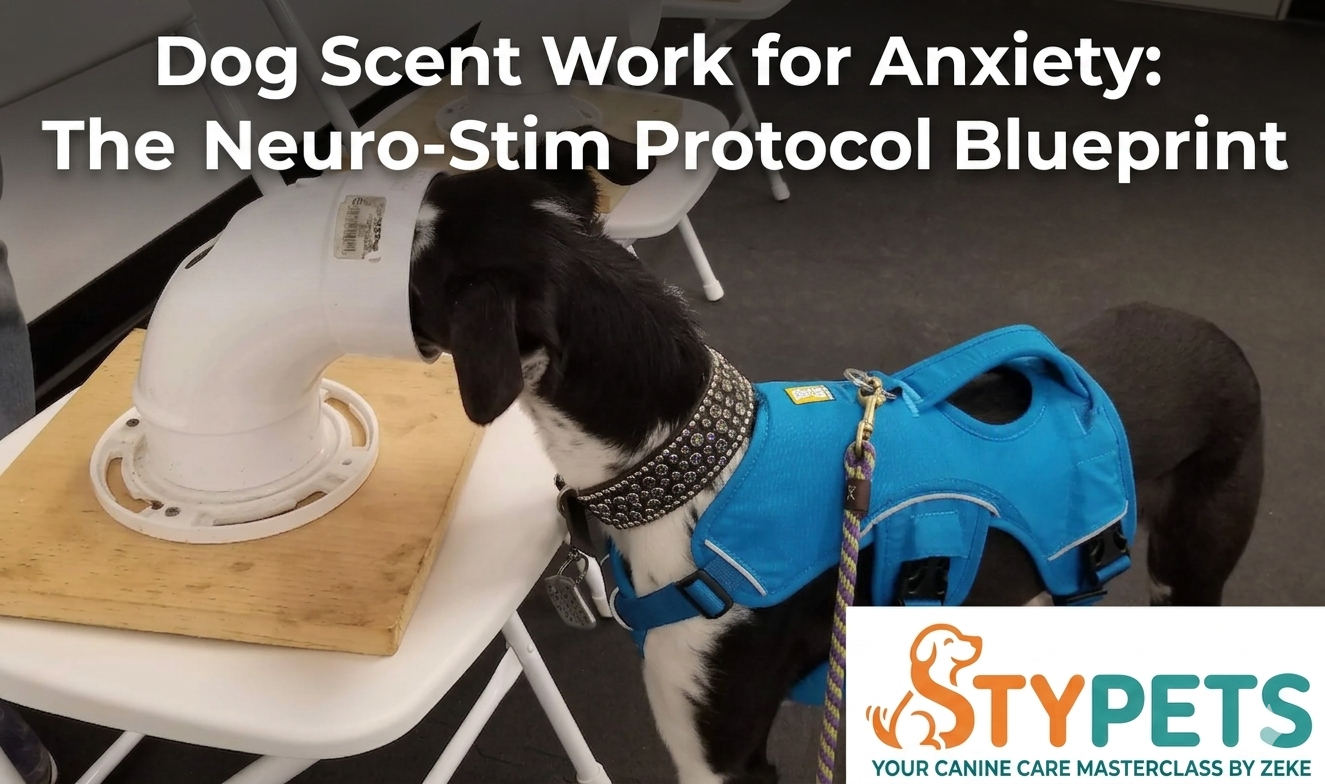
In the high-entropy environment of 2026, many owners are finding that traditional Dog Training methods—like repetitive sit-stays and leash corrections—are failing to address the root cause of reactivity. If your dog lives in a state of hyper-vigilance, you don’t need more obedience; you need a neurological reset. At STYPETS, we utilize dog scent work for anxiety not just as a game, but as a “Neuro-Stim Protocol” designed to bypass the reactive brain and build long-term emotional resilience.
This Masterclass provides a professional blueprint for using dog scent work for anxiety to audit your dog’s stress levels and rewire their response to environmental triggers. We are moving past “hide and seek” into the realm of biological engineering.
1. The Olfactory Bypass: How Scent Rewires the Limibic System
To understand why dog scent work for anxiety is so effective, we must look at the canine “Source Code.” While humans are visual creatures, a dog’s primary processor is their nose.
The Direct Link to Emotion
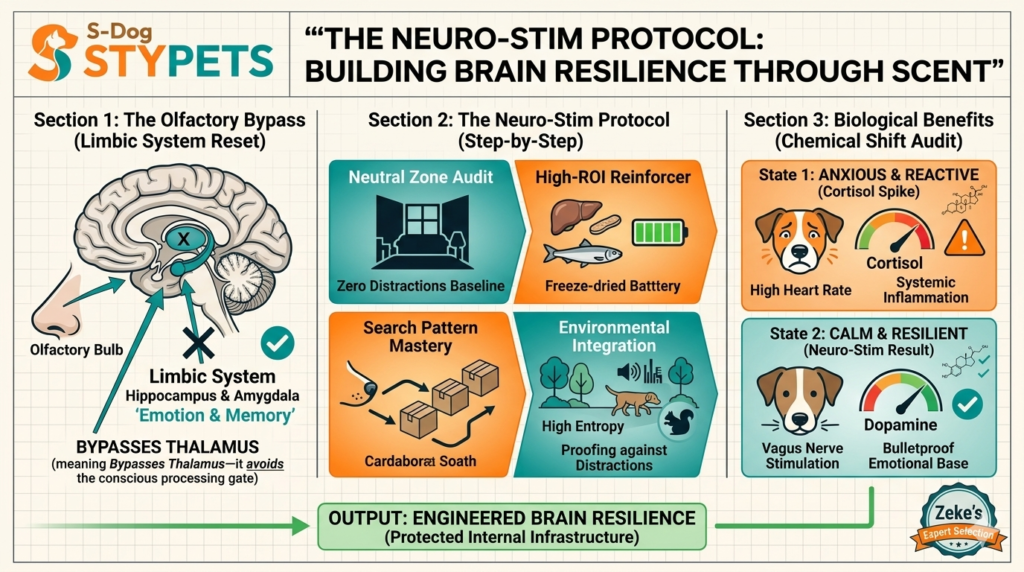
Unlike sight or sound, which must be processed through the thalamus before reaching the emotional centers of the brain, scent has a direct line to the Limbic System. This is the area responsible for memory and emotion—specifically the amygdala (fear) and the hippocampus.
-
The Science: When a dog engages in “Deep Sniffing,” it stimulates the Vagus Nerve. This triggers the Parasympathetic Nervous System (the “Rest and Digest” mode), which actively lowers the heart rate and inhibits the production of cortisol.
-
The STYPETS Audit: By introducing dog scent work for anxiety, you are essentially forcing the brain to switch from the Sympathetic (Fight or Flight) system to a focused, calm state of analysis.
2. Why Traditional Dog Training Often Increases Anxiety
Most owners attempt to “train away” anxiety using command-based obedience. However, for a dog in a high-cortisol state, being told to “Sit” while they are terrified of a passing truck creates Neurological Friction.
The Command Conflict
When a dog is anxious, their “Executive Function” shuts down. Forcing them to perform a static command creates a conflict between their survival instinct and your requirement for compliance. Dog training should reduce stress, not add a layer of pressure.
-
The Shift: Dog scent work for anxiety gives the dog a “Job” that aligns with their biology. It empowers the dog to make choices and use their innate skills, which builds genuine confidence from the inside out.
3. The STYPETS Neuro-Stim Protocol: Step-by-Step
This is not a casual game; it is a structured protocol for building brain resilience. Follow these steps to implement dog scent work for anxiety into your daily management routine.
Step 1: The Neutral Zone Audit
Before introducing scent, you must ensure the environment is a “Neutral Zone.” This means low noise, low foot traffic, and zero distractions. We want the dog to associate the scent work with a state of complete safety.
Step 2: The Primary Reinforcer (The “High-ROI” Treat)
In this protocol, we don’t use standard kibble. We use high-bioavailability, high-value reinforcers like freeze-dried liver or sardines. The scent must be potent enough to trigger an immediate dopamine spike.
Step 3: The Search Pattern (Building Focus)
-
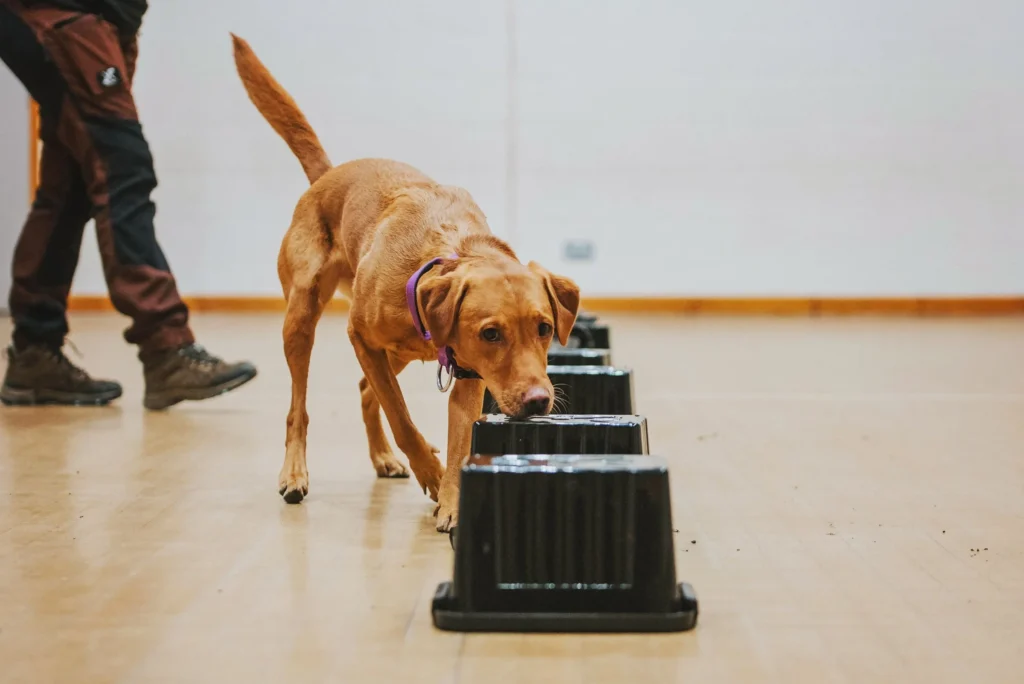
Hide the Scent: Place the treat inside a cardboard box. Leave the lid open.
-
The Release Command: Use a specific word like “Search” or “Find it.”
-
The Discovery: When the dog finds the scent, provide an immediate “Jackpot” reward.
-
Increasing Difficulty: Gradually close the box, then hide multiple boxes, then move the boxes to different heights.
Step 4: Environmental Integration
Once the dog is a “Master Searcher” in the Neutral Zone, you can begin using dog scent work for anxiety in slightly more “high-entropy” areas, like a quiet corner of a park. This teaches the dog to “Tune Out” the world and “Tune In” to their nose.
4. The Biological Benefits: Dopamine vs. Cortisol
The primary goal of the Neuro-Stim Protocol is a Chemical Shift. When a dog is successfully performing dog scent work for anxiety, their brain chemistry undergoes a measurable transformation.
-
Dopamine Release: Solving a scent puzzle releases dopamine, the “reward” chemical. This creates a positive feedback loop where the dog learns that focusing on a task leads to a biological “High.”
-
Cortisol Flush: Deep sniffing requires a specific respiratory pattern—long inhales and short exhales. This physical act helps flush residual cortisol from the system, effectively “resetting” the dog’s baseline stress level.
5. Tools for Success: The STYPETS Gear Audit
You don’t need expensive equipment for dog scent work for anxiety, but you do need the right “Mechanics.”
-
Cardboard Boxes: The best starter tool. They trap scent and provide a “Tactile Success” when the dog nudges them.
-
Scent Tins: For advanced training, use small metal tins with holes punched in the lid. These are used to hide specific essential oils (like Birch or Anise) used in professional detection.
-
Long Line Leash: In a Dog Training context, a 15-foot long line allows the dog the freedom to move and search without feeling the “Pressure” of a short leash.
6. Measuring Success: The Post-Protocol Audit
How do you know if dog scent work for anxiety is working? You must audit the “After-Action” signals.
-
Respiratory Rate: Is the dog’s breathing slower and more rhythmic after a 10-minute session?
-
The “Shake-Off”: Does the dog perform a full-body shake after the search? This is a physical “Reset” signal indicating they are releasing tension.
-
Sleep Quality: Does the dog fall into a deeper REM sleep after the protocol? Deep sleep is where the brain processes information and recovers from stress.
7. Troubleshooting the “Scent Threshold”: Managing Frustration
In Dog Training, we often talk about the “Threshold”—the point where a dog’s emotional state shifts from “learning” to “reacting.” If the scent puzzle is too difficult, a dog with high anxiety may experience frustration, which spikes cortisol and defeats the purpose of the protocol.
-
The Signal: If your dog begins pawing at boxes, barking, or walking away, they have hit their “Frustration Threshold.”
-
The Adjustment: Immediately perform a “Reset Search.” Place the high-value treat in plain sight. This ensures a “Success Loop” and prevents the dog from associating dog scent work for anxiety with stress.
-
The Goal: Keep the “Dopamine-to-Effort Ratio” high. In the early stages, success should be guaranteed within 30 seconds.
8. The Entropy Variable: Moving the Search Outdoors
Once your dog has mastered the “Neutral Zone,” you must audit the impact of Environmental Entropy. A calm living room is a “Low-Entropy” environment; a backyard with squirrels and neighborhood noises is “High-Entropy.”
-
The Strategy: Do not expect a direct transition. When moving dog scent work for anxiety outdoors, you must “Reset the Difficulty.”
-
The Audit: Start by hiding scents on your porch or patio. Use the “Umbilical Tether” (a 6-foot leash) if the dog is too distracted to focus on the search.
-
The Outcome: Successfully searching in high-entropy environments proves the dog has “Proofed” the behavior, indicating a higher level of brain resilience.
9. Cognitive Flexibility: Scent Work for the Aging Processor
Longevity isn’t just about physical health; it’s about “Neuro-Flexibility.” For senior dogs, dog scent work for anxiety acts as a powerful preventative measure against Canine Cognitive Dysfunction (CCD).
-
The Science: Searching for scent engages the Prefrontal Cortex, the area of the brain responsible for problem-solving. This acts as a “mental workout” that keeps the neural pathways active even when physical mobility is limited.
-
The Benefit: Scent work is a low-impact activity. It allows senior dogs to experience a “Success High” without the structural stress of traditional Dog Training exercises.
10. The Multi-Dog Household Hazard Audit
If you have more than one dog, performing dog scent work for anxiety requires a “Safety Protocol” to prevent resource guarding and social pressure.
-
The Rule: One dog searches, one dog “rests.” The resting dog should be in a separate room or crate with a high-value chew.
-
The Logic: Anxiety is often contagious in a pack. By separating the dogs, you allow each individual to reach a “Deep Focus” state without checking their perimeter for competition.
-
The Blueprint: Rotate the dogs every 5 minutes. This teaches impulse control (the “wait”) and provides a mental reset for both.
11. Professional Proofing: Taking Scent Work to the Vet
The ultimate test of the Neuro-Stim Protocol is using it during a high-stress event, such as a veterinary visit or a grooming appointment.
-
The “Scent Anchor”: Bring a small “Scent Tin” with you to the clinic. Before the exam begins, allow your dog to find the tin in the waiting room.
-
The Result: By triggering the Olfactory Bypass in a stressful location, you are signaling to the brain that “The Search” is happening, which helps inhibit the “Fight or Flight” response.
-
The Authority Tip: Tell your vet you are performing a “Neuro-Stim Protocol.” It signals that you are an owner who manages by biology, not just by “telling the dog to be quiet.”
12. The STYPETS Masterclass Conclusion: Final Professional Verdict
At STYPETS, we don’t just “train” dogs; we engineer their environment and biology for success. By integrating dog scent work for anxiety into your daily routine, you are providing your dog with a professional-grade tool for self-regulation.
When you move past the “Command” and focus on the “Chemistry,” you build an unbreakable bond based on biological understanding. Start your first Scent Audit today and watch as your dog’s brain resilience reaches a new 15-year baseline.
FAQ: Mastering Dog Scent Work for Anxiety
1. Can any dog breed do scent work for anxiety? Absolutely. While some breeds (like Hounds) have more olfactory receptors, the neurological benefit of sniffing is universal across every dog breed.
2. How long should a scent work session last? Mental work is more exhausting than physical work. Limit initial sessions to 5–10 minutes. Overworking a dog can actually increase anxiety.
3. Is scent work better than a long walk? For an anxious dog, 15 minutes of dog scent work for anxiety can provide more mental enrichment and “tire them out” more effectively than an hour-long walk in a stressful neighborhood.
4. Can I use essential oils for scent work? Only specific, dog-safe oils used in nose work (Birch, Anise, Clove). Never use unknown oils, as many are toxic to dogs. Most beginners start with high-value food.
5. What if my dog gets frustrated and stops searching? If the dog quits, the “Audit” shows the puzzle was too hard. Make it easier (open the box, move it closer) to ensure a “Success Loop” and a dopamine hit.
6. Does scent work help with separation anxiety? Yes. By performing the protocol before you leave, you can lower the dog’s baseline cortisol, making it easier for them to settle into a “Dormancy Cycle” while you are gone.
7. Is this recognized in professional Dog Training? Yes, “Nose Work” is a fast-growing canine sport and is widely used by behaviorists to treat reactivity and GAD (Generalized Anxiety Disorder) in dogs.
Conclusion: Engineering a Calmer Brain
At STYPETS, we don’t just “train” dogs; we engineer their environment and biology for success. By integrating dog scent work for anxiety into your daily routine, you are providing your dog with a professional-grade tool for self-regulation.
When you move past the “Command” and focus on the “Chemistry,” you build an unbreakable bond based on biological understanding. Start your first Scent Audit today and watch as your dog’s brain resilience reaches a new 15-year baseline.
External Authoritative Sources to Mention: