It is a split-second scenario that every owner dreads. The delivery driver rings the bell, you crack the front door open, and your dog explodes through the gap into a high-entropy, dangerous environment. Door-dashing isn’t just a frustrating behavioral flaw; it is a critical safety failure that risks injury or loss. If you are scrambling to figure out how to stop dog bolting out door situations, you must move past basic corrections and implement an engineered system of threshold mechanics.
At STYPETS, we view every exterior doorway not as an exit, but as a boundary line requiring strict operational access control. Rather than relying on frantic verbal commands when the door opens, we engineer a default biological automatic behavior. This masterclass provides a technical blueprint to change your dog’s involuntary responses, ensuring they look to you for clearance before crossing any threshold.
1. The Anatomy of a Door-Dash: Why Dogs Bolt
To successfully master how to stop dog bolting out door habits, we must first audit the psychological variables driving the behavior. Dogs do not bolt out of spite or a desire to escape your care; they bolt because the door represents a high-value transition zone.
The Dopamine Drive
The front door is the gateway to the most stimulating sensory inputs in your dog’s daily routine: walks, scents, squirrels, and social interactions. Over time, the mere sight or sound of a hand touching the doorknob triggers a massive dopamine spike.
-
Barrier Frustration: Constantly staring at a closed door builds tension. When that barrier cracks open, that stored kinetic energy is violently released.
-
The “Chase Me” Game: If your dog successfully slips past you and you run after them, you inadvertently reinforce the behavior. To your dog, your frantic pursuit is a highly engaging game of tag.
2. Threshold Engineering: The 4-Phase Anti-Bolting Protocol
This structured system replaces your dog’s explosive forward momentum with a calm, analytical “Wait” default state. In the realm of advanced Dog training, consistency beats intensity every single time. Run this protocol twice daily for 10-minute sessions.
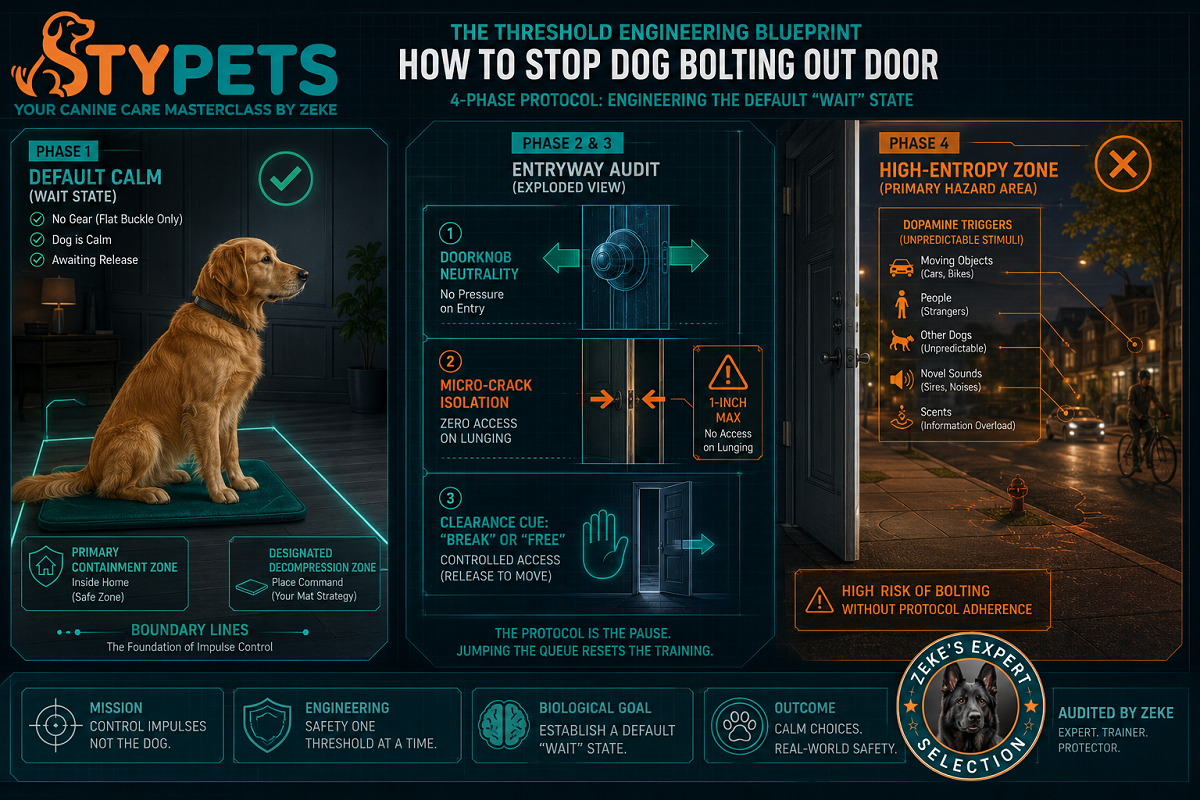
Phase 1 — The Doorknob De-Conditioning (Days 1–5)
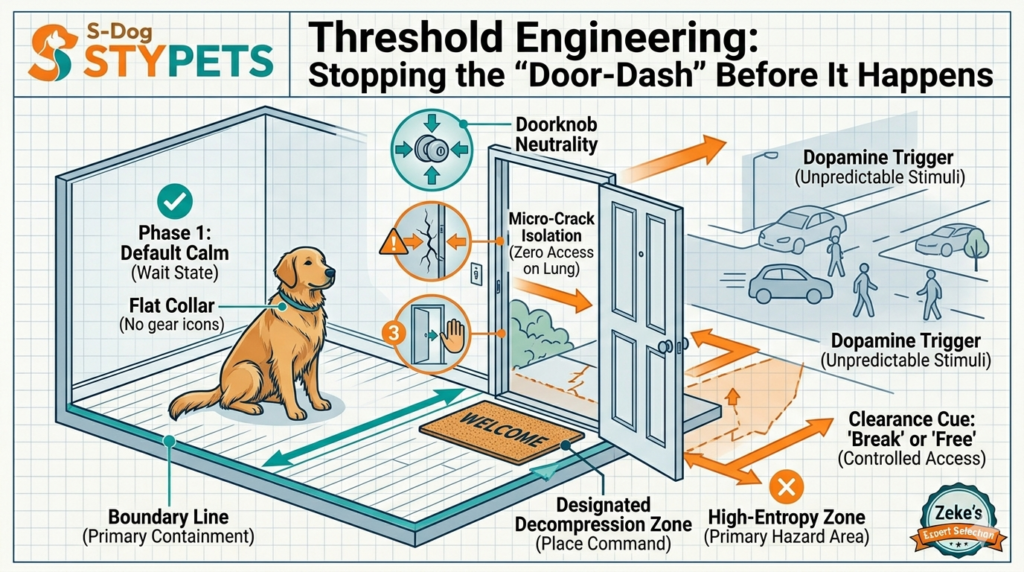
We must break the automatic association between doorknob movement and exit access. Walk to your front door. Touch the handle. If your dog alerts or moves forward, remove your hand. Repeat this until your dog remains completely still when you touch and jiggle the lock.
-
Action: Reward stillness instantly.
-
The Metric: Your dog should view the sound of the keys or handle as a cue to sit, not to charge.
Phase 2 — The Micro-Crack Isolation (Days 6–10)
Once the handle is neutral, we introduce movement to the barrier itself. Ask your dog for a “Sit-Stay” three feet back from the threshold. Slowly turn the handle and crack the door open exactly one inch.
-
The Correction: If your dog’s paws lift or they lean forward, immediately snap the door shut. You do not need to yell; the closing of the door is the ultimate negative marker—it signals that rushing causes the resource to vanish.
-
The Reward: If they maintain the sit, close the door and deliver a high-value reward directly to them at their designated spot.
Phase 3 — The Full Boundary Reset (Days 11–20)
Gradually increase the width of the open door over multiple sessions until it is fully open. Your dog must remain in a seated position, looking past the open expanse, focusing entirely on you.
-
The Clearance Cue: Your dog cannot cross the line until you deliver a specific verbal release code, such as “Break” or “Free.” If they break early, close the door or block them with your body, returning them to the exact starting point.
Phase 4 — High-Entropy Proofing (Days 21–30)
An empty doorway is easy to pass. True mastery of how to stop dog bolting out door actions requires proofing against real-world triggers. Enlist a helper to ring the doorbell, drop a package on the porch, or walk a decoy dog past the open frame while you reinforce the protocol.
3. Creating a Physical “Decompression Zone”
While you are actively building the behavioral infrastructure, you must protect your dog from real-world failures by altering the environment.
The Boundary Marker
Place a highly visible, textured mat exactly four feet back from your entryway. This serves as a physical and visual anchor for your dog’s “Place” command. It is much easier for a canine brain to understand “stay on the blue mat” than it is to understand the abstract concept of “don’t cross an invisible line.”
Secondary Containment
If you are managing a highly driven rescue dog or a breed with an intense prey drive, rely on mechanical backups. Install a temporary freestanding pet gate around the entryway loop. This ensures that even if a human error occurs and the front door is left unlatched, the dog remains contained within a secondary safety airlock.
4. The Biological Impact of Threshold Impulse Control
Teaching a dog to wait at an open door does more than keep them safe; it radically alters their brain chemistry during high-stress moments.
-
Lowering the Baseline: Forcing a sit-stay at a door down-regulates the sympathetic nervous system (fight or flight) and activates the parasympathetic nervous system (rest and digest).
-
Cortisol Management: Dogs that constantly guard or rush doors suffer from elevated daily cortisol levels due to perpetual alertness. Establishing a strict threshold routine reduces this environmental stress burden.
5. 3 Critical Mistakes That Fail Door-Dashing Audits
When implementing an anti-bolting protocol, avoid these common tactical errors that degrade your authority:
-
Using the Dog’s Name as a Recall Order: If your dog escapes, never scream their name in anger. This pairs their name with fear, ruining your future recall baseline. Instead, use a high-pitched, excited emergency cue or turn and run away from them to trigger their natural chase reflex back toward the house.
-
Feeding Rewards Outside the Door: When rewarding your dog for a successful threshold stay, always deliver the treat inside the house. If you lead them outside to reward them, the dog’s brain still concludes that the ultimate prize exists on the other side of the frame.
-
Allowing “Leash-Dragging” Rushes: On regular walks, do not let your dog pull you through the door the moment the latch clicks. The rules of how to stop dog bolting out door apply to every single exit. You must step through first, check the environment, and then invite them forward.
FAQ: Advanced Engineering for Threshold Control
1. How long does it take to permanently stop a dog from door-bolting? Most dogs establish a solid threshold baseline within 21 to 30 days of consistent, daily practice. However, high-drive or historically reinforced bolters may require up to 60 days of proofing to completely overwrite their muscle memory.
2. Can I use a shock collar or electronic boundary to fix door-dashing? We do not recommend punishment-based methods for threshold work. Introducing pain or fear at the front door can cause a dog to associate the open door (or the person standing there) with punishment, leading to severe defensive reactivity or fear-based aggression.
3. My dog only bolts when the doorbell rings. How do I fix this specific trigger? This requires desensitizing the acoustic trigger. Record your specific doorbell sound and play it at a very low volume while feeding your dog their favorite meals. Slowly increase the volume over days until the sound signals “food is arriving in my bowl,” rather than “charge the front door.”
4. What should I do if my dog actively bolts past me right now? Do not chase them. Drop to the ground and yell in an excited voice, or run back into your house while squeaking a high-value toy. Your sudden movement away from them flips their predatory drive, causing them to turn back to track you.
5. Is door-bolting related to separation anxiety? Occasionally, yes. If a dog bolts primarily when you are leaving the house, it may be a panic response driven by isolation distress. However, if they bolt regardless of who is entering or leaving, it is pure impulse-control deficit and threshold attraction.
6. Does fixing the front door stop them from bolting out of car doors? The specific behavior will not automatically transfer, but the concept of impulse control will. You must run a mini version of the protocol with your vehicle: crack the car door, close it if they lung, and only allow an exit once your clearance cue is given.
7. Should I teach my dog to sit or lie down at the door? A sit is typically preferred for threshold engineering because it keeps the dog in an attentive, controlled posture while allowing them to comfortably monitor you for the clearance cue. A down can sometimes cause a dog to lose visual contact with your face, leading them to break early to see what you are doing.
Conclusion: The Professional Safety Baseline
Altering your dog’s threshold mechanics is an absolute non-negotiable metric of responsible Dog care and advanced Dog training. By transforming the front door from an chaotic sprint zone into a structured, calm operational boundary, you remove a massive safety liability from your household infrastructure.
Be patient, honor the phases of the protocol, and remember that you are the sole gatekeeper of the transition space. A calm wait at the door is the ultimate expression of trust and elite behavioral engineering.
-
Certification Council for Professional Dog Trainers (CCPDT) for behavioral training baseline metrics.
-
Karen Overall’s Protocols for Deference regarding biological relaxation signals.