Most dog owners choose their pet’s food based on the photography on the bag or the “buzzwords” in the marketing. However, a professional understands that a dog’s digestive system is a chemical processing plant, and the efficiency of that plant depends entirely on the bioavailability of the raw materials provided.
In this STYPETS Masterclass, we are looking past the “human-grade” claims and “grain-free” labels. We are performing a professional Ingredient Audit to understand how your dog’s biology interacts with common kibble components. If you want to reduce inflammation, improve coat quality, and increase longevity, you must learn to read the back of the bag, not the front.
1. The Protein Paradox: Percentage vs. Bioavailability
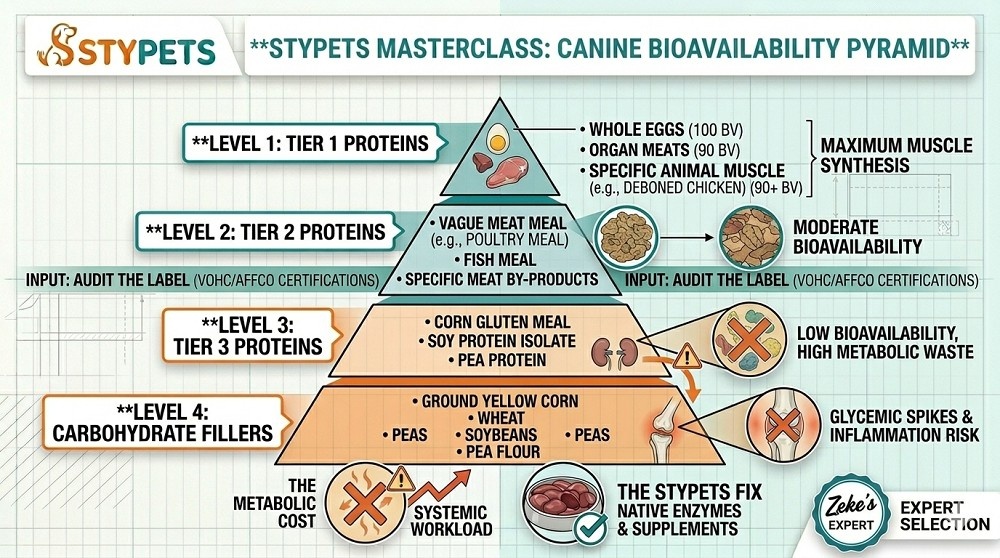
The biggest marketing trap in the pet food industry is the “Protein Percentage.” While a bag may claim “30% Protein,” that number tells you nothing about how much of that protein your dog can actually use.
The Biological Value (BV) Scale
Not all proteins are created equal. The Biological Value measures how well the body can absorb and utilize a specific protein source.
-
Whole Eggs: 100 BV (The gold standard)
-
Muscle Meats (Beef, Chicken): 90+ BV
-
Organ Meats: 90 BV
-
Plant Proteins (Corn Gluten, Soy): 40-60 BV
The STYPETS Audit: Look for specific animal proteins (e.g., “Deboned Chicken”) rather than vague terms like “Meat By-Products” or “Poultry Meal.” If the primary protein sources are plant-based, your dog’s kidneys have to work harder to filter out the waste products of inefficient digestion.
2. The Extrusion Cost: Why Kibble is “Dead” Food
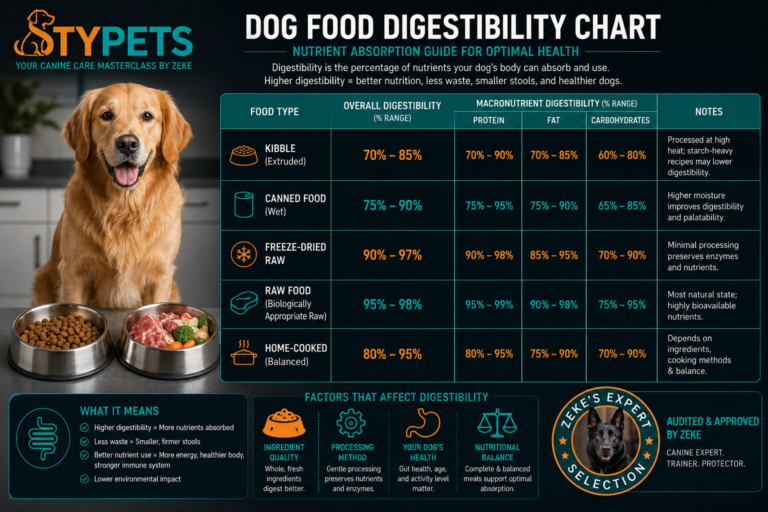
Almost all kibble is produced through a process called extrusion. The ingredients are mixed, pressurized, and cooked at temperatures exceeding 180°C (350°F).
-
The Damage: High-heat processing denatures proteins, destroys natural enzymes, and kills heat-sensitive vitamins (like B-vitamins and Probiotics).
-
The “Add-Back” Strategy: Manufacturers then spray synthetic vitamins and “palatants” (fats and flavorings) back onto the kibble to make it nutritionally complete and tasty.
-
The Pro Reality: Your dog is eating a highly processed, synthetic “space ration.” This is why adding fresh “toppers” like raw organs or lightly steamed greens is a professional necessity for gut health.
3. Carbohydrate Fillers: The Metabolic Load
Dogs have no biological requirement for carbohydrates. However, kibble requires starch (carbs) to act as a “glue” to hold the biscuit shape together.
The Glycemic Index Trap
Many “Grain-Free” foods simply replace corn or wheat with peas, lentils, or white potatoes.
-
The Issue: These ingredients often have a high Glycemic Index, causing insulin spikes that lead to chronic inflammation and obesity.
-
The Audit: If the first five ingredients contain multiple starches (e.g., peas, pea flour, chickpeas), the food is carb-heavy. High carb intake alters the gut microbiome, which is linked to behavioral issues and skin allergies.
4. Identifying “Label Splitting”
Unethical manufacturers use a technique called Label Splitting to make a food look better than it is.
How it works: Instead of listing “Corn” as the second ingredient, they list “Ground Yellow Corn,” “Corn Gluten Meal,” and “Maize.” By splitting the ingredient into three different names, each individual weight is lower, allowing a meat source to move to the #1 spot on the list. In reality, the total volume of corn far outweighs the meat.
5. The “Red List”: Ingredients to Avoid
A professional audit should immediately flag the following “chemical red flags”:
-
BHA/BHT: Synthetic preservatives linked to carcinogens. Look for natural tocopherols (Vitamin E) instead.
-
Artificial Colors (Red 40, Yellow 5): Purely for the owner’s benefit; dogs don’t care about color, and these are linked to hyperactivity and allergies.
-
Carrageenan: A thickening agent often found in wet food that can trigger intestinal inflammation.
-
Generic “Animal Fat”: This can be sourced from any 4-D animal (Dead, Dying, Diseased, or Disabled).
Zeke’s Final Word:
“You are quite literally what you eat, and your dog is no different. If you wouldn’t eat highly processed cereal for every meal of your life, don’t expect your dog to thrive on it without help. Learn to audit the label, find the bioavailability, and fill the nutritional gaps.” — Zeke