For decades, the standard response to “What should I feed my dog?” was simple: a bag of brown, processed, shelf-stable balls. It was convenient, formulated for “complete and balanced” nutrition according to industry standards, and required zero effort from the owner. Today, the conversation is radically different.
Walk down any pet supply aisle, and you are bombarded with marketing. Brands promise “ancestral diets,” “human-grade ingredients,” “biologically appropriate ratios,” and “veterinarian-formulated recipes.” The rise of the raw food movement—fueled by a growing distrust of large-scale, ultra-processed pet foods—has split the dog-owning community.
Is kibble “processed junk food” that causes chronic disease? Is raw feeding a “dangerous fad” loaded with pathogens? At STYPETS, we don’t follow trends; we follow physiology. As a Dog Nutrition Expert, I’ve spent years dissecting ingredient panels, analyzing nutrient bioavailability, and witnessing the tangible effects of diet on canine health.
This isn’t a “vibe-based” discussion. We are going to cut through the marketing noise with science, compare these two core feeding philosophies, and give you the definitive, objective toolkit to decide what truly belongs in your dog’s bowl.
1. Defining the Baselines: What Are We Actually Comparing?
To have an objective debate, we must first define the products.
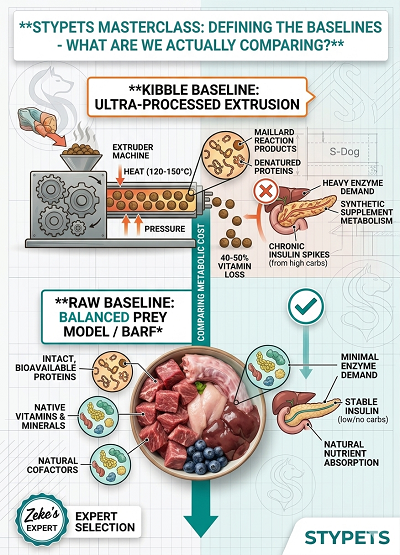
The Kibble Baseline: Ultra-Processed Extrusion
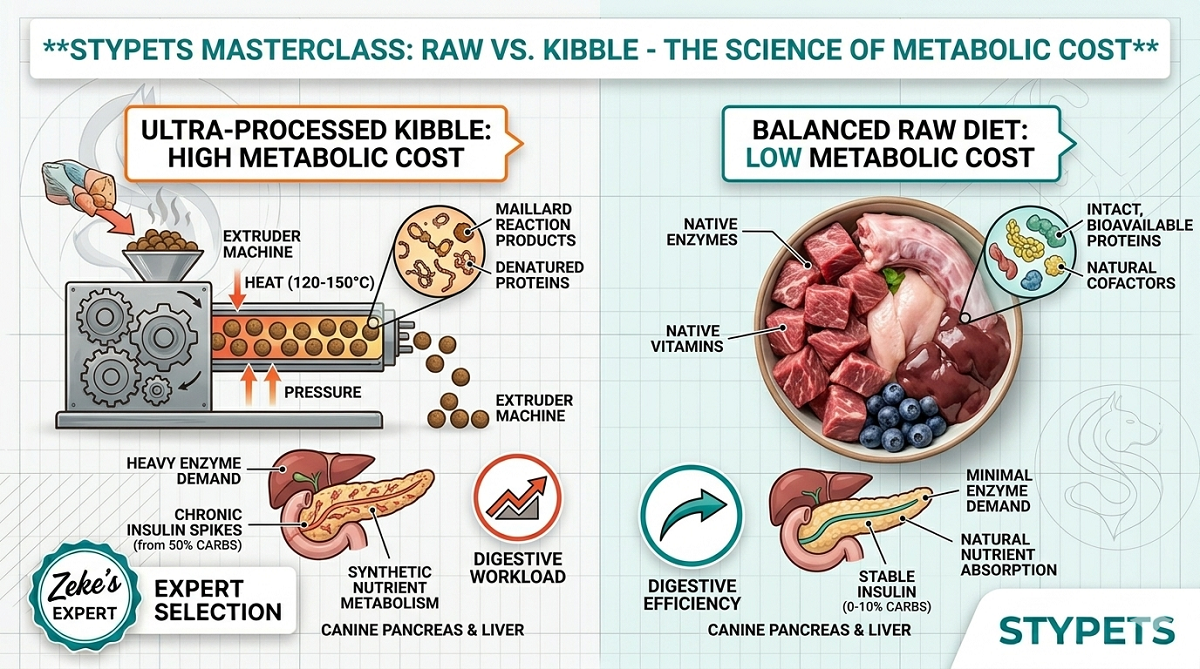
Dry kibble is produced via a manufacturing method called extrusion. Ingredients (meat meals, grains, starches, fats, and synthetic vitamin premixes) are ground into a dough. This dough is subjected to extreme heat, pressure, and moisture for a brief period before being forced through a die to create shapes. Finally, it is dried.
Marketing will tell you this ensures every bite is balanced. Science, however, notes that extrusion uses heat high enough (often 120°C to 150°C) to cause the Maillard Reaction. While this browns the food, it denatures proteins, destroys up to 40-50% of certain heat-sensitive vitamins (like Thiamine and Vitamin A), and deactivates most natural enzymes. To maintain “completeness,” manufacturers must add these nutrients back in synthetically after processing.
The Raw Baseline: The “BARF” or “Prey Model”
Raw feeding, at its core, is a diet composed entirely of uncooked, moisture-rich ingredients.
-
BARF (Biologically Appropriate Raw Food): Typically 70% muscle meat, 10% raw edible bone, 10% organ meat (usually 5% liver), and 10% vegetables/fruit/supplements.
-
Prey Model Raw (PMR): Seeks to eliminate vegetation, aiming for ratios found in a prey animal: 80% muscle meat, 10% bone, and 10% organ (again, 5% liver).
Marketing calls this “ancestral feeding.” Physiology notes that these diets are fundamentally different from processed food because the nutrients are in their native, bioavailable form. The proteins are not denatured, and vital enzymes, amino acids, and fats are consumed exactly as the body is designed to process them.
2. The Great Bioavailability Debate: Synthetic vs. Native Nutrition
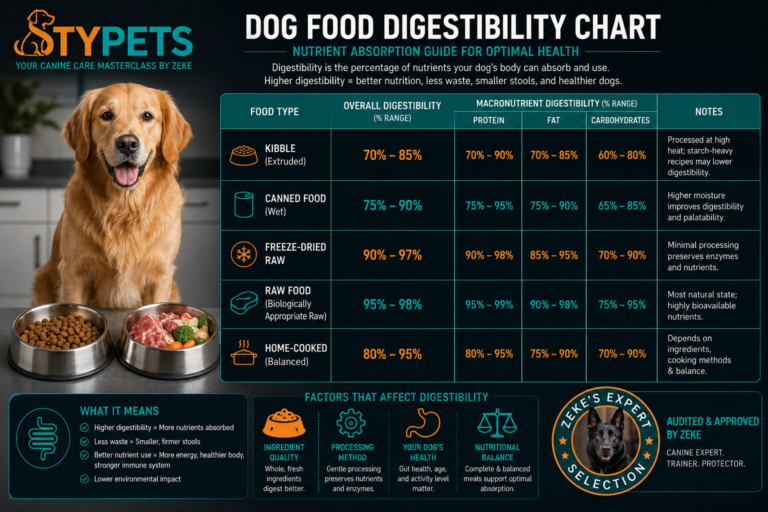
This is the scientific crux of the argument. It isn’t just about what is in the food; it’s about how much of that nutrient the dog can actually digest and utilize.
Bioavailability of Kibble
Kibble often boasts impressive nutrient numbers on the bag. However, those numbers frequently come from synthetic supplements rather than whole-food sources. While synthetics are chemically identical to their natural counterparts (e.g., Synthetic Vitamin C is Ascorbic Acid), they often lack the necessary cofactors (enzymes, bioflavonoids, mineral transporters) that occur naturally in food to facilitate absorption.
The digestive tract of a carnivore is highly efficient, but it must work significantly harder to identify, metabolize, and excrete processed material and synthetic binders.
Bioavailability of Raw
Nutrients in a well-formulated raw diet are naturally complex. When a dog consumes a raw chicken thigh, they are getting calcium, phosphorus, glucosamine, and chondroitin in the correct biological ratios for absorbing bone minerals. They are getting Omega-3 fats and critical B-vitamins in their native lipid/protein matrices. The enzymes found in the raw meat and raw organs assist the pancreas in digestion, reducing the biological cost of processing the food.
3. Carbohydrates: The Canine metabolic Dilemma
The most critical macronutrient difference between raw and kibble is carbohydrates.
-
Kibble: By definition, dry kibble requires starch (from grains, peas, potatoes, or tapioca) to hold its shape during the extrusion process. Most standard kibbles are composed of 30% to 60% carbohydrates.
-
Raw: Contains 0% to 10% carbohydrates (found only if vegetables are included).
The Metabolic Science
Dogs have zero nutritional requirement for dietary carbohydrates. They are highly efficient at synthesizing all the glucose they need from proteins (gluconeogenesis) and fats. When we force a canine body—optimized to burn protein and fat for energy—to process 50% glucose from complex starches, we force a metabolic adaptation.
High carb intake causes persistent insulin spikes. Over time, chronic hyperinsulinemia can contribute to inflammation, pancreatic stress, and is a significant driver of the current canine obesity epidemic. Kibble is, metabolically speaking, a high-sugar diet.
4. The Kibble Context: Convenience and the AAFCO Shield
While processing is the main drawback, kibble offers advantages that cannot be ignored.
-
Convenience: Open bag, scoop, pour. It is ideal for busy lifestyles.
-
The AAFCO Standard: If a kibble bag says “complete and balanced,” it means it meets the minimum nutritional guidelines set by the Association of American Feed Control Officials. While AAFCO standards are a baseline, not a target, they provide a necessary safety net against nutrient deficiency.
-
Budget: Good quality kibble is generally more affordable than good quality raw feeding, especially for large breeds.
5. The Raw Context: Pathogens and Formulation Pitfalls
While raw feeding has massive physiological benefits, it carries two significant, evidence-based risks.
-
The Pathogen Question: Marketing may ignore this, but science does not. Raw meat—even human-grade—is a bacterial goldmine for Salmonella, E. coli, and Listeria. Dogs, as scavenger carnivores, possess a stomach pH as low as 1.0. This, combined with a short digestive tract, allows them to process these bacteria with ease in most cases. The real risk is human handling in the home.
-
Nutritional Imbalance: This is the most common and serious error in raw feeding. Feeding only chicken breast (muscle meat) will lead to severe calcium and Vitamin D deficiencies in weeks. Achieving perfect, long-term balance in a home kitchen requires meticulous calculation. An improperly formulated raw diet is far more dangerous than the lowest quality kibble.
6. Zeke’s Hybrid Strategy: Bridging the Divide
As a Dog Nutrition Expert, I understand that not everyone can commit to full raw feeding (budget, time, or logistics). The debate does not have to be all-or-nothing. We can apply the 80/20 Rule (which we used for Sniff-aris vs. Leash Work in the Training Masterclass).
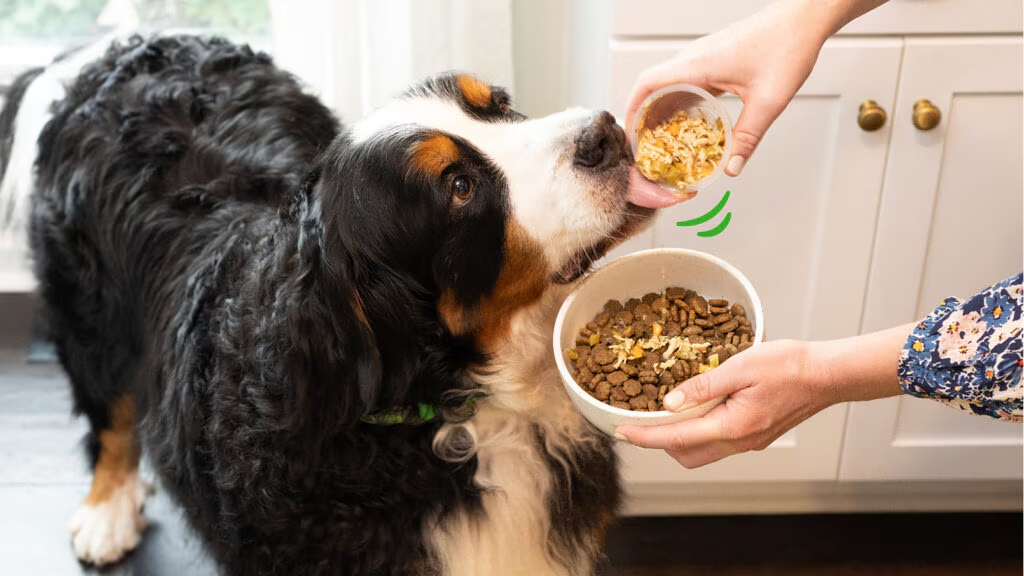
The science shows that adding just 20% fresh, living foods to a standard kibble base can provide the enzyme boost, high-quality protein, and phytonutrients that kibble lacks, without sacrificing the safety net of the AAFCO formula.
Zeke’s Expert Food Toppers:
-
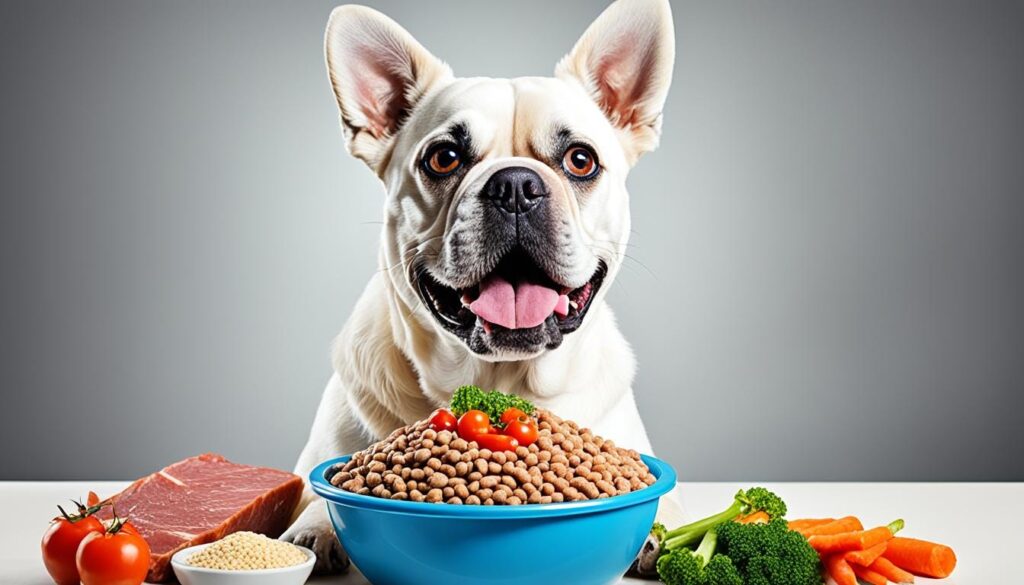
Raw local egg (excellent biotin, healthy fats, and proteins)
-
Steamed broccoli or blueberries (adds phytonutrients and fiber)
-
Sardines in water (critical Omega-3 boost for skin and joint health)
Zeke’s Final Word:
“The debate isn’t actually raw versus kibble. The debate is Processed versus Fresh. A good quality kibble will always be better than a bad quality raw diet, but a properly balanced fresh diet will always be superior to processed kibble. Focus on bioavailability, and let physiology dictate the bowl.” — Zeke
The STYPETS Expert Series
-
Training: Stop Leash Pulling: The 3-Step Protocol
-
Adoption: The 3-3-3 Rule for Rescue Success