
In the professional audit of canine rescue, the first 90 days are the most volatile phase of the entire biological partnership. Most owners expect a “honeymoon period” where the dog is instantly grateful. However, at STYPETS, we view adoption through the lens of Neurological Decompression.
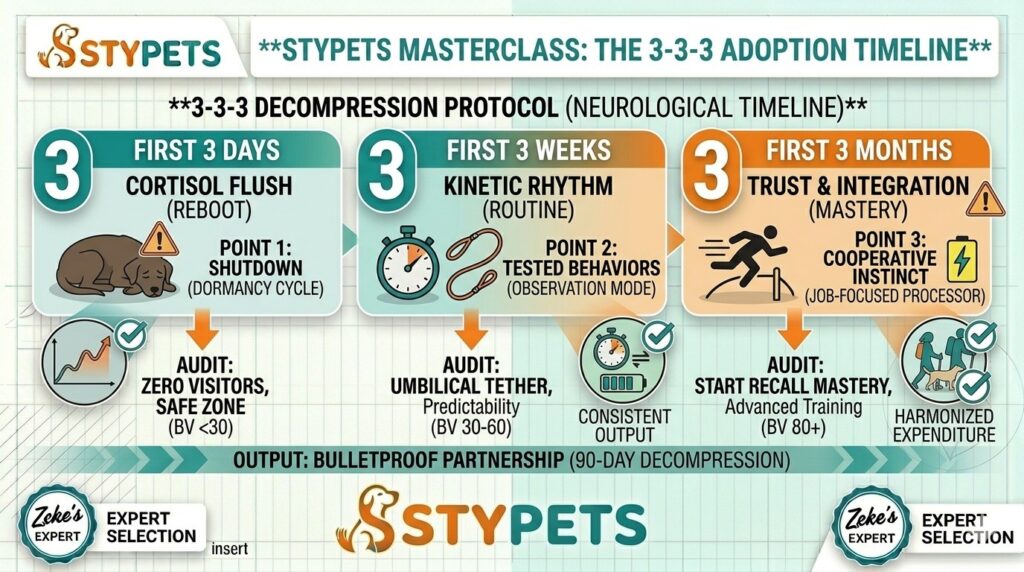
When a dog enters a new environment, their nervous system is in a state of hyper-cortisolemia. They are not “being bad” or “stubborn”; they are biologically incapable of learning complex tasks because their brain is locked in survival mode. To successfully integrate a new dog, you must follow the 3-3-3 Blueprint—a professional timeline that respects the canine’s need to decompress before they can perform.
1. The First 3 Days: The Cortisol Flush
The first 72 hours are defined by sensory overwhelm. Your dog has just undergone a massive environmental shift—moving from a high-stress shelter or a foster home into your territory.
The Biological Reality
The dog’s amygdala is firing at 100% capacity. This manifests in two ways:
-
The Shutdown: The dog refuses to eat, hides in their crate, or sleeps for 18 hours straight. This is a “system reboot.”
-
The Hyper-Vigilance: The dog is startled by the refrigerator humming or the sound of a car passing. Their “Fight or Flight” threshold is at its lowest point.
The STYPETS Protocol: Minimize “Cognitive Loading.” Do not introduce them to your extended family, the neighbor’s dog, or the local pet store. Provide a “Safe Zone” (a crate or a quiet corner) and focus on one thing: Predictability.
2. The First 3 Weeks: Establishing the Kinetic Rhythm
By the end of the third week, the systemic cortisol levels begin to stabilize. The dog is no longer in “Survival Mode”; they are moving into “Observation Mode.”
The Behavioral Audit
This is the phase where “Tested Behaviors” emerge. As the dog feels safer, they will start to audit your boundaries. They are looking for the Kinetic Rhythm of the house:
-
When is the “Input” (Food)?
-
When is the “Output” (Exercise)?
-
Who is the “Architect” of the rules?
The STYPETS Protocol: This is the window to implement the Umbilical Method. Keep the dog on a leash attached to you or within your line of sight. You aren’t “training” yet; you are establishing that all resources and safety come directly from you. This prevents the development of “Separation Anxiety” before it can take root.
3. The First 3 Months: Mastery and Trust
At the 90-day mark, the dog’s brain has finally remapped its definition of “Home.” This is where the true personality—the “Genetic Lottery” results—finally reveals itself.
The Neurological Shift
Trust is a biological currency that takes 90 days to mint. By now:
-
The dog’s Recovery Rate after a stressful event (like a vet visit) has improved.
-
They have developed a Bonding Baseline with their primary handlers.
-
The “Survival Instinct” has been replaced by a “Cooperative Instinct.”
The STYPETS Protocol: Now is the time for Advanced Cognitive Loading. Start your “Recall Mastery” or “Advanced Obedience” blueprints. The dog now has the emotional bandwidth to handle the pressure of learning without fear of losing their security.
4. Avoiding the “Honeymoon Crash”
A common error in the 3-3-3 protocol is giving too much freedom too early. Owners often stop crating or tethering the dog at Day 10 because “he seems fine.”
This creates a Neurological Vacuum. Without clear boundaries, the dog feels the need to audit the environment for threats themselves, leading to territorial barking or resource guarding.
Zeke’s Rule: “Strictness today is the parent of freedom tomorrow.” Maintain the professional blueprint for the full 90 days. If you skip a step in the foundation, the entire behavioral structure will eventually lean.
5. The 3-3-3 Audit Checklist
| Phase | Core Goal | Critical Boundary |
| 3 Days | Decompression | Zero Visitors / Quiet Environment |
| 3 Weeks | Routine | 100% Supervised Movement (Umbilical) |
| 3 Months | Integration | Start High-Level Training Blueprints |
Zeke’s Final Word:
“You cannot rush biology. You can buy the best food and the most expensive bed, but the only thing that truly builds a bulletproof dog is time and consistency. Respect the 90-day window, and you’ll have a partner for life. Ignore it, and you’ll be auditing behavioral problems for years.” — Zeke