
Many owners believe that bringing home a companion for their resident pet is a simple way to increase happiness. However, from an engineering perspective, adding a second dog to the household isn’t just an addition—it is a multiplication of complexity, resource demand, and social variables. Without a proper hazard analysis, what was intended to be a “playmate” can quickly become a “systemic stressor” for both the humans and the animals involved.
In this STYPETS Masterclass, we treat the multi-dog home as a complex ecosystem. We will perform a structural audit of your resources, analyze the “Social Entropy” of canine introductions, and provide a technical blueprint for a successful Dog Adoption transition.
1. The Resource Audit: Calculating System Capacity
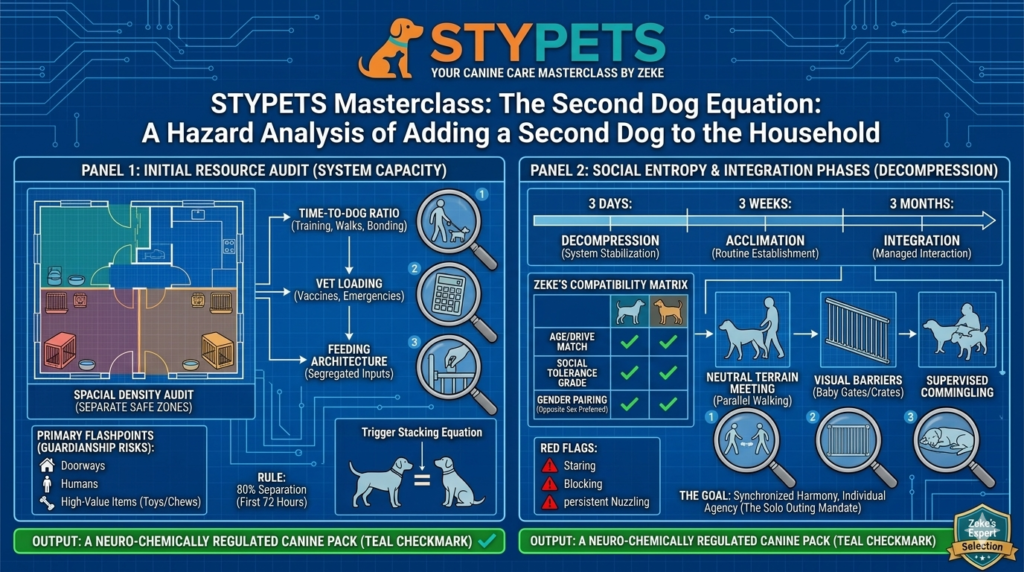
Before adding a second dog to the household, you must perform a “Hard Resource Audit.” A common failure in Dog Adoption is the assumption that a second dog only costs “a bit more.” In reality, the maintenance load follows an exponential curve.
-
Time-to-Dog Ratio: Each dog requires individual training and bonding time. If you spend 1 hour a day on your current dog, you need 2.5 hours for two dogs to account for “group management.”
-
Space Density: Can your home support two independent “Safe Zones”? If dogs cannot escape each other’s sensory range, social friction is inevitable.
2. Social Entropy: The “Resident vs. Newcomer” Dynamics
Canine social structures are not static. When adding a second dog to the household, you are introducing “Social Entropy”—a move toward disorder. Your resident dog has a “Work-Life Balance” that is about to be disrupted.
A successful Dog Adoption depends on understanding your resident dog’s “Social Tolerance” grade. Is your dog a “Social Butterfly” or “Socially Selective”? Introducing a high-energy puppy to a socially selective senior is a recipe for system failure.
3. Hazard Identification: Resource Guarding and Territoriality
The primary hazards in multi-dog households are “Resource Flashpoints.” These are specific locations or items where the “Incentive Value” is so high that it triggers defensive behavior.
-
Primary Flashpoints: Entryways, food bowls, high-value chews, and “Favorite Human” proximity.
-
The Zeke Fix: Perform a “Baseline Sweep.” Remove all toys and bones before the new dog enters. Do not reintroduce these until the “Social Baseline” has stabilized.
4. The Neutrality Protocol: Engineering a Safe First Contact
Never introduce dogs inside the home. The home is a “High-Value Territory” for the resident. To optimize the success of adding a second dog to the household, use the Neutrality Protocol:
-
Neutral Terrain: Meet at a park or a neighbor’s yard where neither dog has a “Claim.”
-
Parallel Walking: Do not let them meet nose-to-nose immediately. Walk them 10 feet apart, allowing them to audit each other’s scent without the pressure of a greeting.
-
The “Three-Second” Rule: If they greet, count to three and then move them away. This prevents the “Arousal Spike” that leads to snaps.
5. The First 72 Hours: System Stabilization Phase
The 3-3-3 rule of Dog Adoption applies heavily here. The first 3 days are for “Decompression.”
During this phase of adding a second dog to the household, keep them physically separated by “Visual Barriers” (baby gates or crates) for 80% of the day. This allows the dogs to process each other’s “Sensory Signal” (smell and sound) without the “Collision Risk” of physical proximity.
6. Managing Multi-Dog Friction: Identifying Red Flags
Not all growls are failures, but you must identify “Systemic Red Flags”:
-
Staring: Prolonged, “hard” eye contact is a threat signal.
-
Body Blocking: One dog physically preventing the other from reaching a resource.
-
Persistent Nuzzling: Often misinterpreted as “love,” it can be a “Control Manifold” behavior.
7. The Economics of Dog Adoption: Hidden Maintenance Costs
From a financial engineering perspective, the second dog doubles your “Emergency Fund” requirements.
-
Vet Loading: Vaccinations and preventative heartworm/flea care are linear costs.
-
Boarding Stress: Finding care for two dogs is significantly harder than for one, often requiring specialized “Multi-Dog Suites” that come at a premium.
8. Training in Tandem: Preventing “Littermate Syndrome” Dynamics
Even if the dogs aren’t related, “Same-Age Pairing” can lead to excessive codependency. When adding a second dog to the household, you must maintain “Individual Agency.”
-
Solo Training: Train each dog separately at least 3 times a week.
-
Solo Outings: Take the new dog on errands alone to ensure they bond with you, not just the other dog.
9. The Walk Equation: Managing Physical Load
Walking two dogs simultaneously is a high-level skill. If one dog reacts, the other often “Jointly Reacts”—this is called Emotional Contagion.
-
The Split-Walk Phase: For the first 30 days of adding a second dog to the household, walk them separately. This ensures you have 100% “Control Volume” over the newcomer’s leash manners.
10. Feeding Architecture: Segregating High-Value Inputs
Food is the most common “Critical Failure Point” in a multi-dog system.
-
The Barrier Rule: Feed dogs in separate rooms or crates. Even if they “seem fine,” the low-level stress of “Competitive Eating” can damage Dog Adoption success over time.
-
The “Wait” Protocol: Use “Incentive Alignment.” Both dogs must “Settle” before a single bowl touches the floor.
11. Age and Drive Matching: Zeke’s Compatibility Matrix
To ensure a “Success State,” use Zeke’s Compatibility Audit:
-
Drive Match: A high-drive working line dog paired with a low-drive companion is a “Social Mismatch.”
-
Gender Pairing: Generally, “Opposite-Sex” pairings (Male/Female) have the lowest rate of “Inter-Dog Aggression” failure.
12. The Emotional Contagion Effect: Managing “Sympathetic Arousal”
In engineering, “Resonance” occurs when one vibration triggers another. In a multi-dog home, this manifests as Emotional Contagion. If your resident dog becomes reactive to a delivery driver, the newcomer—who may have been perfectly calm—will biologically “mirror” that stress.
When adding a second dog to the household, you aren’t just managing two dogs; you are managing a shared nervous system.
-
The Feedback Loop: If Dog A spikes in cortisol, Dog B’s heart rate will increase within seconds.
-
The Zeke Mitigation: We use “Strategic Separation” during high-trigger times (like mail delivery) to prevent the dogs from “rehearsing” group reactivity.
13. Individual Agency: The “Solo Outing” Mandate
One of the biggest risks in Dog Adoption is the loss of the individual. Dogs in pairs often become “Pack Dependent,” losing their ability to function without their partner.
To prevent this when adding a second dog to the household:
-
The 80/20 Rule: 80% of activities can be together, but 20% must be solo.
-
Independent Desensitization: Take the new dog to a hardware store or a cafe without the resident dog.
-
Crate Distance: Position crates across the room from each other rather than side-by-side to encourage independent sleeping habits.
14. The “Gatekeeper” Protocol: Human Leadership as a Safety Valve
In a multi-dog system, the human must act as the “Regulator.” If the dogs are left to “sort it out,” they will use the only tools they have: teeth and posturing.
-
Threshold Management: Never let two dogs rush through a doorway at once. This “bottleneck” is a prime location for redirected aggression.
-
The “Wait” Command: Both dogs must sit and wait for their name to be called before crossing a threshold. Maintaining these boundaries is critical when adding a second dog to the household.
15. Redefining “Play”: Distinguishing Fun from Friction
Many owners mistake “Bullying” for play. When adding a second dog to the household, you must be able to read the Consent Signal.
The STYPETS Consent Test: If Dog A is pinning Dog B or chasing them relentlessly, gently step in and hold Dog A. If Dog B immediately runs back to Dog A to re-engage, it is a “Success State” play. If Dog B stays away, shakes off, or drinks water, they were overstimulated and needed the “System Reset” you provided.
16. High-Level Resource Management: The Toy Audit
Toys are “Incentive Magnets” that can cause immediate system failure.
-
The Bin Rule: Never leave high-value toys (squeakers, tugs) on the floor. These are “Regulated Resources.”
-
Managed Interaction: Only bring out toys during supervised sessions where you can mediate the interaction.
-
The “Trade-Up” Strategy: Always have a third toy or treat ready to “trade” if one dog becomes overly possessive of an item.
17. The Senior-Puppy Dynamics: Protecting the Aging Chassis
If your resident dog is a senior and you are adding a second dog to the household that is a puppy, you are introducing a high-entropy unit to a low-energy system.
-
The Physical Toll: Puppies often “pester” seniors, causing physical pain to aging joints.
-
The “Safe Elevated Zone”: Provide your senior dog with a place the puppy cannot reach (like a couch or a gated room).
-
Mandatory Puppy Naps: Puppies lack an “Off-Switch.” You must enforce crate naps to give your senior dog the “Decompression Time” they require to maintain their health.
18. Emergency Shutdown: Breaking Up a Conflict
Despite your best Dog Adoption efforts, friction may occur. You must have a “Fail-Safe” plan. A sound blast or a physical barrier like a “baby gate” can provide the 1-second “System Pause” needed to intervene safely when adding a second dog to the household. Knowing how to safely intervene in a conflict prevents a temporary friction point from becoming a permanent systemic failure.
19. FAQs: Solving the Multi-Dog Equation
-
Q: Should I get a puppy or an adult for my second dog? A: Adults are “Known Quantities” with established temperaments. Puppies are “Variable High-Energy” units that require more “Management Bandwidth.”
-
Q: How long until I can leave them alone together? A: Never leave a new Dog Adoption alone with the resident for at least the first 2-4 weeks.
-
Q: My resident dog is growling. Should I punish them? A: No. A growl is a “Bio-Signal.” If you punish the growl, you remove the “Warning System,” which leads to “Bites Without Warning.”
-
Q: Does adding a second dog to the household help with separation anxiety? A: Rarely. It often results in “Double Separation Anxiety.” Solve the resident’s issues before adding a second unit.
Conclusion: Engineering the Balanced Pack
Adding a second dog to the household is a high-reward endeavor that requires a high-level “Management Infrastructure.” By performing a rigorous Dog Adoption audit and following the Neutrality Protocol, you can move your home from “Social Chaos” to “Synchronized Harmony.”
[The “Off-Switch” Protocol] for managing household arousal levels.
[The Ingredient Audit] for managing separate nutritional requirements.
IAABC (International Association of Animal Behavior Consultants): Regarding multi-dog household management.
The ASPCA: For standardized dog-to-dog introduction guidelines.