Have you ever wondered why your dog is suddenly reactive, anxious, or unable to focus despite hours of training? While we often look to the brain for answers, the real culprit might be residing in the belly. Recent scientific breakthroughs have revealed a profound “gut-brain axis,” proving that dog gut health and behavior are inextricably linked.
In this STYPETS Masterclass, we aren’t just looking at dog food as fuel; we are auditing it as a neuro-chemical precursor. By the end of this guide, you will understand how to engineer your dog’s microbiome to produce a calmer, more focused, and emotionally regulated companion.
1. The Gut-Brain Axis: The Biological Superhighway
When evaluating dog gut health and behavior, we must look at the Vagus nerve. This bi-directional cable ensures that any irritation in the digestive tract is immediately translated into a behavioral response. If you ignore the hardware of the gut, you cannot expect a success state in the software of the mind.
When we discuss dog gut health and behavior, we are talking about the Vagus nerve. This nerve acts like a high-speed fiber-optic cable, sending constant updates from the digestive tract to the brain. If the gut is inflamed, the brain receives a “threat” signal, often resulting in anxiety or aggression.
2. The Neurochemistry of Dog Gut Health and Behavior: Why Serotonin Starts in the Gut
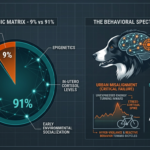
Did you know that approximately 90% of a dog’s serotonin—the “feel-good” hormone—is produced in the digestive tract?
Serotonin is responsible for mood stabilization, sleep regulation, and impulse control. If your dog’s microbiome is imbalanced (a state known as dysbiosis), their ability to produce serotonin plummets. This creates a “short-circuit” in their emotional regulation, making even the best dog training efforts feel like an uphill battle.
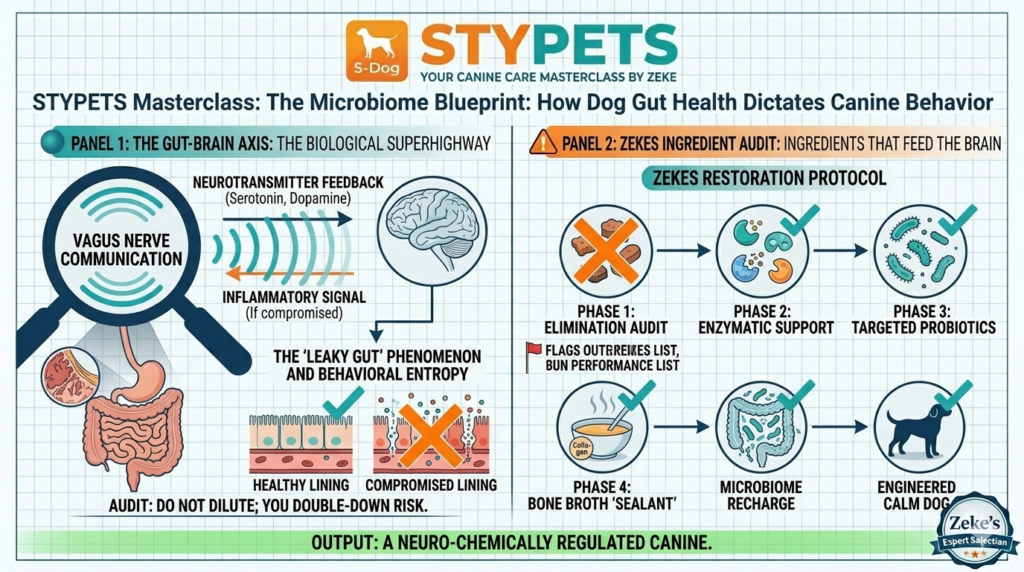
3. The “Leaky Gut” Phenomenon and Behavioral Entropy
In the world of canine engineering, a “Leaky Gut” (Intestinal Permeability) is a critical system failure.
Systemic inflammation is the primary enemy of dog gut health and behavior. When the intestinal barrier fails, the resulting ‘Leaky Gut’ creates a neuro-chemical storm that manifests as reactive or unpredictable actions.
4. Zeke’s Ingredient Audit: Foods That Feed the Brain
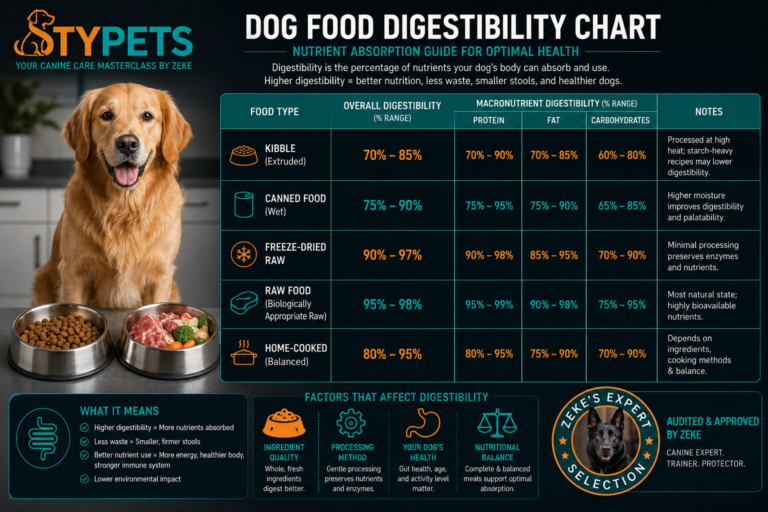
Not all dog food is created equal. To optimize dog gut health and behavior, we must move away from high-entropy fillers and toward bioavailable nutrients.
Red-Flag Ingredients That Damage Dog Gut Health and Behavior (Avoid These):
-
Excessive Simple Carbs: Corn, wheat, and soy feed the “bad” bacteria that cause sugar spikes and crashes.
-
Artificial Preservatives: BHA, BHT, and Ethoxyquin act as “microbiome disruptors.”
-
Hidden Sugars: These trigger systemic inflammation and hyperactivity.
The Performance List (Include These):
-
Prebiotics: Chicory root and pumpkin fiber that act as fuel for beneficial bacteria.
-
Probiotics: Live strains like Lactobacillus and Bifidobacterium to populate the gut.
-
Omega-3 Fatty Acids: Sourced from small oily fish to reduce brain inflammation.
5. A Technical Protocol for Improving Dog Gut Health and Behavior
Restoring your dog’s gut isn’t a weekend project; it is a structural renovation.
-
Phase 1: The Elimination Audit. Remove highly processed treats and common allergens for 30 days.
-
Phase 2: Enzymatic Support. Add digestive enzymes to your dog food to ensure maximum nutrient absorption.
-
Phase 3: Targeted Probiotics. Introduce a high-quality canine-specific probiotic to re-engineer the bacterial landscape.
-
Phase 4: Bone Broth “Sealant.” Use collagen-rich bone broth to help “seal” the intestinal lining and reduce permeability.
6. Environmental Toxins and Gut Integrity
Just as we performed a Hazard Audit for the home, we must consider external factors that kill gut flora. Over-vaccination, excessive flea/tick chemicals, and chlorinated water can act as “biological wipes,” clearing out the good bacteria. Always follow a chemical exposure with a “Microbiome Recharge” phase.
7. FAQs: Solving Behavior Through Nutrition
Q: Can a change in dog food really stop aggression? A: If the aggression is fueled by chronic pain or systemic inflammation caused by the gut, a diet change can significantly lower the dog’s “reactive threshold.”
Q: How long does it take to see behavior changes from gut healing? A: While physical improvements happen quickly, behavioral shifts usually take 4–8 weeks as the serotonin levels stabilize.
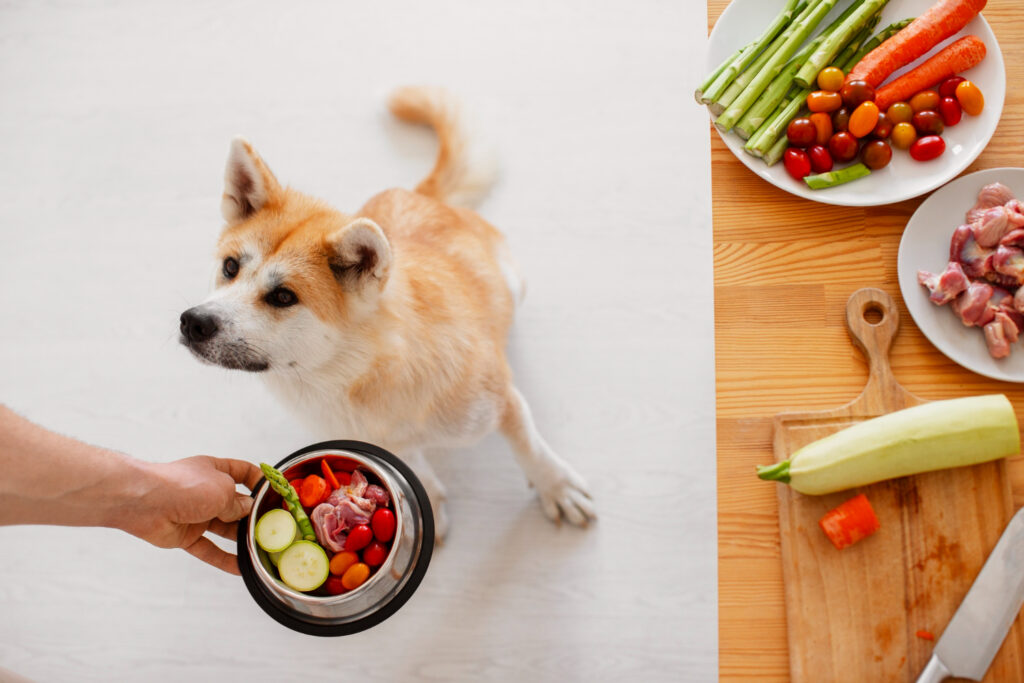
Q: Are raw diets better for dog gut health and behavior? A: Raw diets are highly bioavailable but require strict hygiene and balance. For some dogs, they are a “Success State”; for others, high-quality cooked diets work better.
Q: Does stress affect the gut? A: Absolutely. Stress releases cortisol, which can physically damage the gut lining. It is a feedback loop: stress hurts the gut, and a hurt gut causes more stress.
Q: Can I use human probiotics for my dog? A: It is not recommended. Dogs have a more acidic stomach and a unique bacterial profile. Use canine-specific strains for maximum efficiency.
Q: What is the best “brain food” for a nervous dog? A: Foods high in Tryptophan (like turkey) and Omega-3s (like sardines) are excellent for supporting neurotransmitter health.
Q: Is “Grain-Free” better for the microbiome? A: Not necessarily. It’s about the quality of the carb. Whole oats or sweet potatoes are often better than the legumes used in many grain-free kibbles.
8. The Enteric Nervous System: The “Second Brain” Engineering
The gut is the only organ in the canine body with its own independent nervous system—the Enteric Nervous System (ENS). This mesh-like system of neurons governs every stage of digestion and waste management.
When the ENS is under stress from low-quality dog food, it enters a state of high-energy output. This creates a “system noise” that the dog perceives as generalized anxiety.
-
The Static Effect: Much like a radio station with poor reception, a dog with a stressed ENS cannot process training commands clearly.
-
The Zeke Fix: We use “Restorative Fasting” periods (12–16 hours) to allow the ENS to clear cellular debris, reducing the internal “noise” and improving focus during training.
9. Metabolic Waste & Aggression: The Toxicity Loop
If the microbiome is unable to break down proteins efficiently, it produces metabolic byproducts like ammonia and phenols. In a high-drive dog, these toxins can cross the blood-brain barrier.
The Behavioral Tipping Point
This “toxic load” often manifests as:
-
Unprovoked Irritability: The dog snaps at familiar stimuli.
-
Night Terrors: Excessive pacing or whining during sleep cycles.
-
Resource Guarding: A biological drive to protect high-energy resources due to perceived internal scarcity.
10. Zeke’s “Bio-Audit” Checklist for Dog Gut Health and Behavior
By using this checklist, you are performing a diagnostic on the link between dog gut health and behavior. A score of 1 on the Consistency Index is a clear indicator that behavioral entropy is imminent.
-
The Consistency Index: Is the stool firm and segmented? (Score 1–5). Loose stools are a 100% indicator of gut-brain communication failure.
-
The Frequency Log: Does your dog eliminate more than 3 times a day? Excessive volume indicates “Low Bioavailability” in their current dog food.
-
The Gas Signature: Strong, foul-smelling gas indicates protein fermentation (putrefaction) in the colon—a major trigger for irritability.
-
The Coat Texture: A “dull” or greasy coat is the external blueprint of internal gut inflammation.
-
The Eye Clarity: “Eye goop” or redness is often the first visual signal of a microbiome under siege from allergens.
11. The Prebiotic Architecture: Feeding the “Good Guys”
Probiotics are the “workers,” but Prebiotics are the “lumber” they use to build a healthy gut wall. Without specific fibers, your expensive probiotics will simply pass through the system without colonizing.
Zeke’s Preferred Prebiotic Sources dog gut health and behavior:
-
Inulin (Chicory Root): Acts as a high-octane fuel for beneficial Bifidobacteria.
-
Resistant Starch: Cold, cooked potatoes or green bananas provide the structural support needed for a “Success State” microbiome.
-
Fermented Veggies: Small amounts of raw sauerkraut (unpasteurized) provide a diverse bacterial “Update” to the dog’s internal software.
12. Long-Term Maintenance: The “Re-Seed and Feed” Cycle
The microbiome is a living ecosystem that requires constant updates. Zeke recommends a 90-day Re-Seed cycle.
-
Days 1–30: High-dose canine probiotics and digestive enzymes.
-
Days 31–90: Maintenance dose with increased soluble fiber (Prebiotics).
-
Quarterly Audit: Every three months, re-assess behavioral reactivity. If “The Off-Switch” is failing, look back at the gut.
Engagement Power Words to Use:
-
Bio-Signal: Use this instead of “symptom.”
-
Systemic Failure: Use this instead of “getting sick.”
-
Neuro-Chemical Foundation: Use this instead of “health.”
-
Incentive Alignment: Use this when discussing how the gut influences the dog’s desire to work.
[Recall Mastery: How to Get Your Dog to Come Every Single Time]
Bioavailability Battle: Raw vs. Kibble Through a Scientific Lens