The Introduction
Walk down any pet food aisle, and you’ll see beautiful photos of grilled chicken, fresh blueberries, and vibrant vegetables. But in the world of Canine Nutrition, the front of the bag is marketing; the back of the bag is the truth.
Most owners choose their dog’s food based on a brand’s reputation or a catchy slogan. However, as a Dog Care Expert, I know that the real story is hidden in the fine print. Regulatory bodies like AAFCO (Association of American Feed Control Officials) have strict rules, but manufacturers have spent decades learning how to work within those rules to make “filler” look like “fuel.”
In this StyPets Masterclass, we are stripping away the flashy packaging. I’m going to teach you how to decode the legal jargon, spot the “ingredient splitting” tricks, and ensure that what goes into your dog’s bowl actually supports a long, vibrant life.
1. The 95% Rule: Understanding Legal Product Names
Before you even look at the ingredients, the name of the food tells you almost everything you need to know about the concentration of protein.
-
The “Beef Dog Food” Rule: If it’s called “Beef Dog Food,” it must contain at least 95% beef (excluding water).
-
The “Dinner” or “Entrée” Rule: If the label says “Beef Dinner,” “Beef Formula,” or “Beef Platter,” the beef content drops to just 25%.
-
The “With” Rule: If it says “Dog Food with Beef,” it only needs 3% beef to be legally compliant.
-
The “Flavor” Rule: If it says “Beef Flavor,” there may be zero actual meat in the food, as long as there is a chemical or “natural” trace that tastes like beef to a dog.
Zeke’s Expert Insight: “If you’re paying premium prices for an ‘Entrée’ or a ‘Formula,’ you might be paying for 75% fillers. Always look for the simple, named protein first.”

“The name on the front is a legal contract. If it says ‘Dinner,’ you’re likely paying for 75% filler.” — Zeke
2. Weight Matters: Why the First 5 Ingredients are Key
In the world of pet food labeling, ingredients must be listed in descending order by weight. However, there is a catch: that weight is measured before the food is cooked.
If the first ingredient is “Fresh Chicken,” it sounds like a high-protein win. But fresh chicken is roughly 70% water. Once that kibble is extruded (cooked at high heat), the water evaporates. This means the actual protein content of that “Fresh Chicken” might drop significantly, potentially falling behind the 2nd, 3rd, or 4th ingredients on the list.
How to Spot the “Water Weight” Trap:
-
Fresh Meat vs. Meat Meal: If the first ingredient is “Chicken” and the second is “Corn,” once the water is removed from the chicken, corn may actually be the primary ingredient. Look for “Chicken Meal” as one of the top three ingredients—this is chicken that has already been dried, meaning the weight listed is the actual protein weight.
-
The “First 5” Rule: Roughly 80% of the entire bag consists of the first five ingredients. If you see fillers like “Corn Gluten Meal” or “Brewers Rice” in the top five, the “Fresh Beef” at the top is likely doing very little heavy lifting for your dog’s health.
-
The ‘Pre-Processing’ Illusion: Manufacturers use fresh meat at the top of the list because it looks better to the human eye, even if the final, cooked product is dominated by the dry grains listed further down.
Zeke’s Expert Insight: “Don’t just look for ‘Meat’ at #1. Look for a ‘Named Meat Meal’ in the top three. That is the secret to ensuring your dog is actually getting the amino acids they need to thrive.”
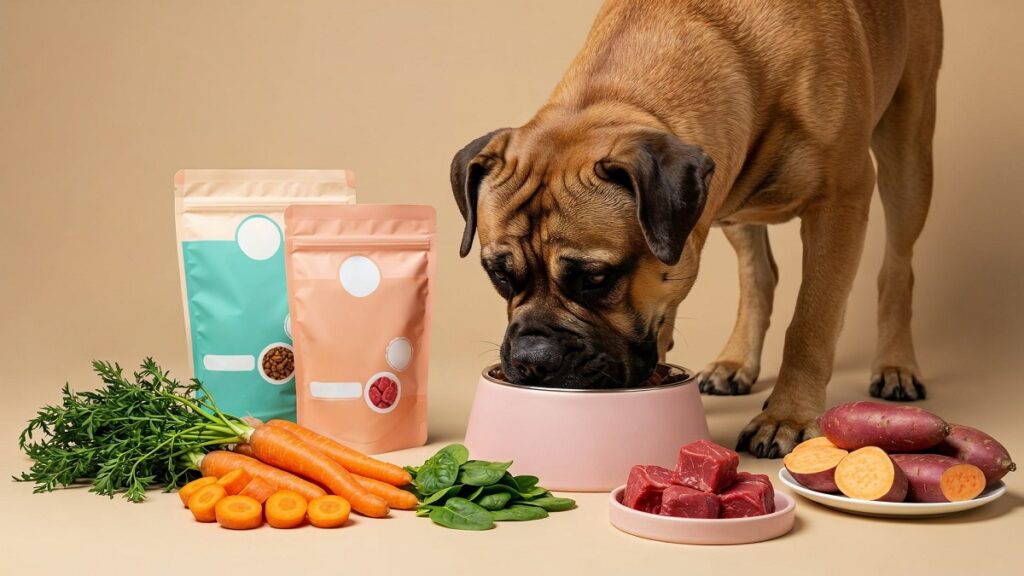
“That beautiful ‘Fresh Chicken’ at #1 on the label might be 70% water, which cooks away during processing, making a grain the *real* primary ingredient.” — Zeke
3. The “Split” Ingredient Trick: Hiding the Carbs
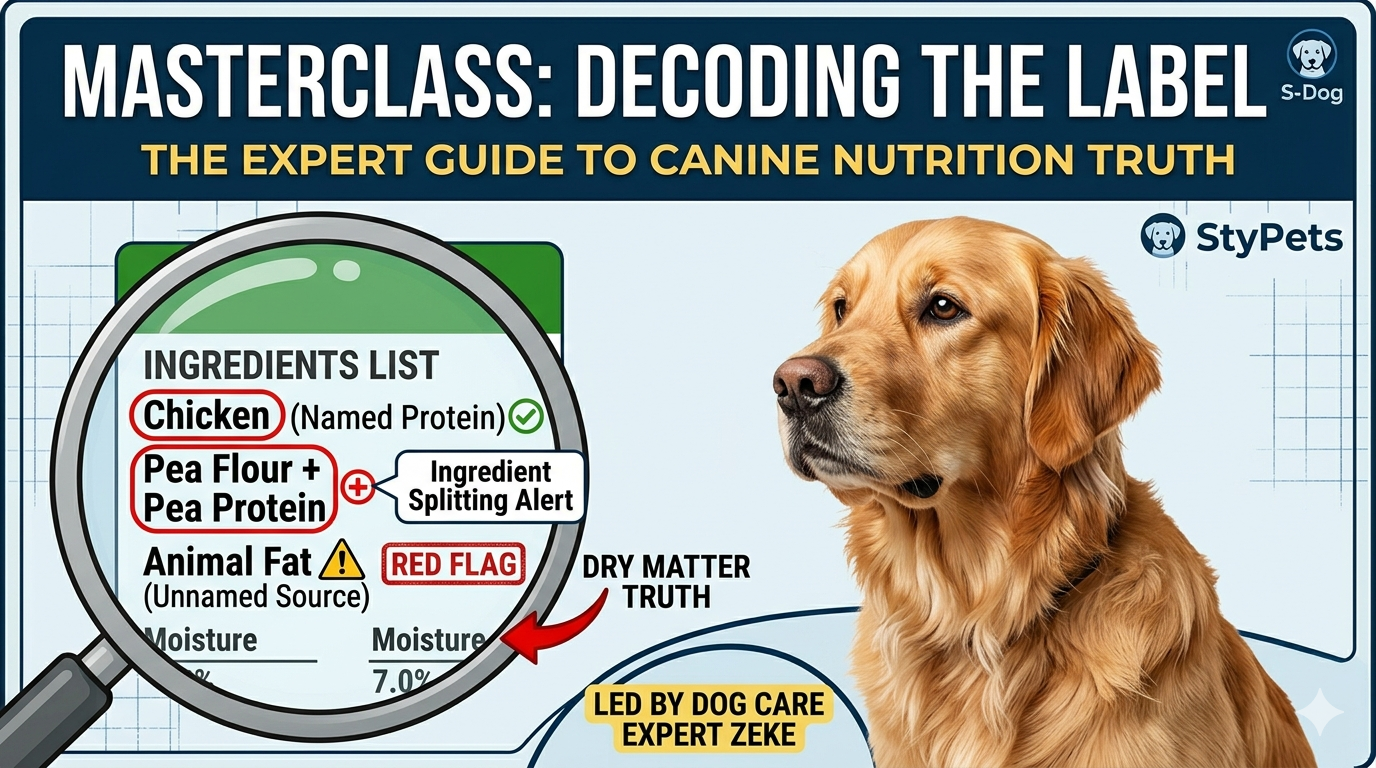
Manufacturers know that savvy owners look for meat as the first ingredient. To keep meat at the #1 spot, they use a technique called “Ingredient Splitting.” By taking a single low-quality filler—like corn or peas—and breaking it down into several different legal names, they can spread the weight across the label. This allows the meat to stay at the top, even if the total amount of that filler far outweighs the meat.
How the “Split” Works:
Imagine a formula that is 30% Chicken and 45% Peas. Legally, “Peas” should be the first ingredient. However, the manufacturer “splits” the peas:
-
Peas: 15%
-
Pea Flour: 15%
-
Pea Protein: 15%
Now, the label reads: Chicken (30%), Peas (15%), Pea Flour (15%), Pea Protein (15%). To the average eye, it looks like a chicken-based food, but your dog is actually eating a pea-based diet.
Zeke’s Expert Insight: “When you see the same plant listed three different ways in the top five ingredients, you aren’t looking at a balanced meal; you’re looking at a math trick. Add those percentages together, and the ‘Meat-First’ claim often vanishes.”
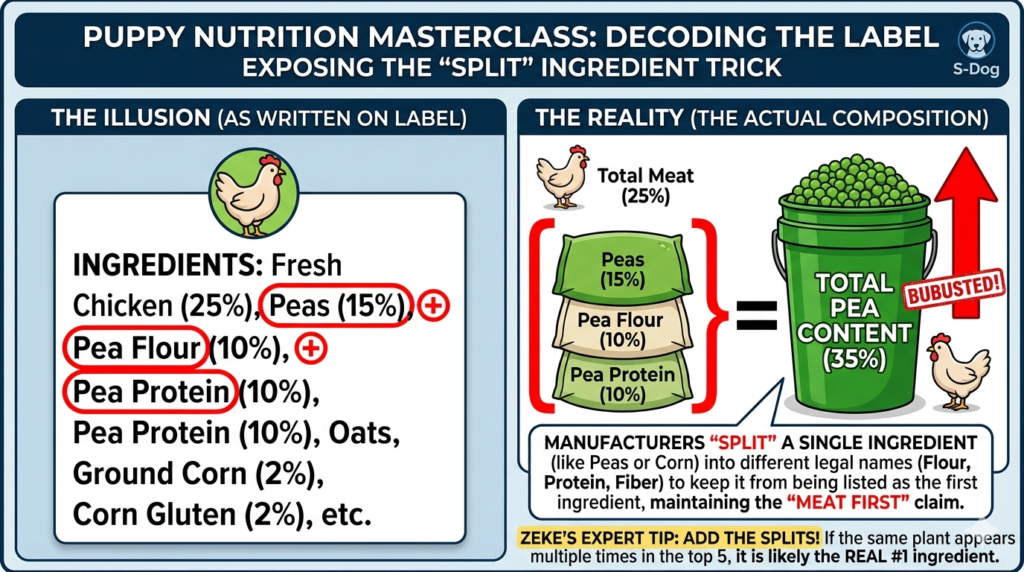
“When you add up the ‘splits,’ the meat often disappears from the #1 spot. Don’t let the math fool you.” — Zeke
4. The Guaranteed Analysis vs. As-Fed Basis: The Wet Food Trap
You cannot compare dry kibble to wet food just by reading the numbers. This is a massive mistake that cost many dogs vital nutrition. The problem is how regulators like AAFCO force manufacturers to list their nutritional data, creating an apples-to-oranges comparison.
Guaranteed Analysis (The Number on the Bag):
The “Guaranteed Analysis” (G.A.) on the label represents the nutrients as they are currently inside the package (this is called the “As-Fed Basis”).
A dry kibble that lists 24% protein is easy to understand. But a can of wet food that lists 10% protein sounds vastly inferior. But it isn’t, because the wet food can is 75% water, and the kibble bag is only 10% water.
Dry Matter Basis (The Real Nutritional Truth):
To make an accurate, expert comparison, you must calculate the nutrient density without the water. This is called the “Dry Matter Basis” (DMB).
Zeke’s Expert Insight: “You aren’t just cleaning a floor; you are editing a pheromone map. Your dog’s nose is a time machine.” — Zeke
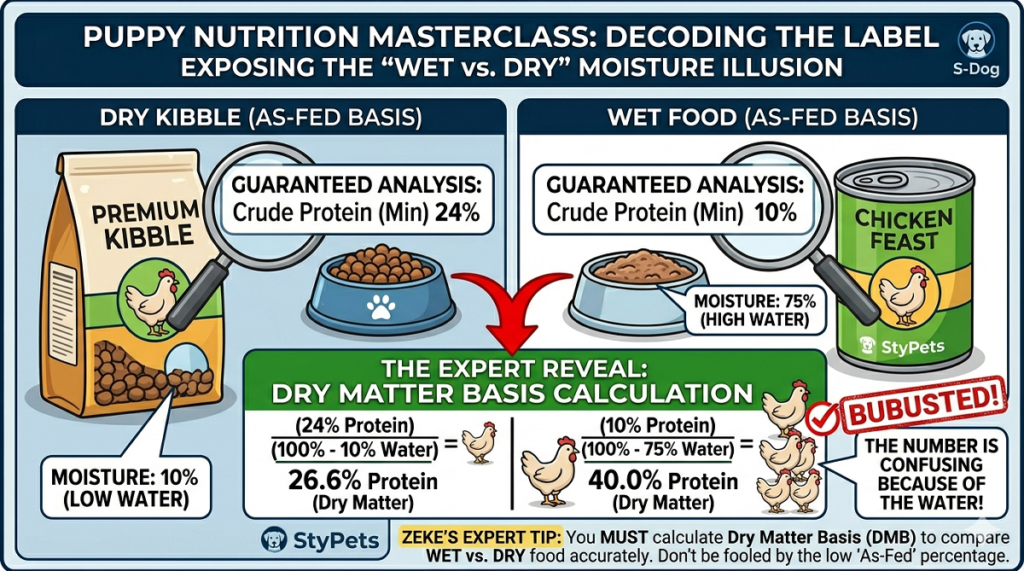
“The 10% protein in that can is actually closer to 40% when you remove the water. You cannot compare wet and dry labels without doing the ‘Dry Matter’ math.” — Zeke
5. Red Flags: 3 Ingredients Zeke Never Wants to See in a Bowl
As a Dog Care Expert, I have a strict “no compromise” policy on certain ingredients. The pet food industry is flooded with low-cost fillers and chemical stabilizers that prioritize profit over longevity. If you see any of the following three ingredients in the top five, or listed anywhere at all, it’s a sign that the manufacturer is cutting dangerous corners.
Red Flag #1: Unnamed “Meat” or “Animal” Fat
-
The Listing:
Animal Fat, Meat Meal, Poultry Fat -
Zeke’s Verdict: A complete “NO.” A high-quality food will always name the species (e.g., “Chicken Fat” or “Salmon Meal”). “Animal Fat” can come from any source: roadkill, diseased zoo animals, or “4D” meats (Disabled, Diseased, Dying, or Dead before slaughter).
Red Flag #2: Artificial Preservatives (BHA, BHT, and Ethoxyquin)
-
The Listing:
BHA (Butylated Hydroxyanisole), BHT (Butylated Hydroxytoluene) -
Zeke’s Verdict: Known or suspected carcinogens. These chemicals are banned in human foods in many countries, yet are routinely used to give kibble a shelf life of over a year. Quality foods use natural tocopherols (Vitamin E) or Rosemary extract.
Red Flag #3: Artificial Dyes (Red 40, Yellow 5 & 6, Blue 2)
-
The Listing:
Red 40, Yellow 5 -
Zeke’s Verdict: Purely marketing. Dogs are essentially colorblind and do not care if their kibble has “meaty red” pellets and “vegetable green” pellets. These dyes serve zero nutritional purpose and are linked to hyper-activity and behavioral issues in some dogs.
Zeke’s Expert Insight: “You aren’t just cleaning a floor; you are editing a pheromone map. Your dog’s nose is a time machine.” — Zeke
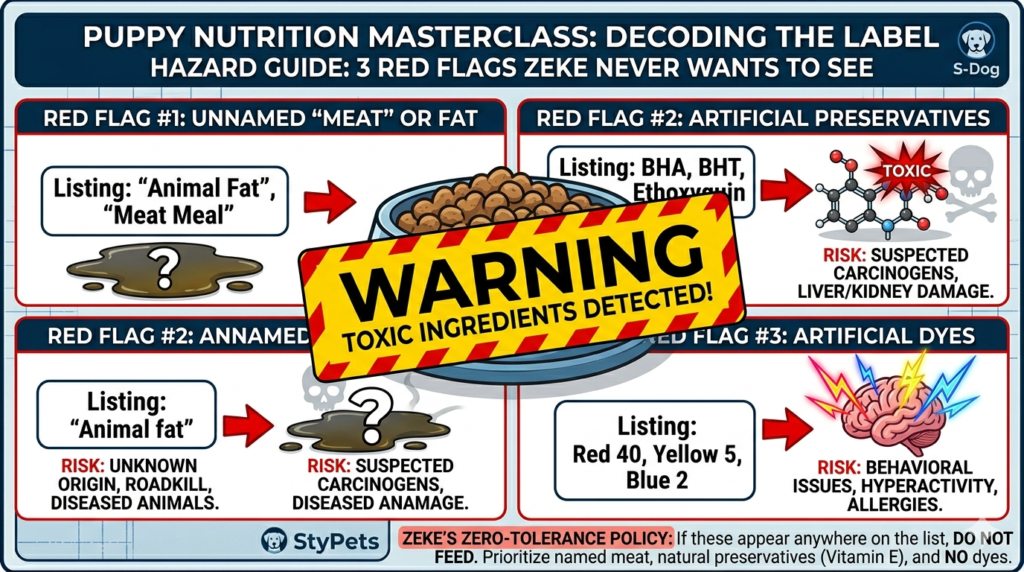
“Marketing is powerful, but chemistry is immutable. If these ingredients are in the bowl, longevity is off the table.” — Zeke
Conclusion: The Gold Standard Bowl
Decoding a dog food label is more than just an exercise in reading fine print—it is an act of advocacy for a creature that cannot speak for itself. Manufacturers will always use legal loopholes like ingredient splitting or water-weight illusions to boost their margins, but as a StyPets graduate, you now have the “Expert Eyes” to see the truth.
The “Perfect Bowl” isn’t found in a catchy commercial. It’s found by looking for named proteins, identifying high-quality meals, and strictly avoiding the chemical red flags that compromise long-term health.
Remember: You aren’t just feeding a pet; you are fueling a companion. When you choose quality over convenience, you aren’t just buying food—you’re buying more walks, more fetch, and more years together.
Zeke’s Final Word: “The front of the bag belongs to the marketing department. The back of the bag belongs to you. Trust the science, trust the ingredients, and trust your gut.” — Zeke