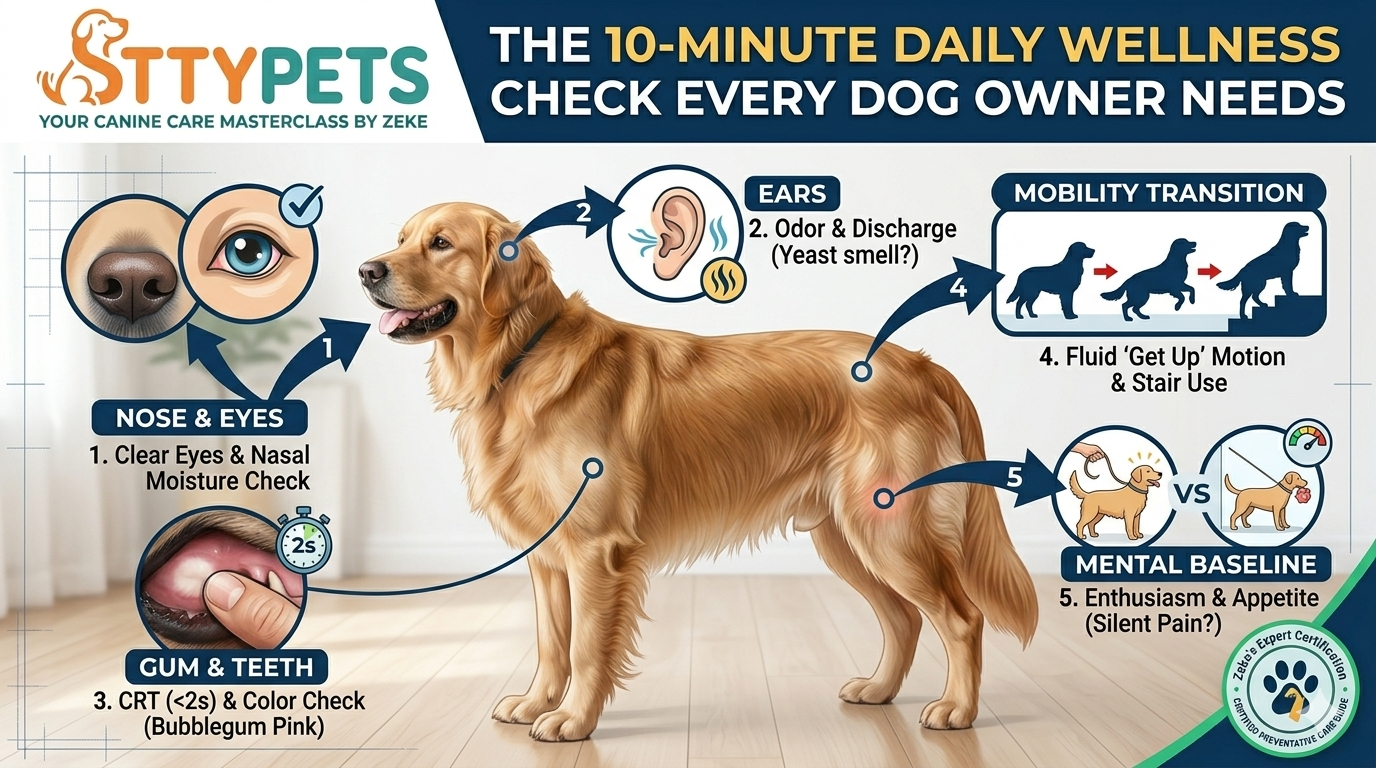
Introduction: Why “Observation” is the Best Medicine
Your dog is a master of disguise. In the wild, showing pain or weakness made a canine a target, and that primal instinct remains hardwired into your living room companion today. By the time a dog “looks” sick to the untrained eye, the underlying issue has often been simmering for weeks.
As a Dog Care Expert, I’ve seen countless “emergencies” that could have been simple “fixes” if the owner had caught the subtle shifts in the dog’s baseline earlier. This is where the 10-Minute Daily Wellness Check becomes your most powerful tool.
In this StyPets Guide, I’m going to teach you how to use your hands and eyes to perform a professional-grade physical exam at home. We aren’t trying to replace your veterinarian; we are trying to give them the best possible data. When you know your dog’s “Normal,” the “Abnormal” sticks out like a neon sign.
Zeke’s Expert Insight: “A vet sees your dog for 20 minutes a year. You see them for 5,000 hours. You are the primary investigator; the vet is just the consultant. Start acting like the lead on the case.” — Zeke
1. The Nose-to-Tail Scan (The Physical Check)
A dog’s body tells a story every day, but only if you know how to read the chapters. Start at the front and work your way back. This isn’t about being a vet; it’s about knowing your dog’s normal so you can spot the abnormal.
-
The Eyes: Should be clear, bright, and free of discharge. Redness or cloudiness is an immediate “watch” item.
-
The Ears: Give them a sniff. A healthy ear smells like nothing; a yeasty or “corn chip” smell often signals an infection before the scratching starts.
-
The Nose: Contrary to myth, a dry nose doesn’t always mean a fever, but nasal discharge or “crustiness” is a red flag.
Zeke’s Expert Insight: “Prevention isn’t a yearly vet visit; it’s a daily conversation between you and your dog’s body. If you catch it early, you’re a hero. If you catch it late, you’re a customer.” — Zeke
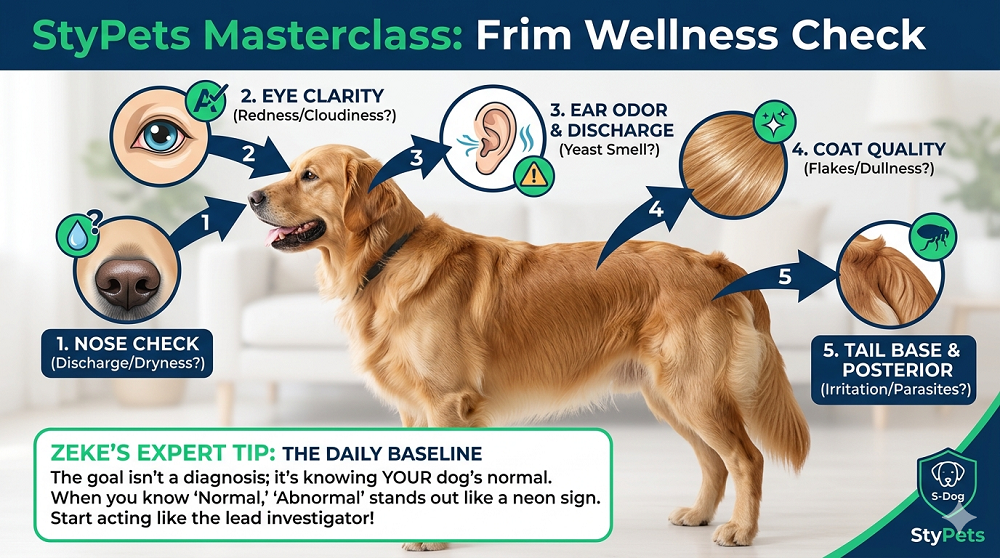
“The body speaks a language only the observant can understand. Use this blueprint every day.” — Zeke
2. The “Hands-On” Lumps and Bumps Check
In the professional world, we call this a “Tactile Exam.” Your goal is to map your dog’s body so thoroughly that you can feel a change the size of a pea. This isn’t just a pet; it’s a systematic search for abnormalities.
The “Flat Hand” Technique
Don’t poke with your fingertips—you’ll miss subtle changes. Instead, use the flats of your fingers and your palms. Move in small, circular motions, applying light pressure to feel the structures beneath the skin.
-
The Lymph Nodes: Gently feel under the jawline, in the “armpits,” and behind the knees. These should feel like small, soft beans. If they feel like hard marbles, it’s time for a professional consultation.
-
The Ribcage: You should be able to feel the ribs easily without pressing hard. If you have to “dig” for them, your dog is over their ideal weight—a major wellness red flag.
-
The Abdomen: Gently press into the belly. It should be soft and tucked. If your dog tenses up, grunts, or the area feels “hard” like a drum, this is a sign of internal discomfort or bloating.
Zeke’s Expert Insight: “A lump is just a story the body hasn’t finished telling yet. Most are harmless fatty lipomas, but some are chapters you want to close early. Map them, track them, and never ignore them.” — Zeke
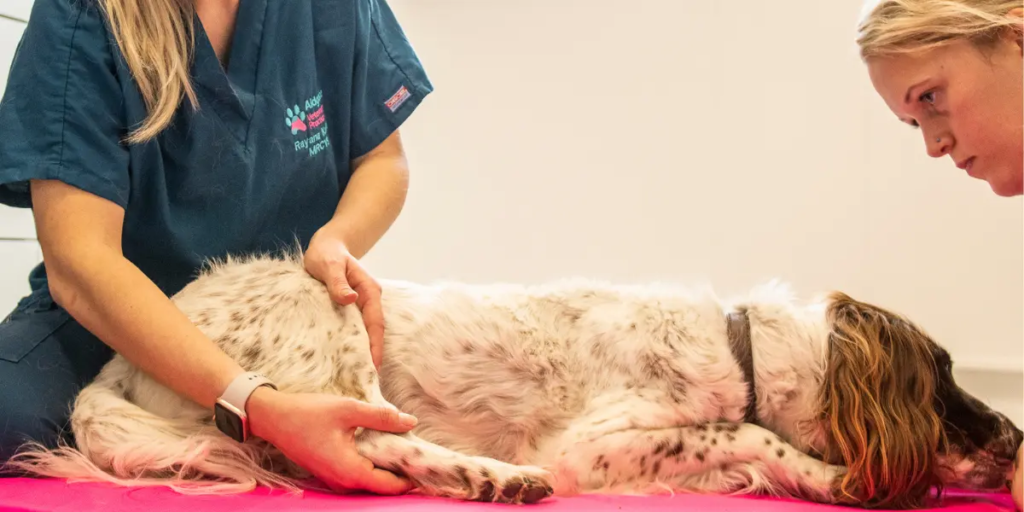
“Your palms are more sensitive than your eyes. Feel for the ‘peas’ before they become ‘plum’ sized.” — Zeke
3. Gum Color and Capillary Refill Time (CRT)
In an emergency, every second counts. Your dog’s gums are a direct window into their cardiovascular system. Learning how to read them can help you instantly differentiate between a minor issue and a potential crisis. This is a skill I teach every new handler, and it should be part of your Daily Dog Wellness Check.
The Two-Step Check
This assessment involves two distinct observations: checking the color and measuring the speed of blood return.
-
Observing Gum Color:
-
Normal: Healthy gums are “Bubblegum Pink.” A healthy pink indicates good blood flow and oxygenation.
-
The Problem: Many dogs have natural black pigmentation on their gums. This is normal. To check, lift the upper lip and find a non-pigmented (pink) area, or check the inner lining of the lower eyelid (the conjunctiva) for color.
-
Abnormal: * Pale or White: Suggests anemia, shock, or severe blood loss. (Emergency!)
-
Blue or Purple (Cyanotic): Indicates a critical lack of oxygen. (Immediate Emergency!)
-
Deep Red or Brick Red: Can signal heatstroke, sepsis, or severe infection.
-
-
-
Measuring Capillary Refill Time (CRT): Capillary Refill Time (CRT) measures how long it takes for blood to return to the tissue after being pushed out.
-
The Procedure: * Lift your dog’s upper lip.
-
Locate a pink area of gum tissue.
-
Gently but firmly press one finger against the gum. This pushes the blood out of the tiny vessels (capillaries).
-
Remove your finger. The spot will be white (blanched).
-
Count how many seconds it takes for the spot to return to pink.
-
-
The Results: * Normal: Blood should return in under 2 seconds. (Ideally, almost instantly!)
-
Delayed (2+ Seconds): This indicates poor circulation, dehydration, or potential shock.
-
-
Zeke’s Expert Insight: “You can tell the quality of an engine by the exhaust, and you can tell the quality of the circulation by the gums. The ‘CRT’ isn’t just a number; it’s a direct message from the heart. If that message takes 3 seconds to arrive, you need to listen closely.” — Zeke
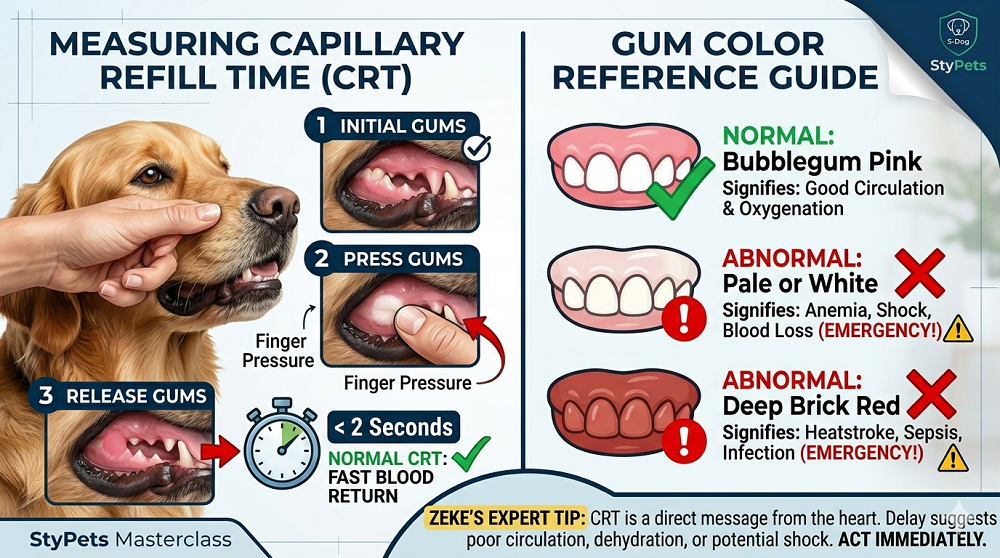
“The gums tell you the story of the heart in two seconds flat. Pay attention.” — Zeke
4. The Vital Signs: Respiration and Mobility
Monitoring vital signs isn’t just for the ICU. By tracking your dog’s resting breath and their “get up” transition daily, you can spot early signs of heart disease, respiratory distress, or joint pain (arthritis) before your dog ever lets out a whimper.
1. The Sleeping Breath Count (Resting Respiration Rate)
The best time to check your dog’s lungs and heart is when they are fast asleep.
-
The Method: Watch the chest rise and fall. One rise + one fall = 1 breath. Count how many breaths they take in 30 seconds and multiply by 2.
-
The Baseline: A healthy resting dog should breathe between 15 to 30 times per minute.
-
The Red Flag: If your dog is consistently hitting over 35–40 breaths per minute while sleeping, this can be an early warning sign of congestive heart failure or fluid in the lungs.
2. The “Get Up” Transition (Mobility Check)
Stiffness is often dismissed as “just getting old,” but in my Masterclass, we treat it as a management priority. Watch your dog when they first wake up and transition from a lying position to a stand.
-
The Check: Do they push up easily? Or do they “heave” their front end up first and struggle with the rear?
-
The Red Flag: “Bunny hopping” up the stairs, stiffening after a nap, or licking at specific joints are all silent cries for joint support or pain management.
Zeke’s Expert Insight: “Breathing is the rhythm of life, and mobility is the freedom of it. If the rhythm speeds up or the freedom slows down, the body is asking for help. Don’t wait for the limp; watch the rise of the chest.” — Zeke
5. The Mental Baseline: Enthusiasm and Appetite
In my years as a Dog Care Expert, I’ve learned that a dog’s “spirit” is often the first thing to flicker when the body is struggling. “Silent pain” doesn’t always look like a limp; sometimes, it looks like a dog who simply decides not to bring you the ball today.
By tracking your dog’s Enthusiasm and Appetite daily, you are monitoring their neurological and emotional health.
1. The “Enthusiasm” Quotient (EQ)
Every dog has a baseline level of “drive.” Some are high-energy athletes; others are professional couch potatoes.
-
The Check: Observe the reaction to a high-value trigger (the leash, the word “walk,” or a favorite squeaky toy).
-
The Red Flag: If a high-drive dog becomes “indifferent,” or a social dog starts seeking isolation (hiding under a table or in a dark room), they aren’t “just tired.” They are likely redirecting their energy toward internal healing or managing discomfort.
2. The Appetite Transition
A change in eating habits is the most classic “Siren” in canine health.
-
The Check: Note the speed and “gusto” of their meal consumption.
-
The Red Flag: “Deterring” (walking up to the bowl and walking away), “Selective eating” (only eating treats but refusing kibble), or “Slow chewing” can signal anything from dental pain to kidney issues.
Zeke’s Expert Insight: “A dog doesn’t have a ‘bad day’ at the office. If their mood shifts, it’s a biological response, not a personality quirk. When the tail stops wagging for the things they love, the body is talking. Listen.” — Zeke
[Decoding the Label: What Your Dog’s Food is Actually Telling You]